 Seattle Family Calendar
 Subscribe

Hello in there, baby!
Ready to curl up on the couch with your pickles, ice cream and a good book? It’s time to let your unborn baby enjoy the sound of mama’s voice and some beautiful examples of language. This may be the easiest time to read to your child — after all, they can’t run away or try to eat the book!
Try a new language or an old favorite
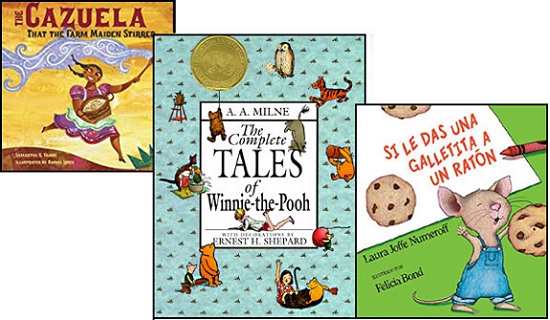
“The Complete Tales of Winnie-the-Pooh” by A.A. Milne, illustrated by Ernest H. Shepard
I absolutely love the language and Milne’s brilliant narration in the “Winnie-the-Pooh” books. The stories are so wonderful, you will enjoy reading them as much as your baby will enjoy hearing the sounds.
“The Cazuela That the Farm Maiden Stirred” by Samantha R. Vamos, illustrated by Rafael López
This bilingual book will introduce the sounds of both English and Spanish as you read wonderful prose about a community of farmworkers and animals who gather the ingredients to make a rice pudding. The rhythm and sounds in this book are perfectly executed. As a bonus, you can make the recipe at the end and enjoy a wholesome dessert!
“Si le das una galletita a un ratón” by Laura Joffe Numeroff, illustrated by Felicia Bond
Sure, you could read the English version of “If You Give a Mouse a Cookie,” but this delightful translation is easy to read with even minimal high school Spanish to your credit — what a fun way to introduce your child to the sounds of a different language. If Spanish is not your thing, find this same title or another favorite in any other language to which you want to introduce your child.
Rhyme time
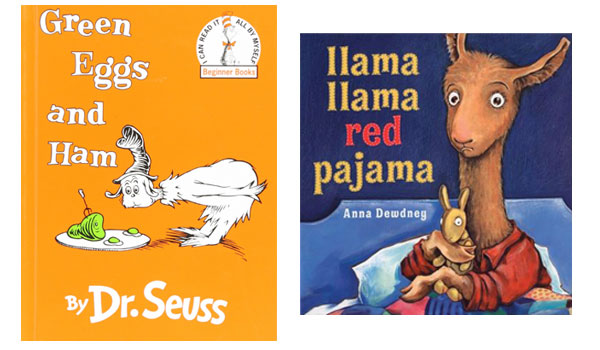
“Green Eggs and Ham” by Dr. Seuss (Theodore Geisel)
This is one of my favorite Dr. Seuss books. It has the advantage of making sense (trust me, not all of them do). The rhythm is wonderful; it’s fun to read and listen to. Plus, you’re going to want to practice your Dr. Seuss tongue twisters for later.
“Llama Llama Red Pajama” by Anna Dewdney
The rhythm and rhymes in Anna Dewdney’s books are so satisfying that I could read them again and again, even to my navel! Which is good, because that’s what you’ll be doing with a baby in utero. This title is a must-have when your child is older, so you might as well get it in rotation now.
Sing-a-long
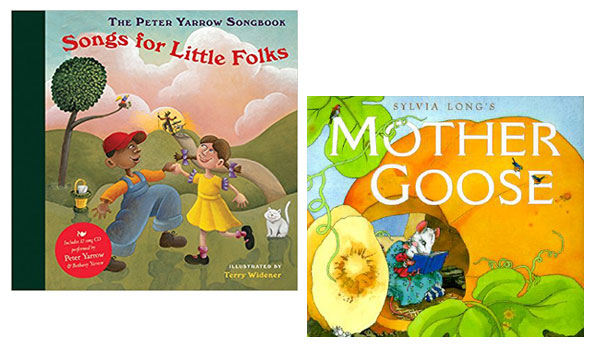
“The Peter Yarrow Songbook: Songs for Little Folks” by Peter Yarrow, illustrated by Terry Widener
As a kid, I used to listen to Peter, Paul and Mary on tape (yes, I said tape) in the car. Here, Peter brings us a beautifully illustrated collection of folk songs to read or sing. Consider it training for all the 3 a.m. wake-ups to come, when your child needs to be sung back to sleep. Do you remember the words to “A Tisket, A Tasket”? Now you will! The book comes with a CD for when the mamas and the papas are too tired to read or sing.
“Sylvia Long’s Mother Goose” by Sylvia Long
There are a lot of Mother Goose books, but this is one of my favorites. The illustrations are wonderful; even adults will enjoy them. Not only will this introduce your baby to some delightful and everlasting rhymes, but it will remind you of stories you thought you had forgotten and some you never knew.
Two classics
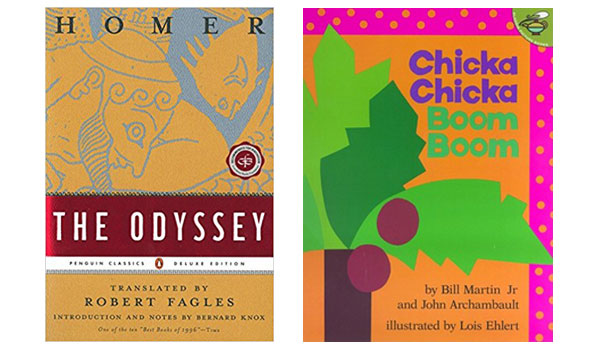
“The Odyssey” by Homer
Okay, hear me out on this one. “The Odyssey” is a beautiful book. It’s from oral tradition, so it’s meant to be read aloud. It’s in verse. It will introduce your baby to beautiful sounds and it will give you a chance to revisit one of the most important works of literature. The Robert Fagles translation is a good one for this.
Shakespeare wrote beautifully. His poems, as we all learned in high school, are written in iambic pentameter, da – DUM da – DUM da – DUM da – DUM da – DUM. The rhythm perfectly mirrors a heartbeat, a sound familiar and soothing to your baby. How great would it be to introduce literature that she is already, on some level, familiar with? Try “A Midsummer Night’s Dream” to get you in the mood for magic.
“Chicka Chicka Boom Boom” by Bill Martin Jr. and John Archambault, illustrated by Lois Ehlert
While not classic in the “hundreds of years old” sense of the word, this is a great read, and I won’t say that about just any board book. It goes quickly, especially if there’s not a toddler trying to squirm off your lap. It’s fun to read, and the sounds of the alphabet will float off the pages.
Editor’s note: This article was originally published in 2013; it has been updated over the years and remains one of the top-accessed baby articles on ParentMap.com.
One final idea!
Try your college textbooks, law articles or the latest beach read. True, these might not be rhythmic or poetic, but if it’s what you need (or want) to read, feel free to read it aloud. Baby will still hear the sound of your voice and the sounds of the English language. And you will be more prepared for classes or work (or just more relaxed). All of which are good things for a parent-to-be.
Editor’s note: This article was originally published in 2013. It has been updated.