
 Seattle Family Calendar
 Subscribe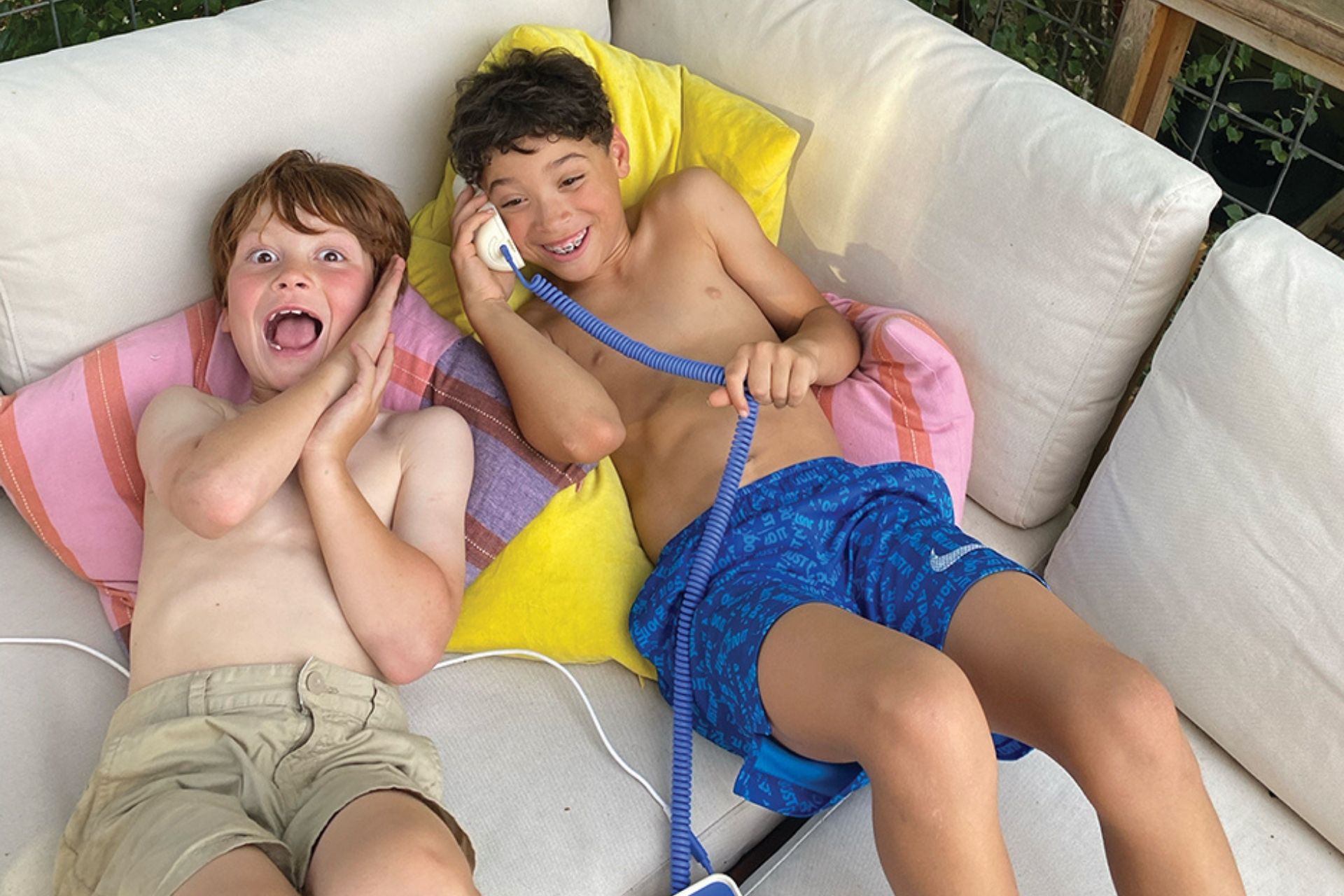

Before we start our interview, I play Chet Kittleson a voicemail. It’s from my 5-year-old granddaughter Stella, calling from the Tin Can I’d ordered for her house. Her little voice, rambling and joyful, fills the room. Kittleson smiles the way someone does when they’ve heard a story a thousand times, and it still gets them.
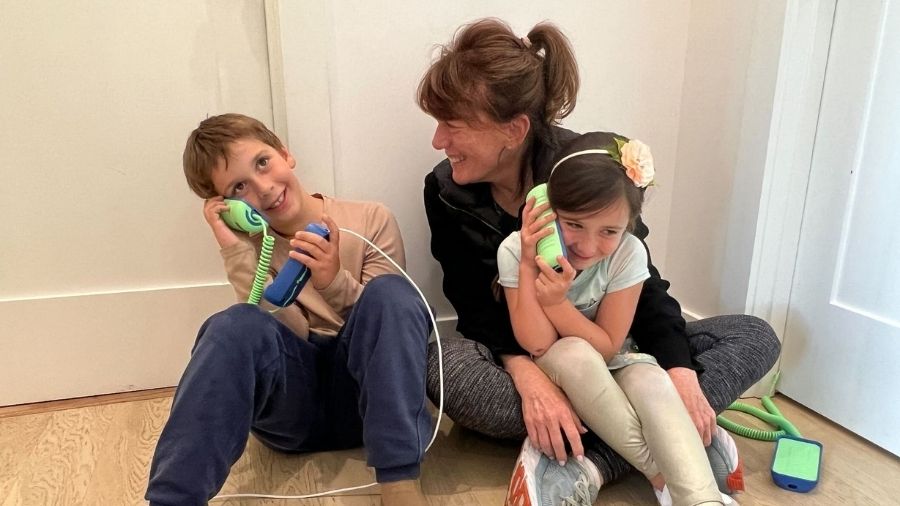
Tin Can, cofounded in 2024 by Seattle friends Kittleson, Max Blumen and Graeme Davies, makes a kids phone that works like the house phone you grew up with. It’s corded, plugs into the wall and has real buttons and no screen. The phones cost $100, come in four colors and can call other Tin Cans for free; a monthly plan for $9.99 allows Tin Cans to send and receive calls to other phone types. The company has sold hundreds of thousands of units across all 50 states and Canada, with preorders open in the U.K., Australia and New Zealand.
I sat down with Kittleson to talk about the childhood landline he says saved him, the conversation that sparked the company and the Christmas morning that nearly broke it.
Q: Most founders talk about the market opportunity. You went somewhere much more personal when I asked about your origin story. Tell us about the childhood that shaped you.
A: My dad was 22 years older than my mom and wasn’t a great guy — I still have a hard time saying that, because he’s still my dad. He’s passed now. But he struggled with addiction, and the first few years of my life were unstable. We lived in trailers, moved around. My mom left him when I was 4, and there were a couple of years of real tumult — we lived with my uncle in Vegas while she tried to find her way. She had a GED and no clear path to support me and my older sister.
I share that because I think it launched me into a major generalized anxiety and panic disorder that I’ve dealt with my whole life — to a lesser degree now, but it’s always been there. And here’s what’s interesting: The landline became a genuine lifeline for me. It was literally the only way I stayed connected to my dad. He’d call me “Randy,” the name of his other son, instead of Chet — that’s a whole thing — but that phone was the thread between us.
And then my mom found her footing, met my stepdad, and we ended up in this small residential community called Shelter Bay. It was the kind of place where kids could roam free. Every morning I’d wake up and call Bryce or Mark or one of my friends and say, “Where are we meeting up today?” I really believe that saved me. The landline gave me agency, connection and joy at a time when I needed all three.
Q: Fast forward to the moment Tin Can was born. What happened?
A: It percolated for a long time before it became a business. The spark was a park conversation during COVID — I’d bike up to get my kids from school every day, and I really needed those 20 or 30 minutes talking with other parents. I’m an extrovert; it was survival. One afternoon, a group of us got onto the topic of playdate planning, and one mom said, “I feel like an executive assistant for my kid.” There was so much laughter and frustration and guilt all at once — this tension between not wanting to hand over a smartphone yet and also not wanting your kid to feel stranded.
And I said, almost offhandedly — it wasn’t a business idea, it was just a comment — “When we were kids, our first social network was the landline.” And everyone lit up. We started reciting our best friends’ phone numbers from childhood. I walked away thinking, “That’s interesting. I wonder if there’s something there.” But I didn’t run home and build it. It percolated for about two and a half years. I read Jonathan Haidt’s book [“The Anxious Generation”] at that time. And somewhere in that stretch, I thought — this might be more than a playdate planning tool. This might really be something.
Q: You handed the first prototypes to your daughter and her friends. What happened?
A: We built maybe five or 10 units and delivered them to two small networks of kids — friends of my oldest daughter and oldest son. I hand-delivered each one, met the families and set everything up. And three things became immediately clear.
First, what kids have been asking for when they ask for a phone is simply a portal into their best friend’s bedroom or their grandma’s house. That’s all they want. And you could see it in their faces the moment the first call came through — this giddy, emotional joy. It was a superpower for them.
Second, the landline design, which we chose very deliberately for its simplicity, was actually cool to kids. I was genuinely worried they’d think it was some old antique. Instead, they were like, “This is the most amazing thing you could have given me.” Like bell bottoms coming back. New to them.
Third, it spread on its own immediately. The only way to get a Tin Can in those early days was to text me directly. I’d leave one house and have five messages from parents saying, “My friend Josie wants one, can you set her up?” We have never once had to figure out how to promote Tin Can. It has always just moved on its own.
Q: There’s a moment in a lot of cultural shifts when people go from quietly suspecting something is wrong to truly knowing it — and feeling like they have to act. Jonathan Haidt’s work felt like one of those moments for millions of parents. You’ve compared it to the cigarette-and-cancer reckoning. Tell us about that.
A: I think Jonathan probably felt the way we feel — he thought he had something important in his research and couldn’t have predicted how quickly it would catalyze into a movement. But here’s the thing: People already knew. I use this metaphor a lot — it was a little like cigarettes. For a long time, people thought, “Inhaling this thing that makes me feel weird is probably not great.” And then someone said cancer. In this case, Jonathan said mental health, suicide and self-harm. And once you know, you have to act. People were hungry for someone to make them really know. And then they were hungry for something to do about it. Tin Can arrived right at that moment when parents were asking, “What do I do?” And we were there.
Q: How are you thinking about getting Tin Can into schools and communities, and what have you built to make that more possible for families at every income level?
A: Tin Can gets better with more friends on it — that’s just obvious and true. And from the very beginning we had community leaders reaching out wanting to do something bigger than a single family. For example, there is a foundation on San Juan Island that got Tin Cans for hundreds of kids across the whole island, and families showed up to this event we attended — it was extraordinary. And there’s a mom in Kansas City who raised money from local businesses and bought Tin Cans for an entire elementary school.
So we built a community program. A community leader can now create a group, invite families via email, and once they accept, all the Tin Cans in that community are automatically whitelisted and appear as contacts. If you already have a Tin Can, you can join a community group with your email. If you don’t, you buy one through the portal at up to 35 percent off. It solves the discovery problem, the setup problem and the cost problem all at once. We’re getting applications every day now from schools, teams and neighborhoods that want to do this.
Q: Many founders get a moment that reveals who they really are under pressure. For you, it came at 4:30 on Christmas morning. What happened, and looking back, what are you most proud of about how you handled it?
A: Our original purchase order was for 3,000 units. We sold orders of magnitude beyond that. We kept pushing back delivery dates as volume grew, which was always a hard call. And we pushed right to the edge of the holidays — we wanted to make it so badly that we shipped before the hardware was fully tested the way it should have been.
Last Christmas morning, at 4:30 a.m., the alerts started. New York hit Christmas first. Customer support requests went from 10 to 20 to 100 to 500 to 1,000 — this relentless, terrifying ramp. Everything broke. It was, honestly, one of the hardest nights of my life.
What I learned — and I’ll credit my mom for this — is that being an emotionally available person in life translates directly into being a good leader. I sent very personal, honest emails to our customers about what went wrong and what we were doing about it. It turns out that’s what people actually want. Pure-hearted vulnerability and honesty go very far. We paused the billing. We communicated constantly. And I think we came out of that holiday with more customer trust than we walked in with. It was hard. I’d never want to do it again. But it showed us — and our customers — who we are.
Q: If you could say one thing to every parent, educator and coach who is lying awake right now worrying about their kid’s loneliness, their screen time, their disconnection — what would it be?
A: We didn’t abandon our kids on purpose. When we left the landline behind, we had no idea we were taking away their first social network — the thing that gave them agency, independence and the ability to reach out to the people they love without asking an adult for permission. That was an accident. And we don’t need to carry guilt about it.
But here’s what I want every parent to hear: There is a way back. You can hand your child something pure and joyful and completely free of the things that keep you up at night. It isn’t addictive. It doesn’t have an algorithm designed to steal their attention. Talking on the phone is actually tiring — kids hang up and go outside. And what happens when they have it is something I’ve watched hundreds of thousands of times now, and it still gets me. Kids light up. They feel trusted and connected at an age when that feeling can change everything.
We didn’t know what we took from them. Now we do. And we can give it back.