Seattle Family Calendar
 Subscribe


Learning to tie your shoes or stand in line may be part of preschool, but that doesn’t mean young children can’t begin to learn about the natural world, too. “A lot of people underestimate what preschoolers can do,” says Rachael Urban, Preschool Division Head at The Bear Creek School, an independent pre-K–12 Christian school in Redmond. “Kids are already curious. Why wouldn’t you build on that and ask ‘why’ questions the way that scientists do?”
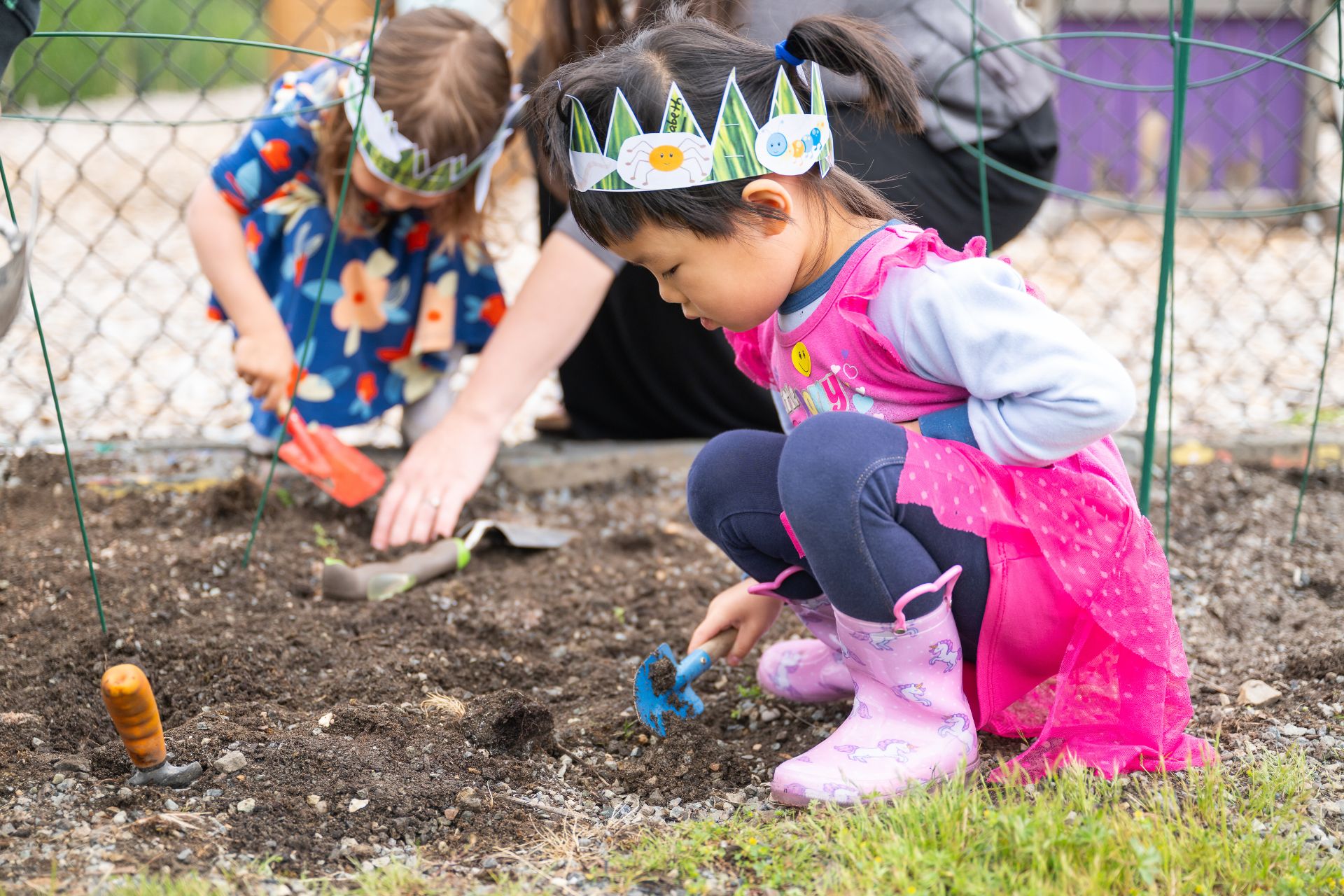
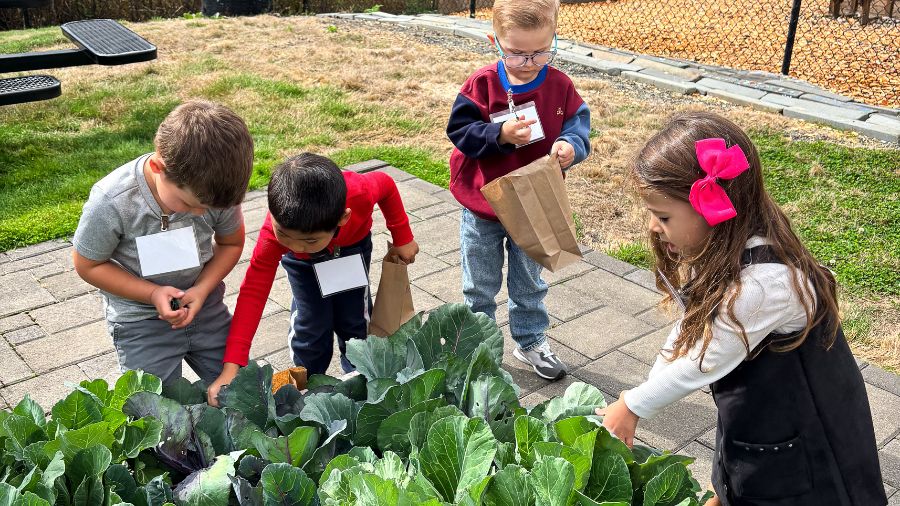
If the thought of preschool science class evokes images of tiny children hunched over desks doing hours of worksheets, think again. At The Bear Creek School, pre-K science classes are filled with hands-on, outdoor activities where children are more likely to get dirty than to get bored. Their unique program called DIG (Discovering and Investigating God’s Creation) rotates through three annual themes — seasons, ecosystems, and cycles — to encourage very young children to observe closely and think deeply about what they see.
The DIG program
“DIG is a chance for students to get outdoors and explore all of God’s creation, but looking through the lens of the scientific method and getting a chance to go through the scientific process of asking questions and discovering things in the world around them,” says Urban.
“Last year, it was all about using a bigger theme of cycles to explain things: life cycle of a worm, a life cycle of a pumpkin,” explains Urban. “They get to go out to our garden beds and see pumpkins. They get to open up that pumpkin and look at the seeds and then talk through the development of a pumpkin from a seed through decomposing. We can explore the scientific process in a natural way that’s also preschool appropriate.”
The cycle’s theme is even extended to geology, as students learn about the life cycle of a rock formed through heat and pressure and then eroded by the action of the water cycle.
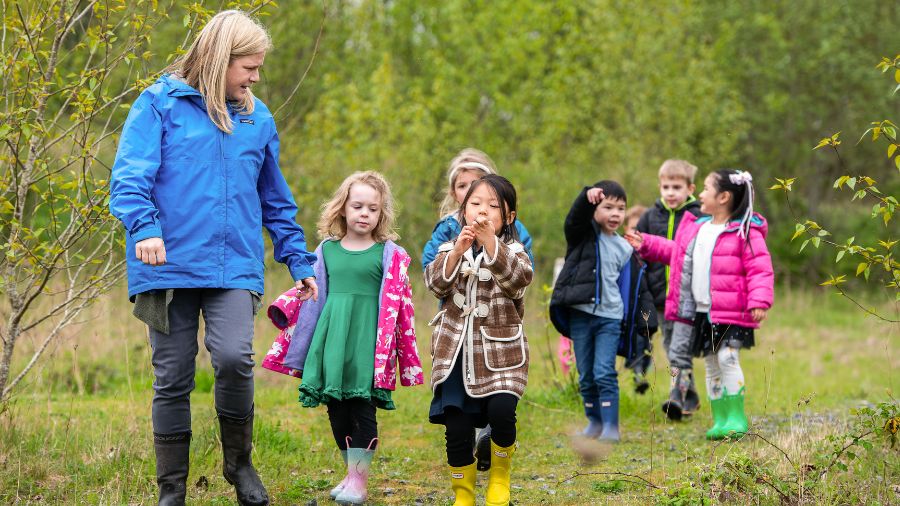
Preschoolers might not understand a complex diagram of evaporation and precipitation, but complex systems like the water cycle are made accessible through experiential discovery. Even very young children can set up rain gauges and measure how much precipitation has fallen at the end of a week or a month. They can take a walk through the school’s wetland area and collect water samples, then see the microscopic life in those samples projected on a screen.
Even if they don’t completely grasp the details of a specific topic, preschoolers can begin to learn to use the scientific method to investigate the world around them. It begins with observation, and learning to shape their observations into theory that can be framed as a question subject to scientific practice. The theories children generate to answer their questions can range from fanciful to surprisingly insightful. Adults can help them test and revise their theories based on the data their tests generate. It’s the same iterative process that scientists use to advance human knowledge.
“Math and reading are super foundational,” says Urban. “We have them keep little journals, even at the threes, fours and fives. It’s not that they’re writing huge, long paragraphs but they get to color things that they may have seen or done for that day. Whether it was worms that they got to see digging and how they help break down and decompose the soil.”
Outdoor play is important to a child’s development
“There is so much research about the importance of these years,” says Urban. “It really helps students to look at things around them and to then be able to ask questions.” Lessons that support children’s natural curiosity help to preserve a sense of wonder and love of learning well beyond the preschool years. For them, learning is most effective when it closely resembles play. Myriad studies confirm that practicing science outdoors is an effective way for young children to learn. And the evidence supporting the importance of outdoor play is even stronger. Outdoor play is crucial for social and emotional learning, cognitive development, physical health, and well-being.
“Fresh air is reinvigorating for the brain. It’s super important for kids to get outside and get dirty and have opportunities to explore,” says Urban. For some preschoolers, digging up potatoes is a fun way to learn where our food comes from. But for some, putting their hands in the dirt is a stretch. When young scholars are still developing the motor skills to tie their own shoes, the physical benefits of hands-on learning can be as important as the academic ones.
Encouraging curiosity at home
Whether or not your child’s preschool has a science curriculum, parents can support their child’s natural curiosity and guide them in developing the observation and critical thinking skills that will serve them in science, and in life. It is not necessary to have a curriculum. Even at school, the best teaching moments can be serendipitous.
Urban relates an example: when a student discovered a slug had hitchhiked into the classroom after a scientific expedition outdoors. Instead of hurriedly removing it, everyone gathered around for observations. They made guesses about how long it would take a slug to crawl across the classroom and thought about the meaning of “fast” and “slow.”
“Even just going for a walk, and exploring together is an opportunity for learning,” says Urban. Instead of discouraging a child’s inclination to pick up messy “treasures” on your walks, join in on their collecting and use their finds as a jumping-off point for inquiry. (Keeping a dedicated “bag of fun” for these collections can prevent rocks and acorns from taking over your house.)
Gardens and plants are easy entry points for parents to introduce scientific queries. Encourage your children to make their own observations. Ask questions such as, “What makes a garden?” Examine plant structures and look at how plant parts, their shapes and growth patterns vary among species. Then develop theories about why they are different. Keep an eye out for bees and other pollinators to talk about pollination and the way plants and animals depend on each other. Together, try to find patterns in what species occur together and what that might say about habitat requirements. Might the plants have interactions among each other the way they do with pollinators?
Don’t be embarrassed when you don’t know the answers yourself; model curiosity and wonder by celebrating those questions as opportunities to learn. Brainstorm together to develop theories and ways that you could test them. Playing scientist with your child just might spark your own sense of curiosity and wonder.
Books to guide and inspire outdoor science for families
- “1000 Hours Outside” by Ginny Yurich
- “Good Housekeeping Amazing Science” by Aubre Andrus
- “Awesome Science Experiments for Kids” by Crystal Chatterton
- “The Ultimate Stem Activity Workbook”
Hands-on science books for kids
- “From Seed to Pumpkin” by Wendy Pfeffer
- “Why Do Leaves Change Color?” by Betsy Maestro
- “Clouds” by Anne Rockwell
Editor’s note: This article was sponsored by The Bear Creek School.