 Seattle Family Calendar
 Subscribe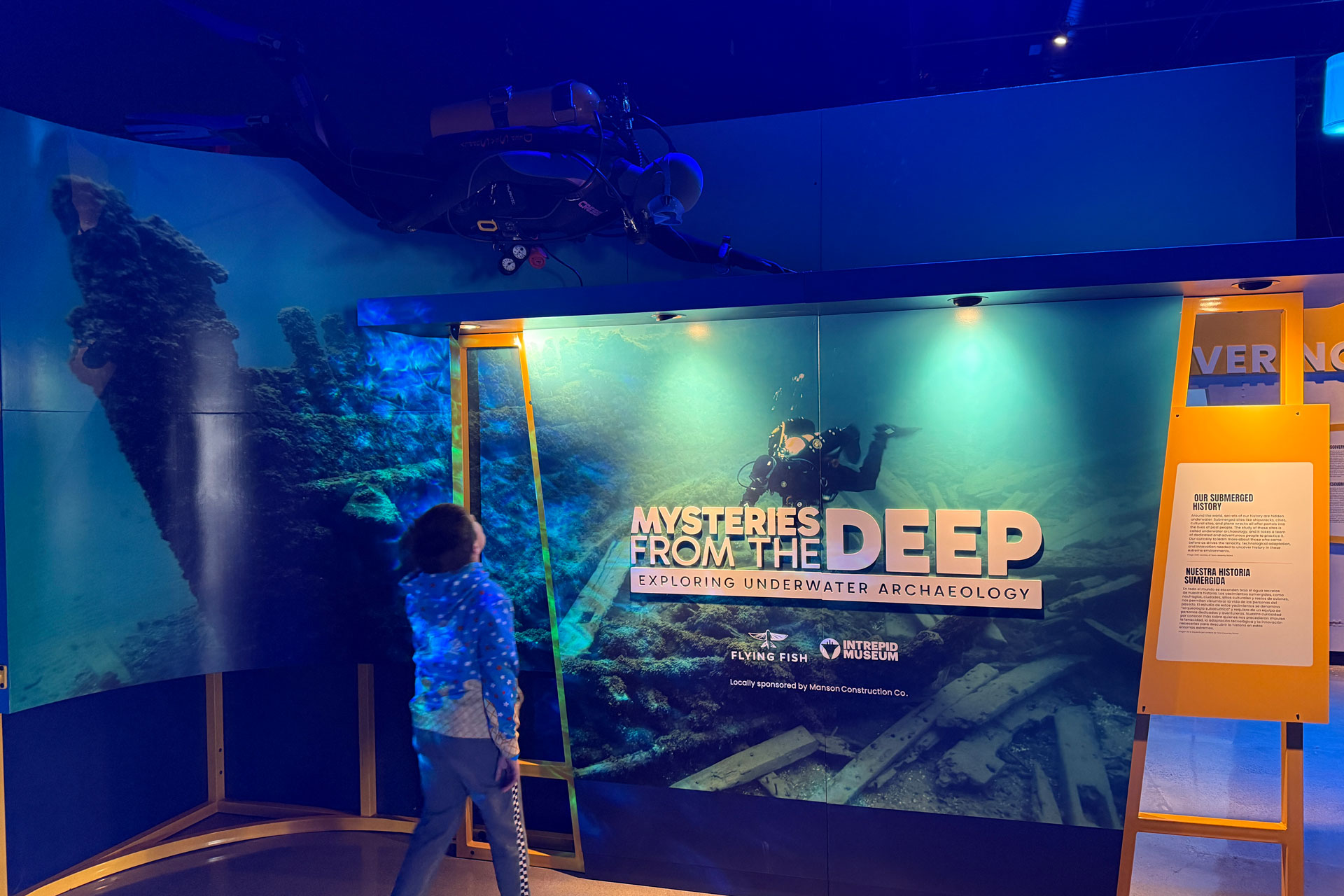

“Mysteries from the Deep: Exploring Underwater Archaeology” brings underwater discoveries to the surface in the newest exhibition to land at the Pacific Science Center.
Get a rare look into discovered shipwrecks, lost cities and submerged landscapes. But you’ll see this exhibition isn’t all about the discoveries.
Produced and toured by Flying Fish and the Intrepid Museum, the traveling exhibition runs through Feb. 22, 2027.
What can families expect at the exhibition?
The displays showcase the art of underwater archaeological studies from discovery to conservation and all of the people above and below the water’s surface who play a part in this important work. This bilingual (English and Spanish) exhibition highlights the rich cultural and historical implications of studying submerged sites around the globe and the expertise that it requires.
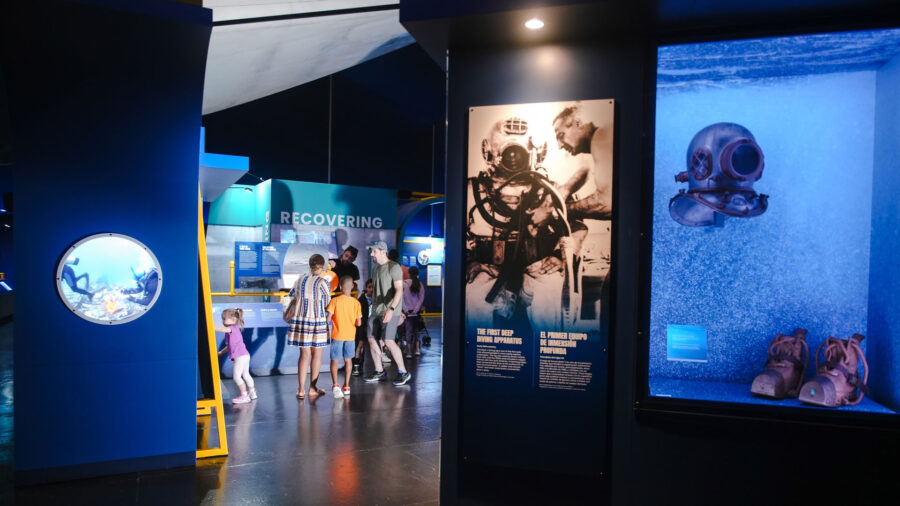
As you step inside this large exhibition, the dim blue lights and projected ground lights make you feel like you’re in an underwater lab. My kids immediately darted in different directions to explore. Throughout the exhibition, there are lots of buttons to press, many interactive displays, engaging expert videos with audio handsets, artifacts to see, and a replica of part of the 19th-century Monterrey C shipwreck to peer into.
There’s lots of space to spread out and meander through all of the displays. There are also a few theater-like areas where you can sit and view slightly longer informational videos than the handset stations offer.
Exhibition highlights and places to discover
Six areas of discovery are the main focus of this exhibition: the Pavlopetri, Clotilda, H.L. Hunley, Alpena-Amberley Ridge, Hoyo Negro, and Monterrey shipwrecks.
The Pavlopetri
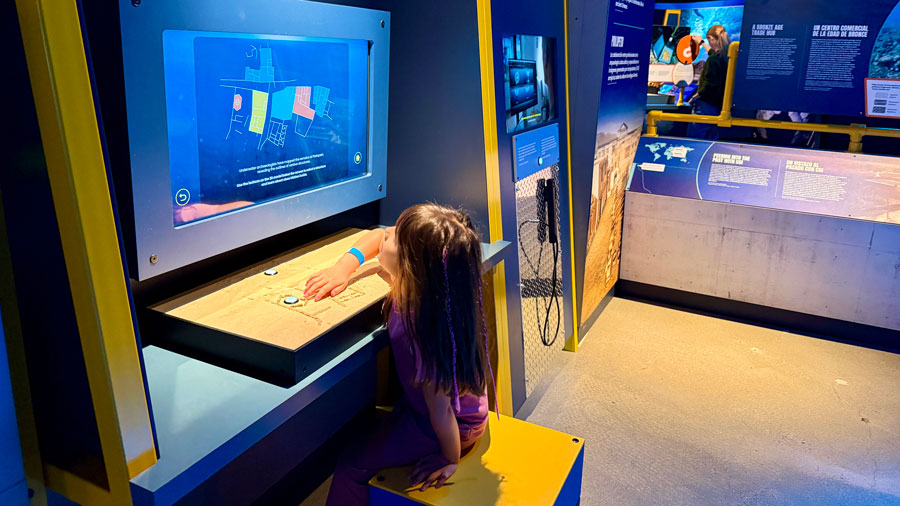
The Pavlopetri is an ancient submerged harbor town in Greece. It’s the oldest known submerged planned city in the world. This section of the exhibition has interactive computer-generated imagery and a 3D model where you can guess how sections of the remains and small artifacts were used within the town, giving you more accurate imagery of building functions 5,000 years ago. The gamified 3D model engaged my kids in learning.
The Clotilda
The Clotilda — the last known slave ship to arrive in the U.S. from Africa — was intentionally sunk in the Mobile River in Alabama. But its history could not be erased forever. This ship was discovered in 2019, and descendant communities of the enslaved Africans continue to work with underwater archaeologists to learn about their ancestors.
The H.L. Hunley
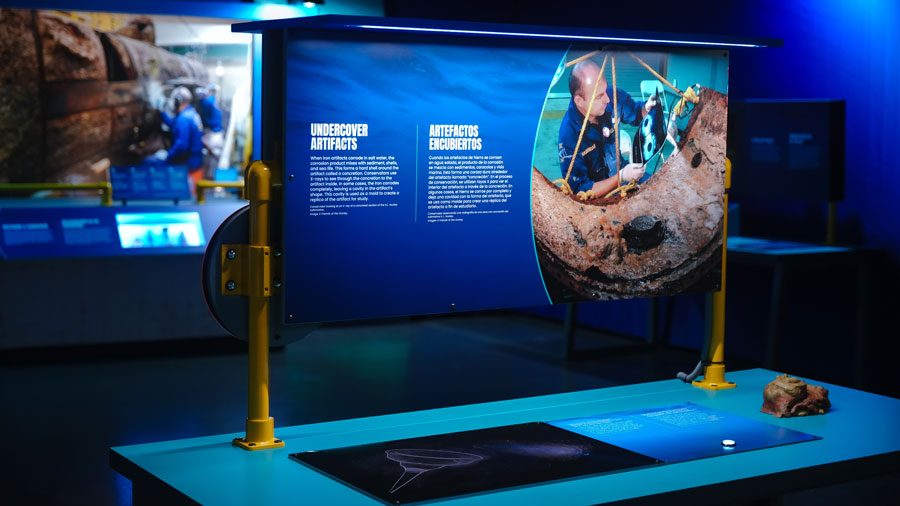
The Civil War combat submarine, H.L. Hunley, is still being restored for conservation. See imaging and hear from the experts on what this process is like. Play with interactive imaging to reveal hidden objects found in concretion samples.
The Alpena-Amberley Ridge
The Alpena-Amberley Ridge computer simulation was created using data and AI. It brings 9,000-year-old caribou hunting sites to life from what is now the bottom of Lake Huron in Michigan. Control the joystick to explore ancient hunting lands of the recreated ridge on the interactive screen. Fair warning: If you’re prone to motion sickness, this can be triggering.
The Hoyo Negro
The Hoyo Negro cave in Mexico also points to the power of technology in being able to study a cave and its contents outside of the water by stitching together thousands of photos and creating a 3D model. The cave simulator allows you to explore this submerged cave where divers discovered the remains of a woman who lived 12,000 years ago and seven species of extinct animals.
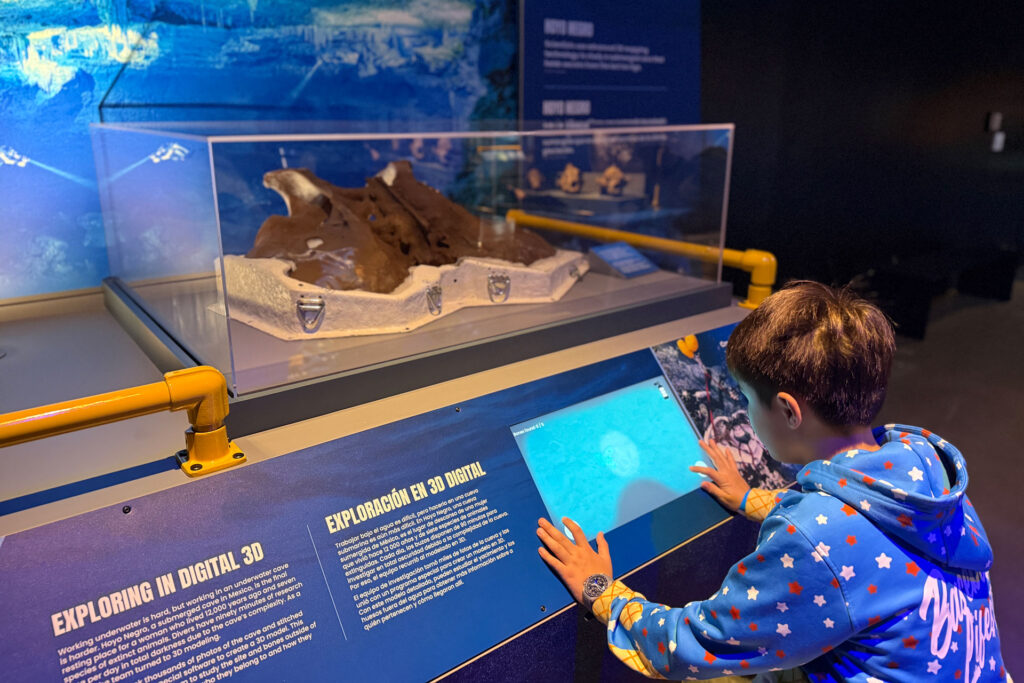
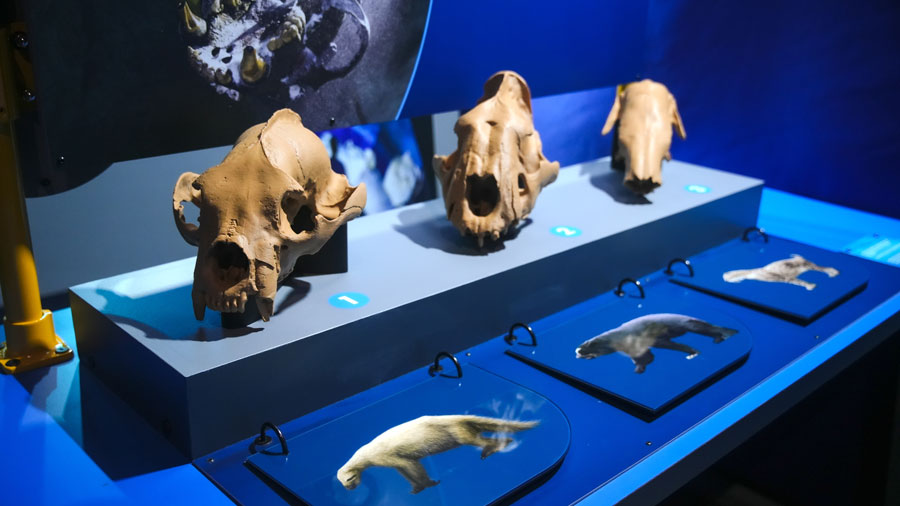
On the gamified 3D model, race the clock to find five bones of extinct animals before your oxygen tank is depleted — a realistic challenge for underwater scientists! This was a favorite activity for all three of my kids. My kids also liked the skull replicas of the extinct animals found here from the last ice age. There is a matching game you can play to guess the animal that represents each skull.
The Monterrey shipwrecks
The Monterrey shipwrecks, sitting at 4,000 feet deep in the Gulf of Mexico, are too deep for human divers. Robot divers collected artifacts that helped piece together this mystery. These wrecks were first located by chance in 2011. While their ship identities still remain unknown, their contents point to a privateer or pirate ship escorting two other vessels. Some of the well-preserved artifacts are on display, as well as some of the remotely operated vehicles (ROVs).
Sprinkled throughout, you can learn more about the equipment used, technology that supports the work, and methods of discovery and conservation. Another fun stop that’s easy to miss is the personality quiz. Learn how you can play a part in underwater archaeology based on your own unique interests and personality. Spoiler: You don’t have to dive to contribute to the field of underwater archaeology.
Why are these underwater findings important?
Yes, some people scavenge shipwrecks for treasure and loot, making underwater finds a sticky situation. It can be challenging to know who has the legal rights to study underwater archeological sites and bring up artifacts. Archaeologists believe that the information available at such sites should be carefully uncovered and shared with all as part of our collective human history.
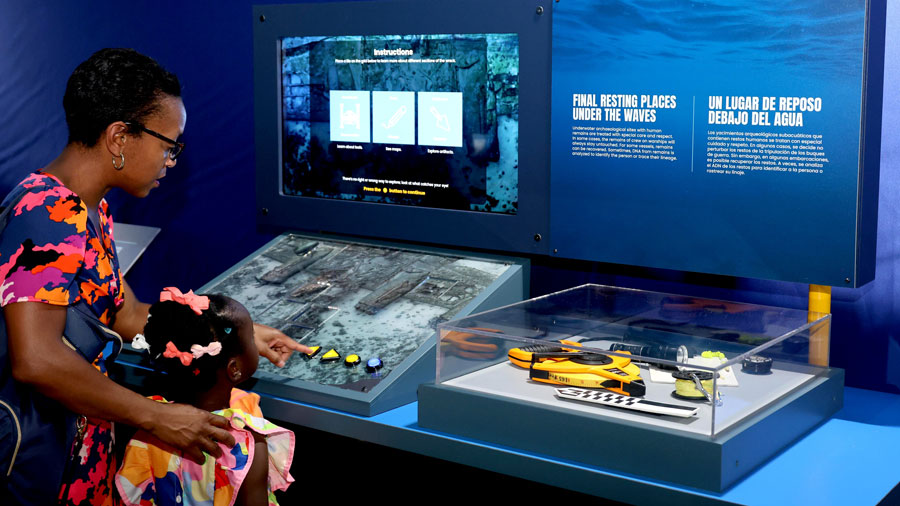
Discoveries and artifacts are worth more than their inherent value. They piece together history, cultures, trade routes, environmental changes, people, animals and places that no longer exist but in the remnants on submerged ground. They can also honor lives lost at shipwrecks and submerged plane wrecks.
Less than 1 percent of shipwrecks around the world have been explored, leaving much to be found!
Who should visit the exhibition?
We saw kids of all ages visiting the exhibition, but I can see older kids (upper elementary-aged and older) getting more out of this since there’s a lot of information to read. History buffs, science enthusiasts and curious minds of all ages will especially enjoy this exhibition. As recreational divers, my husband and I found it compelling.
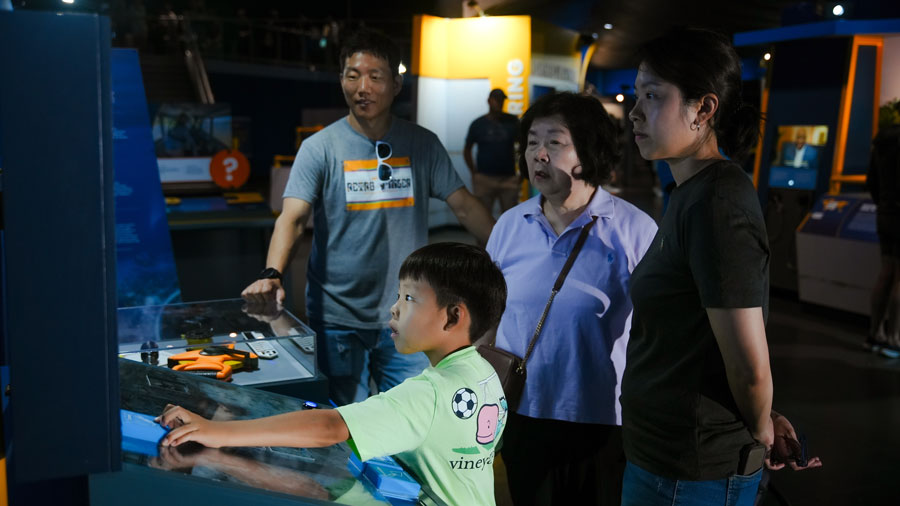
It would take over an hour to visit each display and watch all of the videos. My 7- and 9-year-old started to lose interest in about half an hour. My kindergartner was content for an hour, happy to keep returning to explore the gamified digital 3D model of the Hoyo Negro cave and picking up handsets to “meet” with the experts.
If you go to the ‘Mysteries from the Deep’ exhibit …
Location: Pacific Science Center, 200 Sue Bird Court N., Seattle
Dates: “Mysteries from the Deep: Exploring Underwater Archaeology” is on display at the Pacific Science Center from Oct. 2, 2026 through Feb. 22, 2027.
Age recommendation: The exhibition is appropriate for all ages. Due to the text-heavy nature of the exhibition, it is most engaging for ages 8 and older.
Accessibility: The exhibition is wheelchair-accessible and stroller-friendly.
Cost: Included with general admission to PacSci (starting at $19.95 for Washington adults; $14.95 for Washington youth ages 3–17; free for ages 2 and younger). Purchase tickets online in advance to save on the cost of admission. Memberships are available.
Parking: There are plenty of parking garages nearby, and you can sometimes find street parking in the surrounding area. You can also take public transportation to Seattle Center.