 Seattle Family Calendar
 Subscribe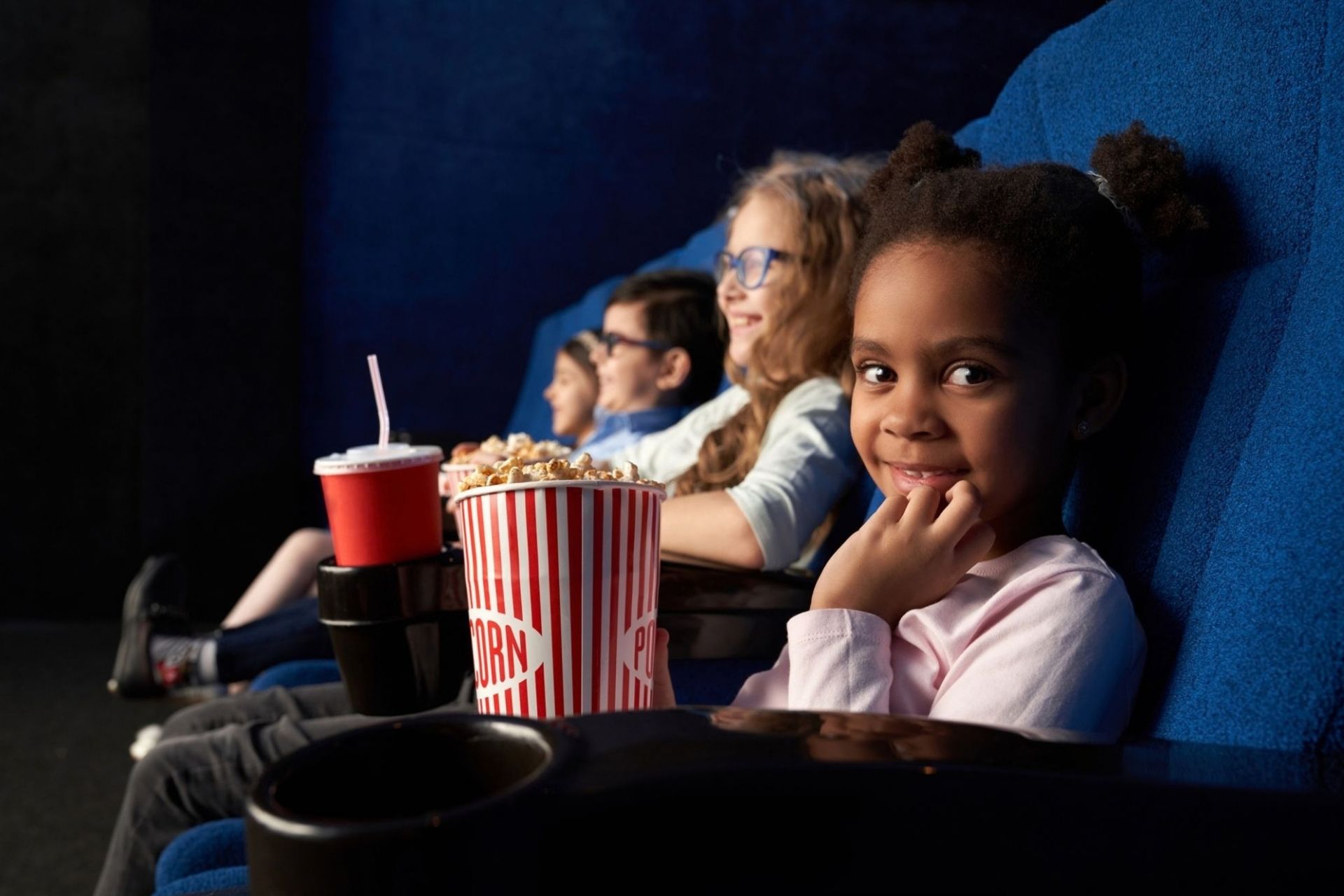

Do you have special memories from the movie theater when you were a kid? No, I don’t mean the ones that took place in the back row with your high school crush. I’m talking about a big-screen moment that moved or impacted you in a way that rarely happens when we watch something on the small screen at home.
For me, it was when I was 16 and saw “The Shawshank Redemption” at the “nice” movie theater in my small hometown. The theater was packed, people were crying and I have never forgotten that film.
It’s no wonder that as parents we are eager to share these movie-going experiences with our kids. But since seeing a movie in a theater is a shared experience, deciding when to take your child to their first showing can feel tricky.
When should I take my child to a movie theater?
Children have their own sensitivities, likes and fears. There is no hard and fast age where kids are ready for a movie theater. However, many parents take their child to their first movie between ages 3 and 5. At that age, children are generally able to pay attention to an entire movie and can understand behavioral expectations like sitting still and being quiet.
Is it too much screen time?
If you are worried about screen time (what parent isn’t?), a movie theater might be a reasonable way for your child to spend their screen-time minutes. While a movie is longer than a 15-minute YouTube show, in a theater kids are intentionally watching something with a clear beginning and end, rather than engaging an infinite video stream.
A movie theater also offers fewer distractions than a phone or tablet. The early childhood development organization Zero to Three recommends screen experiences without a lot of distractions for kids. This means “no ‘extra’ sounds or pop-ups on the screen that take your child’s attention away from the story or activity. Often children can be distracted by tapping or swiping to make things happen on screen.”
More importantly, your child will be watching the movie with you. The American Academy of Pediatrics recommends that parents “consider the quality of interactions with digital media and not just the quantity, or amount of time.” Watching a movie together can be a chance to connect, laugh and talk about what you saw after the lights come back up.
What are some signs my child is ready for a movie theater?
If you feel like a trip to the movies might be in your near future, here are a few questions to keep in mind before you buy tickets:
- How does my child handle a closed, dark space? Is it going to feel too scary when the lights go out? If so, do you have a plan? Maybe they can sit in your lap or hold your hand until the movie gets going and their eyes adjust to the dark.
- Is my child sensitive to loud or sudden noises? Sometimes movies can be very loud. If your child is sensitive to sound, consider bringing noise-canceling headphones or earplugs. You can find some that dampen sound, but do not block everything out. (I have a pair of earplugs I always take with me to the theater after a shockingly loud action movie I recently suffered through.)
- Can my child sit in one spot for an hour or more? Try watching movies at home first to see if your child is ready to sit and pay attention to a feature-length film. Ninety minutes can feel like an eternity when you are trying to wrangle a wiggly kid in a small space.
- How does my child react to scary or sad movie scenes at home? Can they recover once something has spooked them, or will it be time to leave if they get upset or scared? There’s no right answer, but be prepared to do what your child needs, without feeling disappointed that you didn’t make it all the way through.
- How long can they go without a bathroom break? This is a good one to keep in mind when your kid is begging for drinks from the concession stand. That large lemonade might seem fun, but will you be getting up multiple times in the next few hours? Drinks or not, make sure you arrive early enough for everyone to make a trip to the bathroom before the movie starts so they can enjoy the experience comfortably.
- Can my child understand the basic etiquette of a movie theater? While most people do not expect children to behave perfectly, kids do need to be able to follow social norms so that people around them can enjoy the movie. This means no kicking or bumping the seat in front of them, and staying relatively quiet and still. To get ready and learn the rules, try turning the lights down and playing “movie theater” at home while you all watch a show together. It’s a low-stakes way to help your kid learn movie theater expectations.
What should I keep in mind when deciding what to see?
It is, of course, important to consider what your child will be seeing when the lights go down. Sometimes parents are caught off guard by what scares their children. These fears can be related to brain development and how children understand fantasy versus reality.
For example, it may be obvious to you that the events in “The Lion King” are not real — that Simba’s father wasn’t really (spoiler alert) trampled in a wildebeest stampede. But to a child, that scene can be terrifying, and feel very real. The study “Is It Real or Is It Fiction? Children’s Bias Toward Reality” found that “the process of classifying items into real versus fantastical categories develops at least until children are 7 to 8 years old.”
Yet, it’s not only fictional situations that kids have a hard time distinguishing as fantasy. Research has shown that children’s prefrontal cortex has to work much harder to make a judgement about real events. They found that “children may require more cognitive resources and also mainly rely on their own personal experiences” when trying to understand events they see in a movie. For example, if they see a scene in a movie where a child is lost in a grocery store they may conclude: “I go to the grocery store with my mom. Kids can get lost there. This is happening right now, and it could happen to me.”
Since realistic movie scenes mirror everyday life, they often trigger more distress in kids than fantasy violence or monsters. I experienced this firsthand when my oldest son watched Harry Potter. He was not scared by Dementors, but when the kids were sneaking around and breaking rules at Hogwarts, he almost started to cry. Be prepared to talk with your child about whatever they find upsetting, whether it’s dragons, monsters or possibly getting a detention at school.
Where can I find kid-friendly theater experiences nearby?
If you want to dip your toes into the movie theater experience but aren’t sure if your child is ready, consider one of these family-friendly options:
- Cartoon Happy Hour at Central Cinema, Seattle. Every Thursday from 5–7 p.m. enjoy family-friendly cartoons at Central Cinema. This weekly event is free; no tickets needed. Kid-friendly snacks are available for purchase.
- AMC Theatres, Sensory Friendly Films, various locations. On the second and fourth Saturday, AMC turns the lights up and the sound down during a family-friendly movie. It’s okay to move around, dance or even sing. Trailers are not shown, so be on time so you don’t miss the beginning.
- Regal’s My Way Matinee, various locations. During the first showing of the day on select Saturdays the lights will be turned up and the volume turned down. Guests are free to move around and no one needs to be worried about making noise.
Tips for a successful first trip to a movie theater
- Head to an early show. Some theaters have showings as early as 10 a.m. Choose a morning or weekday matinee when theaters are more likely to be quiet and less crowded.
- Sit near the aisle. Many theaters let you reserve specific seats when you purchase tickets online. If you can, reserve seats on the aisle so you can easily step out for a bathroom break or if your child gets restless.
- Skip the trailers. Trailers can be fun, but they add extra sitting time, and are sometimes more intense than the movie you are there to see. Consider arriving 10 to 20 minutes after the movie’s start time to avoid long, loud commercials and previews.
- Bring ear protection. Movie theaters can be surprisingly loud. Bring child-sized headphones or earplugs in case the theater’s surround sound is too much. (Pro tip: Bring some for yourself too.)
- Go with the flow. It’s okay if you end up leaving early if your child feels overwhelmed. There is always next time!