 Seattle Family Calendar
 Subscribe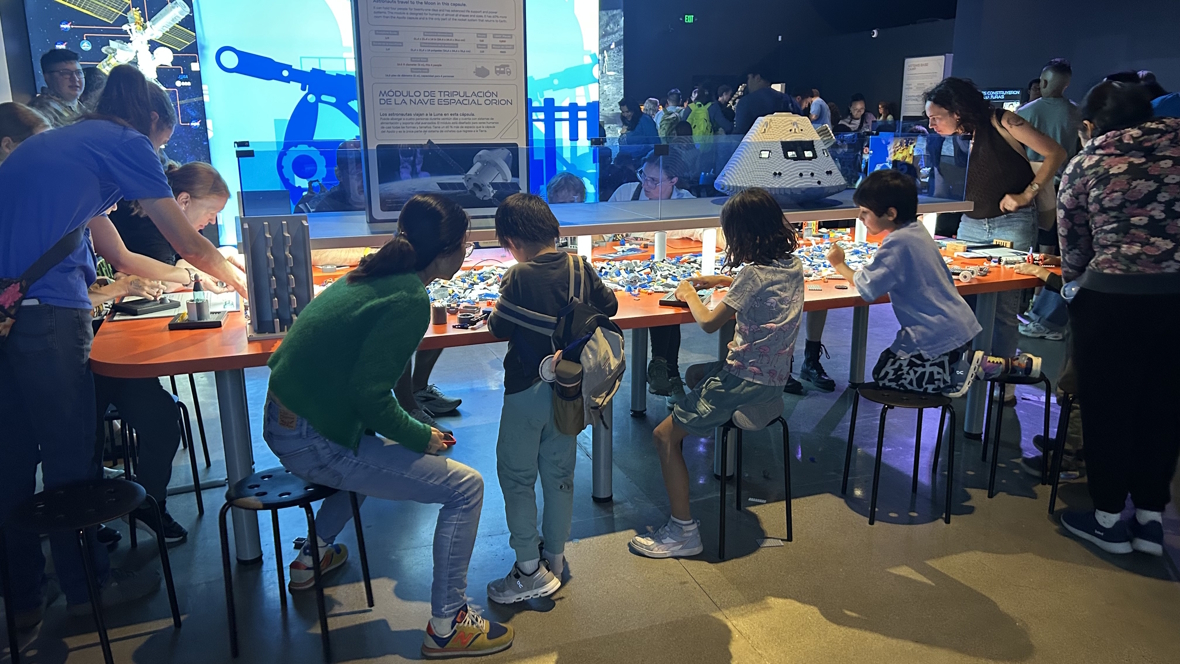

It was a beautiful Seattle evening and people were enjoying the new public pavilion outside the Pacific Science Center (PacSci). One couple was laughing and squirting the giant water cannon while another walked in what is basically a giant hamster wheel floating on water. I was headed inside to the opening of the newest exhibit, “Artemis Adventure with Lego Bricks.”
What is ‘Artemis Adventure with Lego Bricks’?
The new, temporary exhibit launches visitors into the world of space exploration inspired by NASA’s Artemis missions. It is a traveling exhibition produced and toured internationally by Flying Fish and supported by Science World British Columbia.
The highlight of the exhibit is the Lego building stations, which were incredibly popular and busy the whole time I was there. The connection to space exploration and STEM learning felt natural and fun, and encouraged creativity at every turn.
If you’ve got a space fan, a Lego fan or both, be prepared to stay for a while! As one mom was trying to convince her child to leave, I heard her say, “Remember, we do have Legos at home.” Toward the end of the opening I heard the all too common, yet ultimately meaningless, parenting phrase, “Five more minutes, then we have to go,” echoing around me.
Lego brick building stations
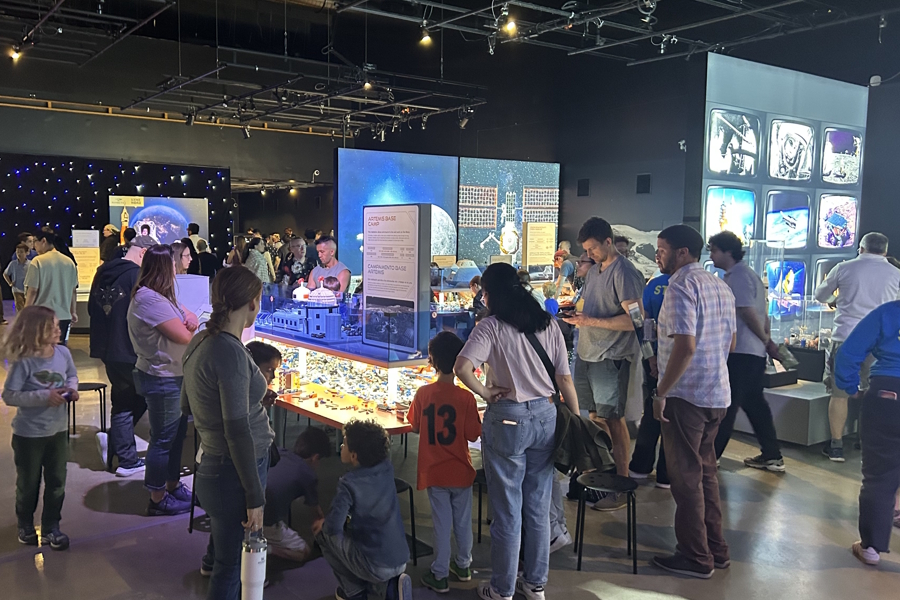
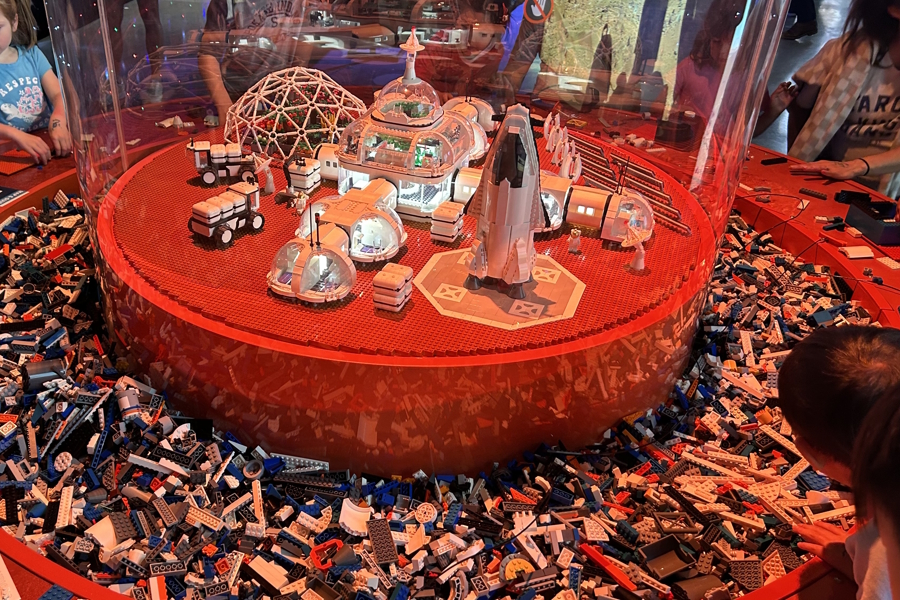
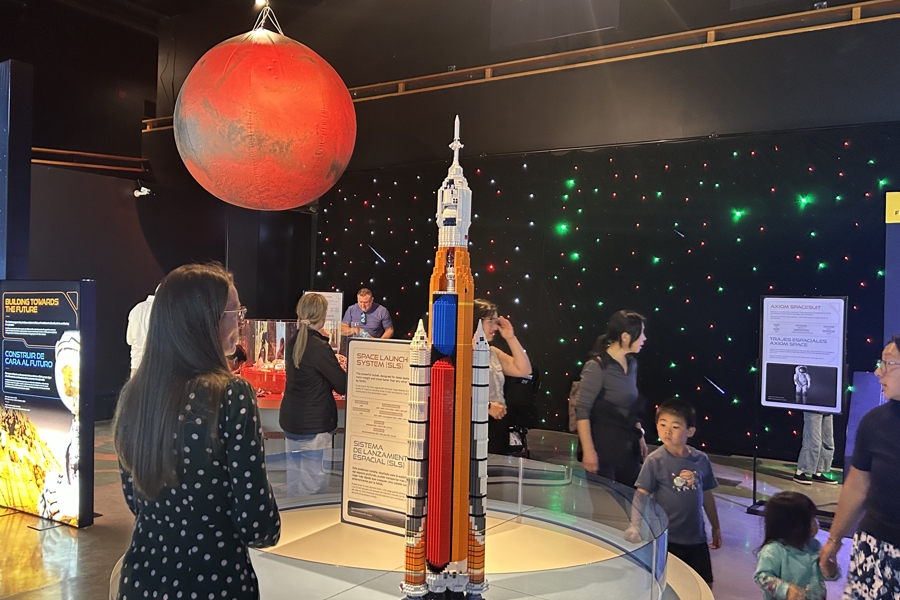
Throughout the exhibit there are large circular tables surrounding troughs of Lego bricks. Each building area has an impressive Lego sculpture elevated above the bricks in the center, and a sign giving some info about the building area’s theme and the Lego status itself (all signage throughout the exhibit is in both English and Spanish). The Mars station model alone took 190 hours and is composed of 23,500 Lego bricks!
Each station had its own focus, with unique and fun interactive elements. For example, a touch screen at the lunar vehicle station guides you through picking a mission, and the lunar exploration station provides special bases to build on that light up on a screen when you find the right landing spot.
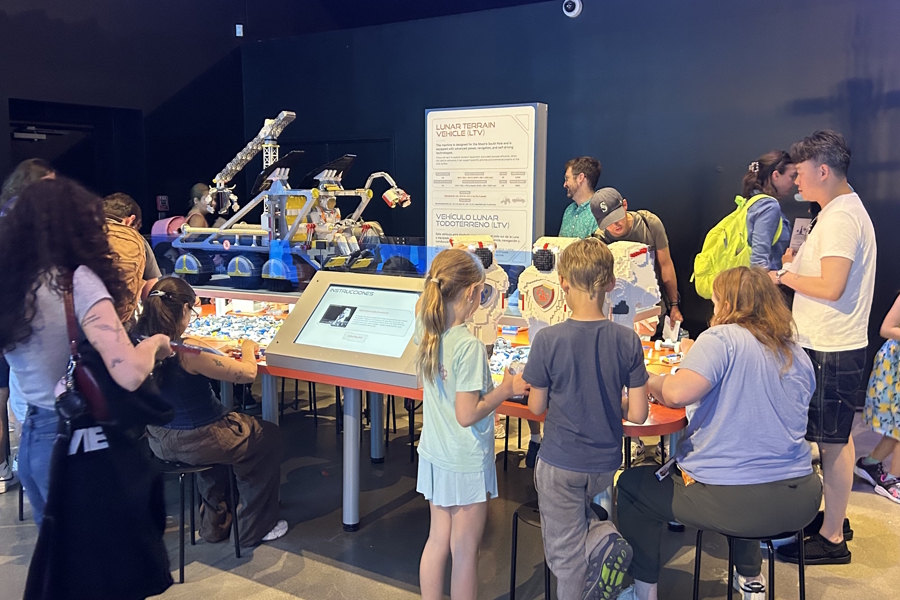
Lunar terrain vehicle
As you enter the exhibit through a walkway made of gigantic Lego bricks your first challenge is to build a lunar terrain vehicle. A huge trough of Lego bricks surrounds a large model of a lunar vehicle, and there is a touch screen inviting builders to select their lunar exploration mission and select which crew members they would bring along. While some kids clicked through the screen, the majority just jumped right into building.
Next to the building station was a double racetrack, similar to one for zucchini car races I see each year at my local farmer’s market. Two lunar vehicles could race to the bottom and see which one makes it over the lunar terrain. I did not see any races while I was there, but I am sure this could be a fun feature, especially for groups of kids visiting together.
Artemis base camp
The next building area is focused on the Artemis lunar base camp. The large Lego model depicted a cabin, a rover and a home allowing crews to stay on the moon for long durations. The info sign said that astronauts will try to make fuel from water and local resources to prepare for future trips to Mars. Just like the lunar vehicle station, kids and adults alike were engaged with building their own additions to the base camp.
Lunar lander challenge
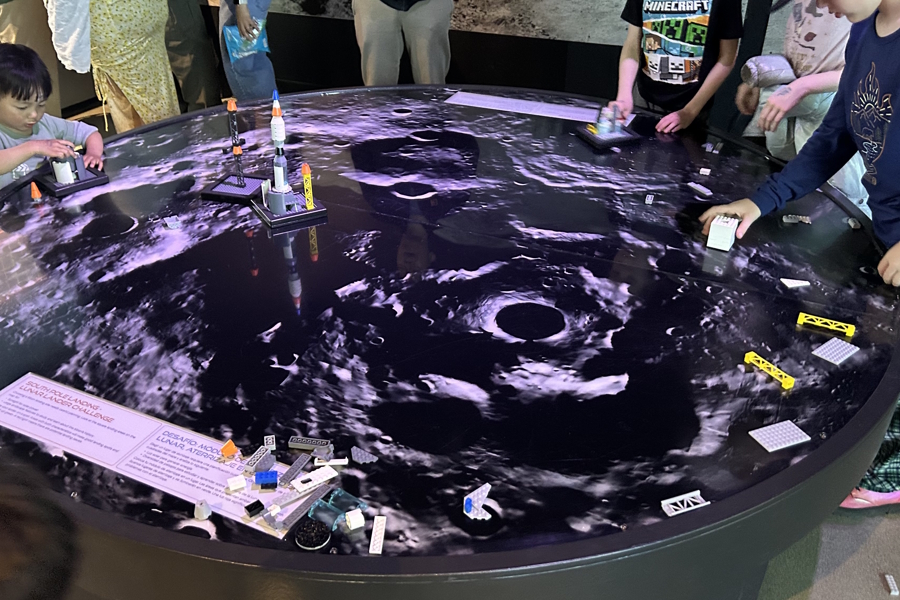
This building station is all about lunar landing. Visitors are encouraged to build a landing craft and then place it on a small black square pad. Next to the building area is a low table with a projection of the moon’s surface. Kids can try to find a good place to land their craft on the moon. If they select the right spot, the table will light up with green light around their black pad. If it turns red, time to find a better landing location! Kids were having a great time pushing their creations around the table looking for the perfect place to touch down.
Mars habitation
The last building station toward the back of the exhibit is all about Mars. This area was more dimly lit, and a large model of Mars hanging above the building area gave everything a red glow. In the center of the building station was a model of what a Mars station might one day look like. (To me, it looked a lot like the station where Matt Damon’s character is trapped in the movie “The Martian.”)
More to explore at ‘Artemis Adventure with Lego Bricks’
While building with Lego bricks is the star of the show, there are other aspects of the exhibit worth checking out.
Coloring station
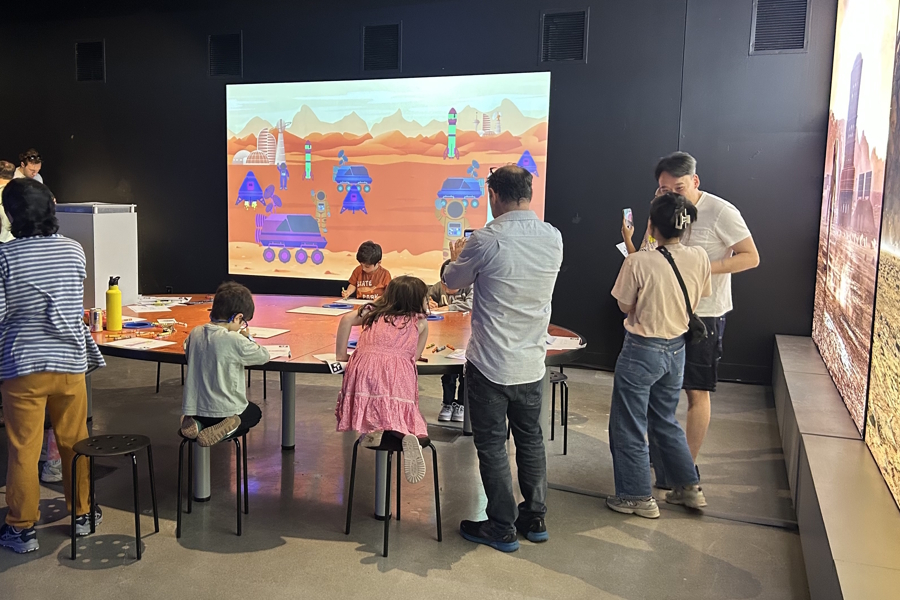
Toward the back of the exhibit is a large round table covered with coloring sheets and crayons, with a screen projecting animated space images behind it. Kids can color a picture, then scan the image using a touch screen station and watch the screen for their picture to appear and bop along with the other animated images. It’s probably no surprise that kids found this very exciting; there was a lot of screaming and jumping up and down when someone’s picture would suddenly join the projection. The process was clear and straightforward too — I watched a little girl who could not have been more than 3 or 4 years old scan her picture without adult help.
Lego bricks sculptures
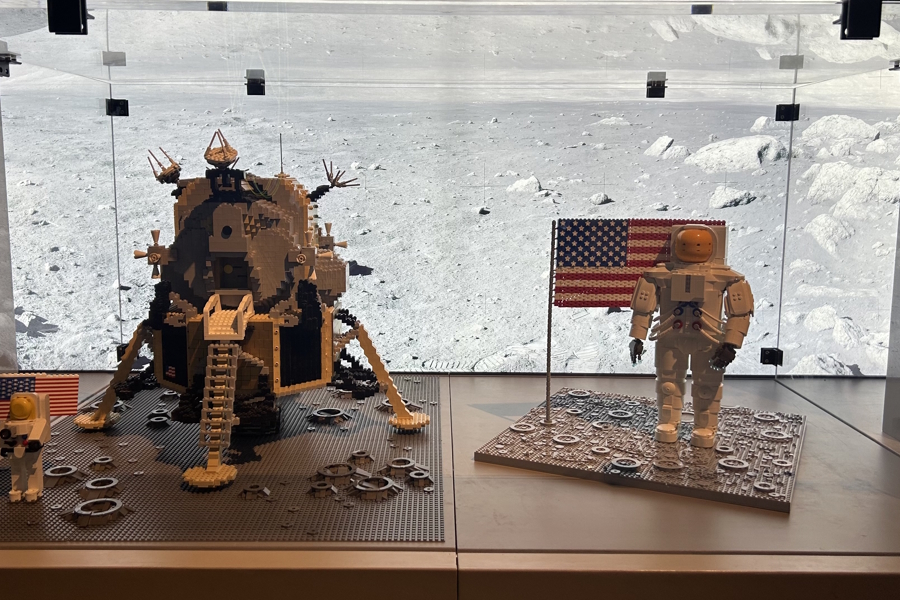
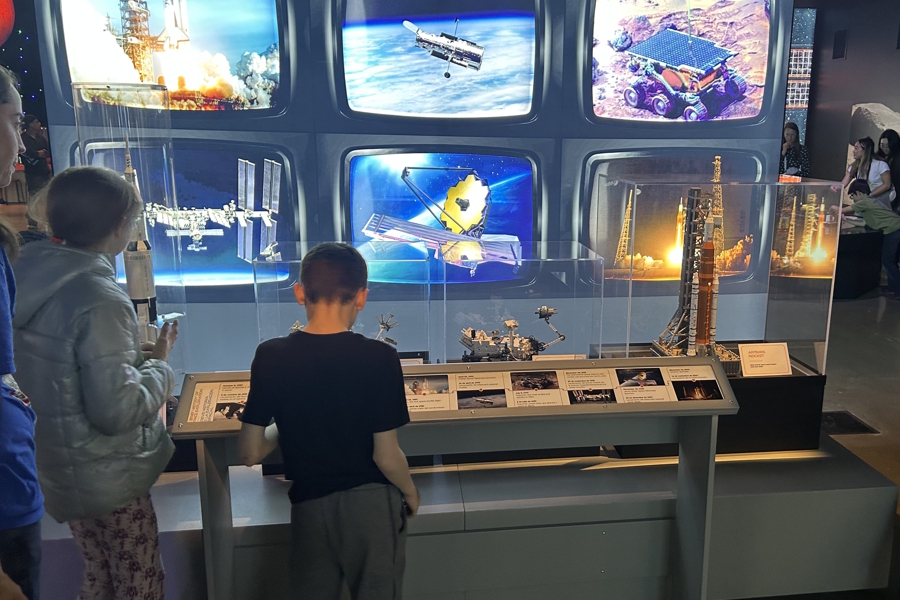
There are amazing Lego sculptures throughout the exhibit of astronauts, spacecraft and more. And while they are impressive, they were not getting much attention. Lego bricks you can play with and touch seemed much more interesting than sculptures you could not, which were often behind protective plastic walls. The displays in the center of the building stations got the most oohs and aahs, but largely visitors seemed to be there to build with Lego bricks, not look at them.
Duplo area for younger kids
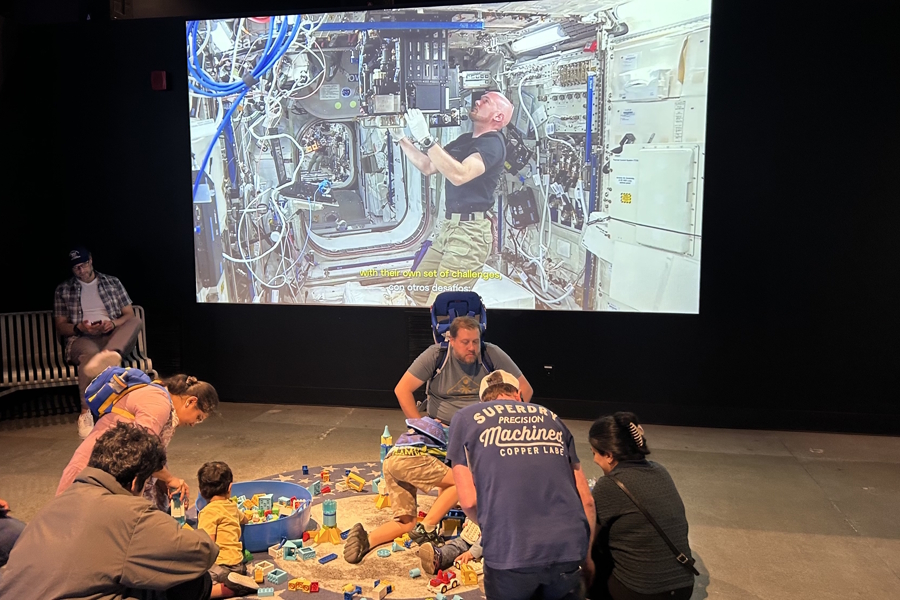
In between some of the building stations a blanket was on the floor covered in Duplo bricks and toddlers, giving the littlest builders a space of their own. Behind the Duplo area, a video was projected on the wall showing highlights of astronauts training to go into space, which was pretty fun to watch.
Community Lego mural
At the very back of the exhibit a community mural is being created. Visitors are given a small Lego base and a guide showing which bricks to add. Each piece is then added to a giant Lego base on the wall. Since this was just getting started during my visit, it was hard to imagine what this will look like when the exhibit is over several months from now, but I love that visitors get to be a part of building something together.
Who should go?
This exhibit really seems to appeal to all ages. There were preschoolers building with Lego bricks next to tweens next to adults, all deeply engaged in their own projects. Everyone is able to make their creations as simple or detailed as they’d like, keeping it fun and challenging (which is, really, the beauty of Lego bricks). And everyone also seemed to be having a great time coloring and watching their pictures appear in the projected animation. There were teenagers carefully coloring next to very young kids just learning how to grip a crayon.
The space is large, open and a little dark. It might be tricky to keep track of multiple kids, especially with a variety of ages, interests and attention spans. And of course, small Lego bricks are not safe for littles who are still shoving things in their mouths. The Duplo area is great, but you will need to keep a close watch since in the short time I was there Lego bricks were already starting to fall to the floor. I do not envy whoever has to clean up that exhibit at the end of the day!
From what I saw, this exhibit is going to be popular and busy. If you can, consider checking it out on a weekday when you will likely have a little more elbow room for building. But no matter when you go, you are sure to be inspired by the incredible Artemis missions and dreams for the future on the moon and Mars. And who knows, maybe one of these kids building with Lego bricks today will find themselves on their way to a lunar base (or maybe even Mars!) in the not-so-distant future.
If you go to the ‘Artemis Adventure with Lego Bricks’ exhibit …
Location: Pacific Science Center, 200 Sue Bird Court N., Seattle
Dates: The exhibit runs May 22–Sept. 7, 2026.
Cost: Included with general admission to PacSci (starting at $24.95 for adults; $18.70 for youth ages 3–17; younger than 3 free. See the website for membership and discount information.)
Parking: Parking is tricky in this dense area of Seattle; consider taking public transit if possible. There are parking garages nearby and sometimes you can find street parking in the surrounding area. See PacSci’s website for more info.
More fun nearby: The Seattle Center has lots of family fun, including a food court, the International Foundation and the Seattle Children’s Museum.