 Seattle Family Calendar
 Subscribe

My kids are grown now. All five are full-fledged adults, a reality nearly impossible to believe. I’ve arrived, officially, in the Years of Reflection. What did I do well? I regularly wonder. And where did I just completely blow it?
For my performance review, I turn to my only stakeholders.
“What was my biggest mistake?”
An answer I didn’t expect
Asking my kids that question is an exercise in humility, sure, but more importantly, it’s an exercise in humanity. In relationship-building. In owning my mistakes, asking for forgiveness and understanding perspectives not my own. It’s become one of my tools for fostering compassionate friendships with my adult children.
Sounds cute, right? Like I’m open to their feedback and magnanimous in response.
The truth, I’m afraid, is less darling. Because it didn’t always go smoothly. And I wasn’t always very receptive to their answers.
“What was my biggest mistake?” I asked my eldest the question for the first time, almost blithely, over Starbucks iced mochas on a random Tuesday. “What did I really get wrong as a parent?”
Abby was 19 and a sophomore in college. Enough time had elapsed, I thought, from living at home together. We’d had enough space, surely, for both of us to have some perspective. Enough distance to look back rationally and discuss kindly.
Her answer came immediately. I thought she might at least pretend to rack her brain — gee, Mom, it’s so hard to think of a single thing you did wrong — but nope. She was lightning quick.
“It was definitely when you grounded me from homecoming,” she said. “That was the worst.”
Did I respond with curiosity? Did I thank her for telling me?
I did not.
“It wasn’t even your homecoming!” I replied instead, defensive grid rising, internal alarms blaring.
“But I was invited,” she said. “All my friends went. They all got to be there, and I didn’t. It sucked. The punishment did not fit the crime.”
How about now? Did I relent and ask her how I’d made her feel? Did I ask follow-up questions? Seek context or insight about her perspective?
Nope. I sure didn’t. I escalated.
“Well, I don’t know what you want me to say about that. I’d do the same thing again. What was I supposed to do, Abby? You were 16! You snuck out of the house! In the middle of the night! On what planet do you sneak out and still get to do fun things with your friends?”
Then I mounted my soapbox and launched into the lecture. You know the one. It’s full of self-righteous, unassailable truths like:
Privileges are commensurate with responsibility!
Homecoming isn’t a right!
Fun things have to be earned!
This is about trust!
This is about safety!
My whole job was to raise responsible adults!
And then I spent the next three years doubling down as we had the same conversation on repeat.
Moving past my fears
The truth is, at the time, I genuinely could not imagine another response. After all, I had a child who had broken the rules. The RULES. And rules, in my mind, equaled safety.
A lot of that mentality came from my conservative evangelical upbringing, a strictures-based paradigm I’ve since deconstructed. Part of it came from the deep parental terror, also fed by the church, that if I loosened my grip for even a second, my children would end up dead in a ditch, addicted to drugs or living a life of crime. Control was paramount, and there was no room for error.
I’d stopped believing by then that rules alone create safety. I’d started believing open relationships do.
I honestly believed my job was to keep terrible things from happening by imposing enough structure, enough consequences, enough order so nothing bad could find a way in.
If rules equaled safety, then breaking rules meant danger.
The math seemed obvious.
What I didn’t understand then was that safety is mostly an illusion. We want desperately to believe that if we make enough rules, enforce enough consequences and maintain enough control, our children will be protected.
But life doesn’t work that way.
Teenagers certainly don’t.
What I also didn’t understand was what Abby was actually telling me.
She wasn’t really saying, “I wanted to go to a dance.” Or, she wasn’t saying just that.
She was also saying, “Something important to me mattered more than the rule.”
She was also saying, “I needed you to work with me, not against me.”
She was also saying, “I wanted to believe that you could hear me.”
At the time, I couldn’t hear any of that because I was still defending the punishment. I was still defending the perception I had of myself. I was still living inside the rigid paradigm that I had to make that decision to keep her safe.
When I was able to separate myself from the situation, though — when I was able to look at it with curiosity rather than judgement — I saw an entirely different truth.
The reality was this: we lived in a safe neighborhood with virtually no crime. My daughter had “snuck out” to walk one block to the park, sit on the swings with friends, and come home.
That was it. That was the whole crime that cost her a core memory with friends.
Parenting with trust instead of control
Years later, when Abby’s twin siblings were 16, she asked me whether they would get in trouble for sneaking out.
The question stopped me cold.
“No,” I said. “They wouldn’t.”
The truth is, they couldn’t. By then, my parenting system had changed to make such an event impossible.
If my later teenagers wanted to go sit in the park at midnight with their friends, they’d poke their heads into my room to tell me they were going. I’d remind them to be quiet and respectful of the neighbors. They’d say, “Duh. Obviously.”
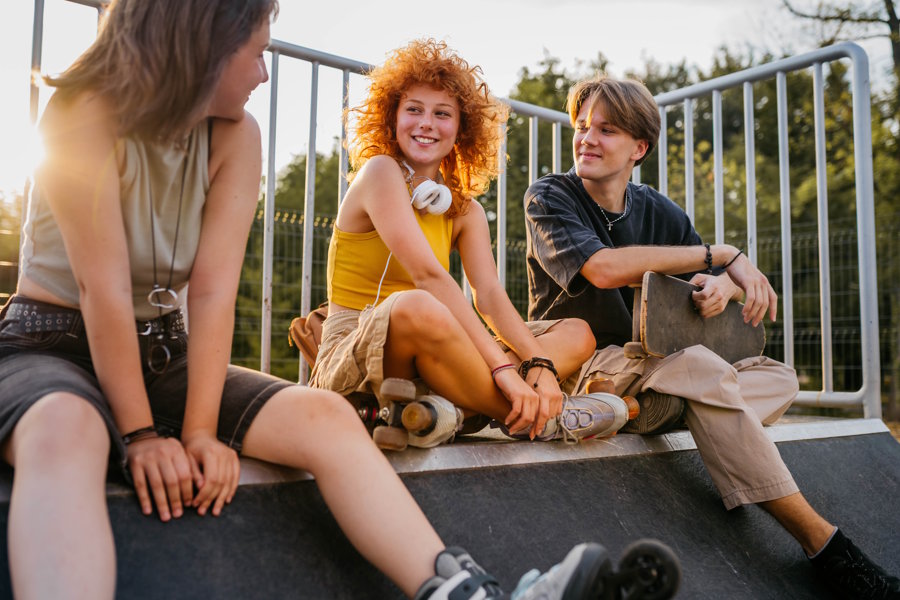
And that would be it. No sneaking. No punishment. No grounding. No missing homecoming.
Just conversations. Discussions about what feels safe and what doesn’t. Collaborative decisions. Shared problem-solving. Trust built from both directions.
I’d stopped believing by then that rules alone create safety. I’d started believing open relationships do. That communication creates safety. That kids who know they can call you at 2 a.m. without fear are safer than kids who are afraid of getting caught. That mental health matters. That belonging matters. That a community of peers matters. That joy matters.
My highest charge as a parent wasn’t actually raising responsible adults as though they were a product I was delivering to the world. It was raising humans who trust themselves. Humans whose sense of responsibility rises from an internal compass, not external rules. Humans who can build a supportive community. Humans who know who they can trust. Humans who know they can trust me. Humans who can make decisions, recover from mistakes, ask for help and tell the truth. Humans who can show up in the world confident and self-actualized, ready to fully participate in all the wonky, wild, weird and wonderful bits ahead.
I think about that homecoming conversation a lot.
Because the remarkable thing isn’t that I asked my daughter to tell me my biggest parenting mistake. It’s that she trusted me enough to answer honestly and then stuck it out until I stopped defending myself so I could finally listen, apologize, change and do better. If that’s not grace, I don’t know what is.
Join The Launch Pad
For the parents navigating eye rolls, growing independence, social pressures and everything in between. Get expert advice and real-world support in ParentMap’s new monthly newsletter just for parents of tweens and teens.