Seattle Family Calendar
 Subscribe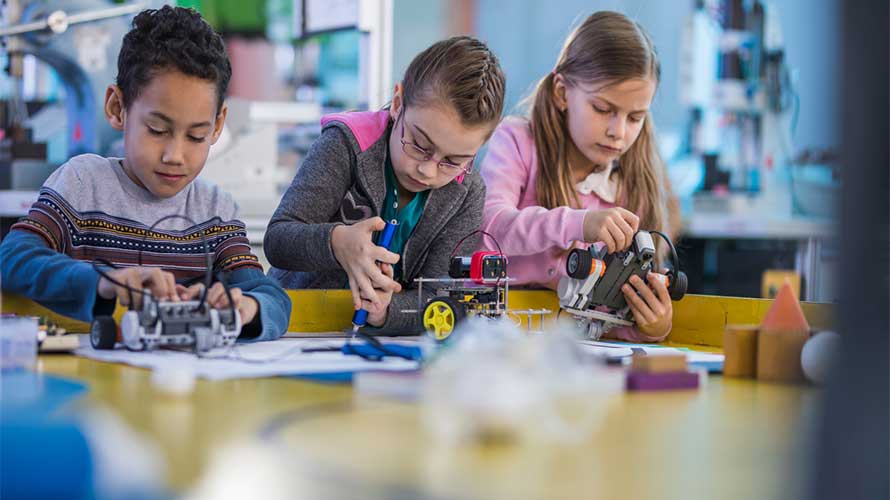

What’s a ‘makerspace’?
Forget Baby Einstein, flash cards and rapid-fire quiz-style learning apps. It’s all about the makerspace! These STREAM-inspired creation stations are popping up in schools and homes everywhere, boasting brain-boosting benefits galore. The idea: Give kids the space to create, invent and experiment and there’s no limit to what they can do.
Ready to set up a room (or closet, or nook, or corner of the dining room table) in your home? It’s easier than you think.
It’s gonna get messy

The good news is that you probably already have everything you need to ignite your child’s creativity.
The bad news is that it is about to get messy up in here! Makerspaces are all about taking chances, making mistakes and, yes, getting messy. (Thanks, Ms. Frizzle.) But seriously, I believe messes are often a sign of artists at work, children at play or both.
If you decide to create a makerspace in your home, shoddily assembled popsicle stick creations will soon litter your home.
Remember, that’s the goal. So, if you can, let it go.
Make space

Though many of the makerspaces you’ll find on Pinterest dedicate entire rooms for tinkering and craft supplies, if you’re like most Seattleites, you don’t have a ton of unused space. That’s okay. We’ve had some variation of a makerspace in every home we’ve lived in (including the 700-square-foot apartment we called home as a family of five in Los Angeles.)
What’s most important is to provide a designated space where kids can easily access their inventory, preferably near a workspace where they can spread out their supplies and get creative. A counter, a desk, a folding table or a workbench will do. Or, consider a space-saving option such as a wall-mounted desk with room for storage or an art cart stocked near the dining room table that can travel with your little makers and their projects.
Just don’t have an inch of space to spare? Talk to your child’s teacher about creating a makerspace at school and volunteer to help set it up.
Raid the recycling bin

Ready-made makerspace set-ups are expensive and kids will burn through even the most well-stocked art supply stores within minutes. So, how do you inspire your little future engineers and artists without breaking the bank?
Dumpster-dive! Well, sort of! Most kids are naturally gifted at turning trash into treasure. So, you likely already have everything you need in your very own recycling bin. Start hoarding recyclables now, and soon you’ll have a well-stocked trove of supplies.
Start stockpiling these items for your makerspace:
- Junk mail
- Magazines
- Damaged books
- Toilet paper and paper towel rolls
- Single-use plastic bags
- Tin cans
- Cardboard boxes
- Milk, juice, egg and ice cream cartons
- Tops/lids
- Jars
- Applesauce tops
- Soda can tops
- … and so much more
Shop secondhand

Though it’s possible to supply almost everything you need to create a great makerspace with re-usable items, if you do want to buy some supplies, try buying used first. Many secondhand stores are a treasure trove for craft supplies. I regularly find yarn, stamps, fabric, lace, beads, craft scissors, pipe cleaners, discarded markers, pens, paper, crayons, dowels and sewing kits all under $1 at the Value Village in my neighborhood. I recently found a full doll-making kit with several sets of doll-making supplies for just $2! I’ve also spotted planters, candle wax, globes, binoculars, headlamps, magnifying glasses, microscopes, telescopes and many other items that inspire scientific and artistic exploration at home.
Another great way to stock up on the cheap is to head for area yard and estate sales. Crafting supplies, power tools and all manner of useless knickknacks abound at garage sales. Enlist kids’ help in hunting for fun finds. My kids love to dig through piles of other people’s crap (and admittedly, I kind of do, too.) Nothing sparks creativity like imagining new uses for old things.
In addition to more traditional craft supplies, I also keep our supply bins stocked with other odds and ends, such as keys, puzzle pieces, and keyboard and Scrabble letters. These items encourage loose parts play and inspire kids to reuse discarded items for new (sometimes similar) creations.
Declutter the closet

Old socks, stockings, scarves, sheets, pillows and clothes are all great additions to a makerspace. I recently unloaded a few old pillows into my kids’ makerspace and they gleefully ripped out the stuffing to create their very own felt-stuffed animals and dolls. For a recent presentation at school, my 8-year-old invited friends over to create puppets out of socks, pipe cleaners and googly eyes. Kids are constantly tearing through their parents’ closets looking for creative inspiration. Rock their world and donate a pile of discarded items to their art space.
Worth the splurge

Though not necessary, there are some items that, IMHO, are worth the splurge (if you have a little spend in your budget.)
A few things that will take your makerspace to the next level: robotics parts, power tools, batteries, a tool set, a low-heat glue gun, the biggest vats of glue you can find (because: slime), lumber, screws, nails, switchboards and circuits.
Of course, the more advanced you decide to get with the parts available in your makerspace, the more you may have to supervise to ensure that the kids are safely using the space. So, in our space, I put dangerous items in lockers they have to ask to use first, while most items remain accessible for them to craft whenever and however they like.
Hands off

And that’s it! You’re on your way to creating an awesome and inventive makerspace for kids.
My one final pro-tip: Keep out. While it’s tempting to assign them Pinterest-worthy craft projects and to hover as they slap a little too much glue on their homemade popsicle stick creations, avoid the urge to better their literal houses of cards. They’ll learn far more if they’re the ones calling the shots (and holding the glue gun.)
Editor’s note: This article was originally published in December 2019, and updated in January 2021.