 Seattle Family Calendar
 Subscribe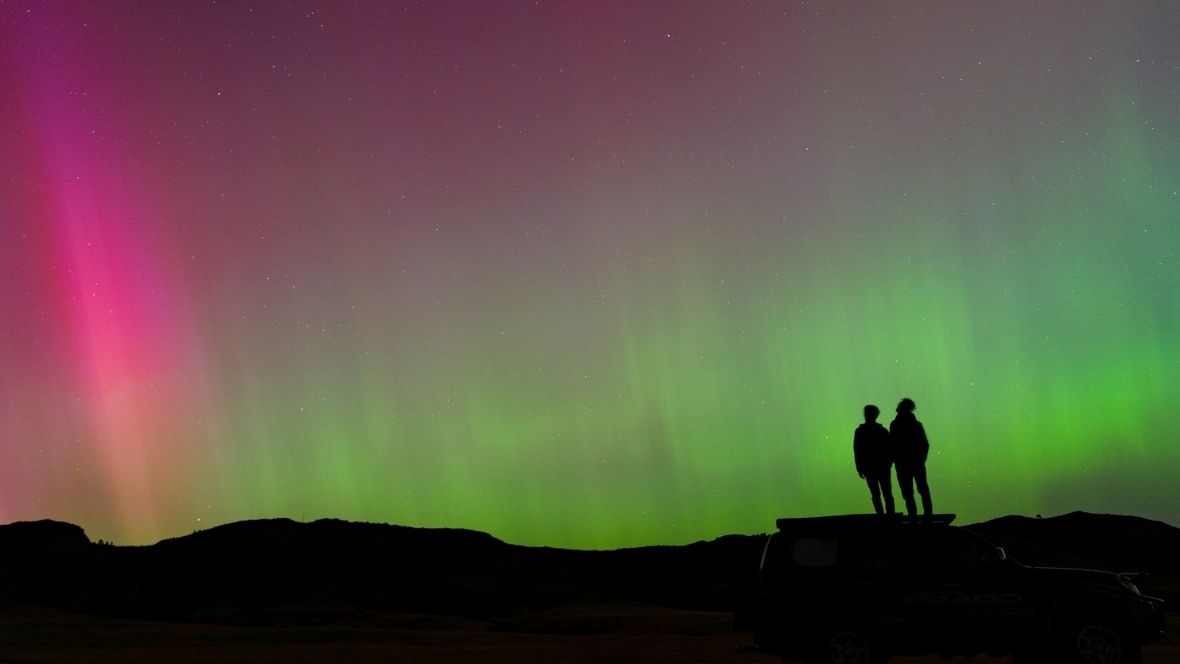

ParentMap’s Northern Lights guide for families includes:
- An explanation of the Northern Lights phenomenon
- How to check local forecasts
- The best time to watch for them
- Where to look and the science behind it
- Educational resources
- Apps and websites
- Kid-friendly glossary of terms
With viral photos, news reports and jaw-dropping Instagram posts of glowing purple-and-green night skies from random Washington backyards, it’s no wonder more Puget Sound families are looking up.
It seems like we’re all hoping to catch the Northern Lights, a natural phenomenon that occurs when solar particles interact with gases in the Earth’s atmosphere, causing them to glow. Here in the Northern Hemisphere, the lights are usually seen in high latitude regions near the Arctic and Antarctic. But occasionally, the magnetic activity is pushed farther south, meaning people in Washington state can sometimes see them, too.
That leaves many Puget Sound families wondering when and where they can catch the glow, no Alaskan cruise required. The short answer? It can happen with patience and a little bit of science on your side. Here are all the details on how to spot the aurora borealis from western Washington, including when to go, where to look and how to set expectations for kids.
What are the Northern Lights?
According to NASA, auroras are colorful and dynamic displays created when energetic space particles collide with atoms and molecules in Earth’s atmosphere. This collision is caused by solar wind, an element of space weather, produced by the sun when it sends out streams of charged particles. When the solar wind particles reach Earth, the particles interact with our planet’s magnetic shield, called the magnetosphere. Then the particles cause atmospheric gases to glow, thus creating the aurora. That radiant light also produces patterns that ripple, shift and flow. They often appear in the forms of rays, spirals or wisps.
Name origins
Some of those energized particles get pulled from the atmosphere toward Earth’s magnetic poles in the north and south. Confusingly, these magnetic points aren’t exactly the same as the geographic North and South Poles we learn about in school, but that’s a science story for another day.
On our side of the world, the aurora is called the Northern Lights, or aurora borealis, with aurora being Latin for light, and borealis meaning north. In the Southern Hemisphere, they’re known as the Southern Lights or aurora australis, with the latter meaning south.
If you’re wondering when the word aurora came to be, its origins began way before Disney’s 1959 animated classic “Sleeping Beauty.” In fact, it has roots in ancient mythology. According to “History of Geophysics” by George L. Siscoe, aurora derives from the Latin name Aurorae, the Roman goddess of the dawn. She was said to announce the arrival of the sun. The name feels fitting for a glowing sky phenomenon, doesn’t it? The modern version entered the scientific writing scene in 1619 when Italian astronomer Galileo Galilei used “aurora” to describe the light display phenomenon. In other words, every time we say “Northern Lights,” we’re basically mini Galileos.
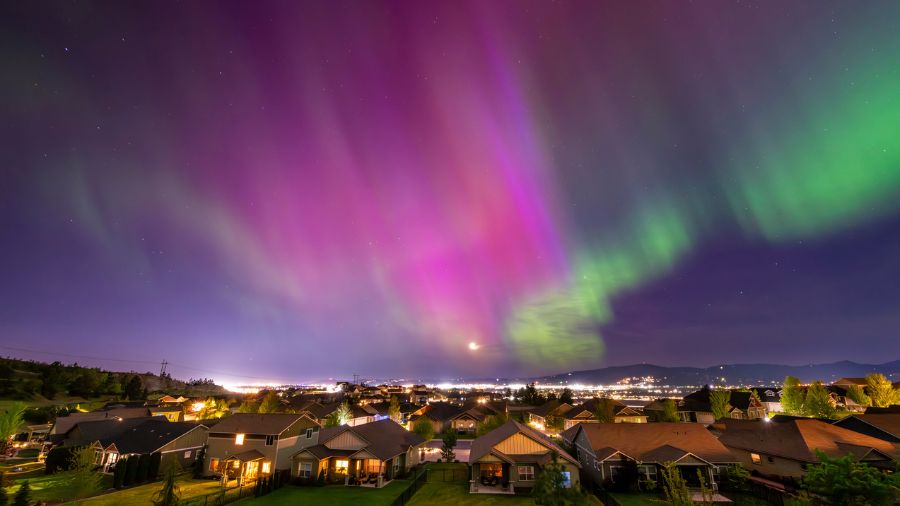
Northern Lights forecasts to check
Strong geomagnetic storms push the aurora farther from the northern magnetic pole in a southward expansion that can eventually spill into Washington skies.
Geomagnetic activity is measured using the Planetary K-index, or Kp-index. According to the U.S. National Oceanic and Atmospheric Administration (NOAA) Space Weather Prediction Center, the Kp-index indicates how “disturbed” Earth’s magnetic field is.
You can track the Kp-index by visiting NOAA’s Aurora Dashboard, a real-time monitoring and forecast hub for aurora activity. The dashboard includes an Aurora Viewline forecast on a map of Earth that says where the aurora might be visible today and tomorrow. The Viewline also displays how far south the aurora may be visible on the northern horizon, so you can see if it dips into Washington state on the map.
When Kp values climb higher, the aurora expands farther from the poles. For example, a Kp of 7 to 9 can bring bright auroras much farther south. Even a Kp of 3 or 4 can produce a visible aurora, though closer to the northern horizon. You can also look for G2 to G5 geomagnetic storm alerts for stronger events.
That said, Alaska-based aurora tour guide Vincent Ledvina of The Aurora Guy advises chasers not to depend too heavily on the Kp-index since it updates every three hours and the aurora “can flare up and intensify quickly in short, localized bursts” that last about 15 to 30 minutes, so the index misses them.
Instead, Ledvina advises folks to look up aurora webcams in their area to scope out local sightings in real time. He has a partial list of worldwide webcams which contains two Washington state locations: one over Skunk Bay in Hansville, and the other in Kent (currently offline).
The best time to see the lights
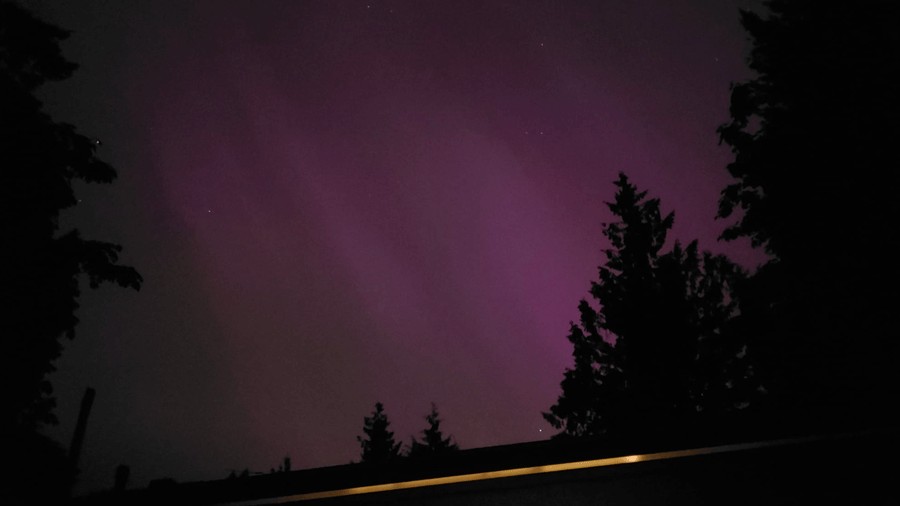
Fall through early spring offers the best odds for viewing the Northern Lights. Longer nights from late September through March mean more darkness, which increases your viewing window. (Summer auroras are possible but compete with short nights and lingering twilight.)
Alice Few, an outreach director with the Tacoma Astronomical Society, suggests heading out late when looking for the Northern Lights. “You will want the sky as dark as possible, so look up when astronomical twilight ends and use that as your starting target.” Prime “dark” time is typically 10 p.m. to 2 a.m.
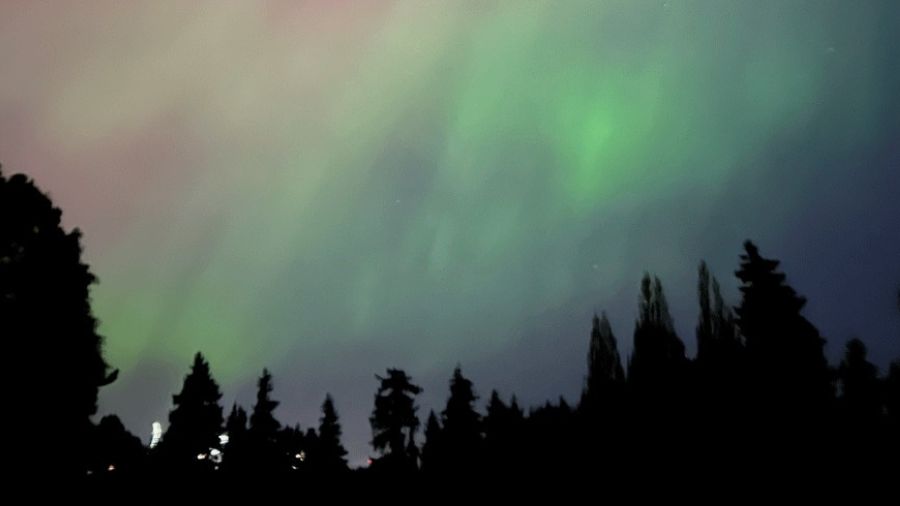
Few also reminded families that the aurora appears north of our latitude, “so a tall stand of trees could block your view,” she added. “Put yourself on the south side of a field, hopefully one without lights, and scan the northern sky.”
Cloud cover is another obstacle around Puget Sound. Even a strong geomagnetic storm will not shine through a thick layer of marine fog. So check the weather and avoid waterfronts where the fog might roll in.
Where to look
The biggest challenge in our region is light pollution. Hillary Stephens, the director of the Pierce College Science Dome, notes that Puget Sound and the I-5 corridor have significant light pollution. To improve your chances, she said, head away from city lights.
“We’ve been lucky enough to have some pretty strong auroral activity in the last couple of years because we are at the peak of the solar cycle. Some of the activity has been strong enough to see through the light pollution,” Stephens says. “Skies that are even just a little darker improve your chances, though.”
These spots can get you past the city’s light pollution:
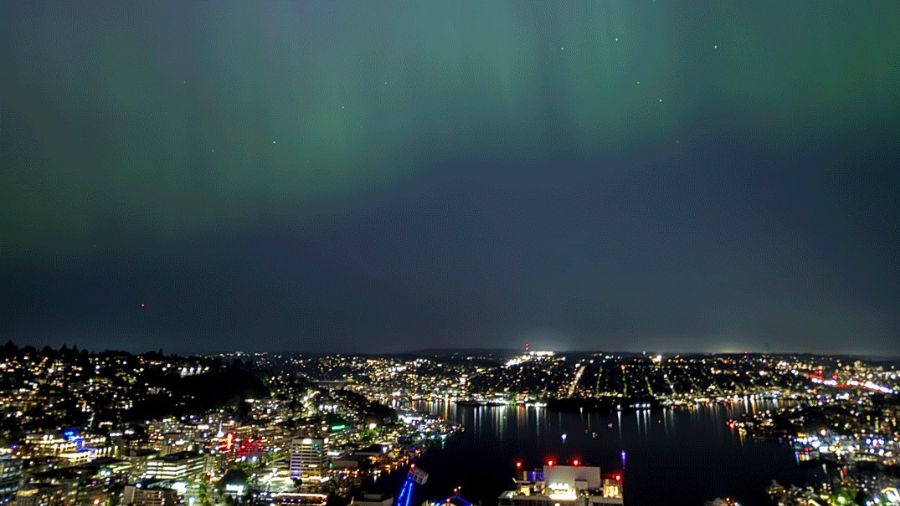
- From Seattle: Drive to the Olympic Mountains to secure some good low-light viewing. Seattleites have also found luck shooting the Northern Lights from Washington Park Arboretum over Union Bay, posting these photos; and another at the Golden Gardens Park, resulting in these photos.
- From Tacoma: Consider driving east past Orting or south past Yelm.
- From Gig Harbor: Head west toward Key Center. Skies that are even slightly darker can improve visibility.
- From Olympia: Head east toward Buckley instead of along the shoreline.
- From anywhere: Avoid areas close to airports and downtown.
If you travel at night to see the aurora:
- Dress for waiting. Even in spring and fall, nighttime temperatures drop quickly. Bring layers, hats and blankets. Consider hot cocoa in a thermos.
- Make it an adventure, not a guarantee. Plan a family stargazing outing with the aurora as a bonus possibility.
- Bring a star app to identify constellations. Look for planets. Count satellites. Then waiting for the aurora becomes part of the memory.
Eye science
No matter where you go, a little eye science knowledge helps how your mind perceives the night sky. With kids, set the scene by explaining that the aurora may look pale gray rather than a neon explosion of color due to:
- How human eyes perceive light
- Too much light outside
- Weaker solar wind events
If you’ve ever seen aurora photos that look electric green and then heard someone say it looked “kind of gray” in person, both can be true.
Our eyes use two types of cells: rods and cones. Rods help us see in low light, but mostly in black and white. Cones detect color, but need brighter light to activate. In dim conditions, we rely heavily on rods, which is why faint auroras may appear pale green or even whitish.
Eye tricks and tips:
- This is the one time when kids giving side-eye is actually okay. Encourage kids to look slightly to the side of faint features. Since the eye’s rod cells are more sensitive outside the center of vision, looking off to the side can help detect the aurora.
- Wait 20–30 minutes. When you’re outside at night waiting for the aurora, the rods in your eyeballs are doing most of the work. Arrive early to give yourselves 20 to 30 minutes for your eyes to fully adjust to the darkness, a process called dark adaptation. Once your rods are adapted to darkness, you can see more colors without a lot of light.
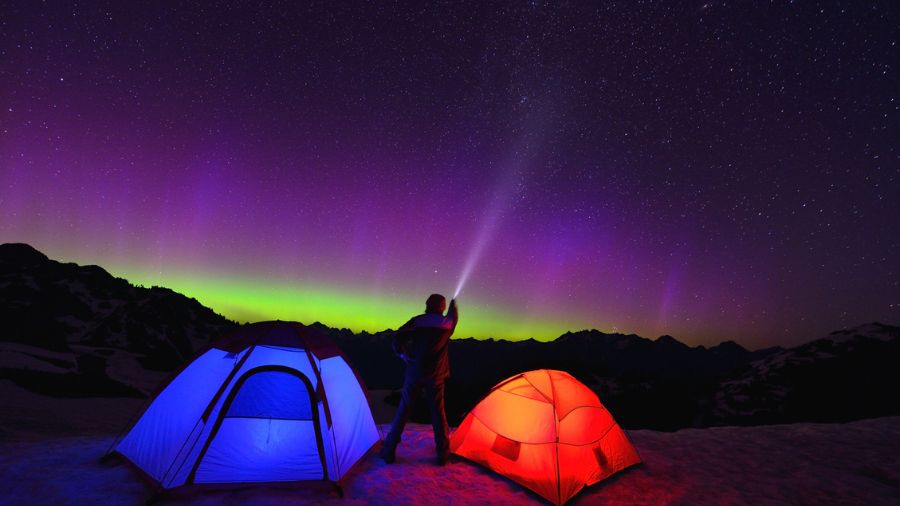
- Consider red light options. Flashlights when heading outdoors in the dark with kids may seem like a no-brainer. But for aurora-chasing, bright white light from a phone screen or flashlight “bleaches” the light-sensitive chemicals in your eye’s rods, resetting the dark adaptation process. Suddenly, faint stars and subtle aurora glow become much harder to see. Instead of white lights, consider hands-free headlamps with a red light setting. Red light helps preserve night vision, allowing your eyes to stay adapted to darkness so you’re more likely to spot a faint aurora. Don’t want to buy a new gadget? Try stretching a red balloon over the face of a flashlight, Few suggests, or placing a red piece of plastic over a phone screen “to protect your dark-adapted eyes.”
- Lower your phone’s brightness, but keep it powered on. Modern cameras, especially smartphones, are great ways to see the Northern Lights. They use long exposure or night mode to collect light over time and can capture colors that look more vivid than what we see with our eyes. That means you can see the Northern Lights better with a camera shot than with your eyes. Test it with this exercise:
- Direct your family to look at one spot in the sky with just their eyes.
- Then snap a pic of the same spot with your phone’s camera. (Be sure to prop your phone up on a stable surface or small tripod before taking the picture so shaky hands don’t blur the image.)
-
Check if there’s a difference!
“Cameras ‘see’ better than we do,” Few says. “Human eyes are not made for working in the dark. Our cameras and smartphone cameras do a much better job capturing faint light, so use them to help you and capture those beautiful dancing lights.”
Educational resources
There are plenty of ways to learn about the Northern Lights, whether or not you see them in person.
The Pierce College Science Dome offers “Aurora: Lights of Wonder,” a 30-minute live planetarium presentation plus video featuring real auroral footage. It takes place inside the planetarium’s 38-foot dome, with a 4K digital projection and 58 seats. Watch the trailer here. The next available showing is March 7, 2026.
The nonprofit State of Washington Tourism organization offers several dark-sky areas to stargaze, with many good spots to see auroras when space weather conditions are right.
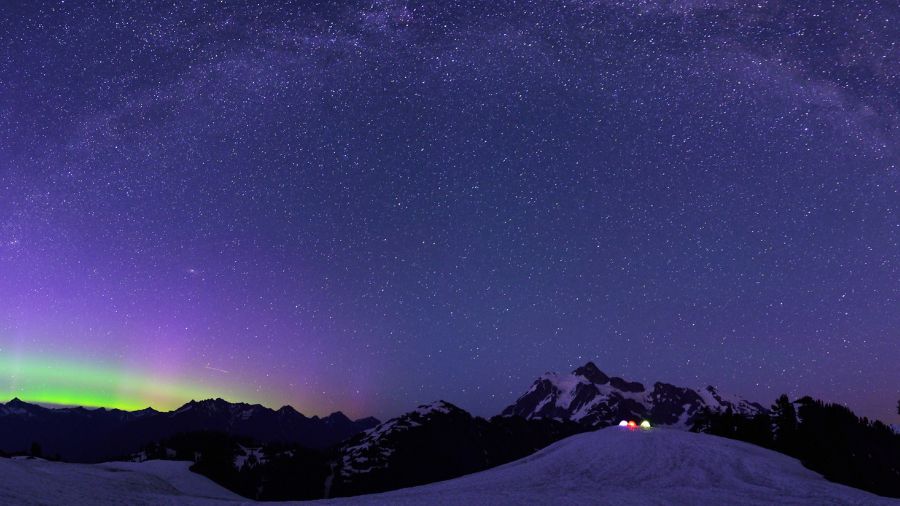
Seattle Astronomical Society and Pacific Science Center offer astronomy programming, which is aurora-adjacent. While observatories cannot guarantee an aurora sighting, they are excellent places for kids to build understanding and excitement around space elements.
PBS Kids also features a short video from its Molly of Denali cartoon segment titled “What Makes the Northern Lights?”
And if your kids learn best through crafts, this 20-minute project from PBS Kids details how to make window art of the Northern Lights using crayons and a cheese grater.
Apps and websites we rely on to track the Northern Lights
Several apps and websites provide real-time data (and even push notifications!) based on aurora tracking data:
- My Aurora Forecast
- Hello Aurora
- AuroraTrack
- Aurora Forecast Live Weather
- SpaceWeatherLive
- See the Aurora
You can assess sky darkness worldwide with the interactive Light Pollution Map, or find designated international dark-sky areas through Darksky.org.
Citizen scientists at NASA’s Aurorasaurus project track aurora sightings around the planet using volunteer reports to map the Northern and Southern Lights. The site sends out aurora alerts to people who sign up for them.
Northern Lights Facebook groups are another way to get real-time information from chasers on the ground about what’s going on. Aurora Borealis Washington State, for example, is a private group with more than 100,000 aurora enthusiasts and chasers.
The bottom line
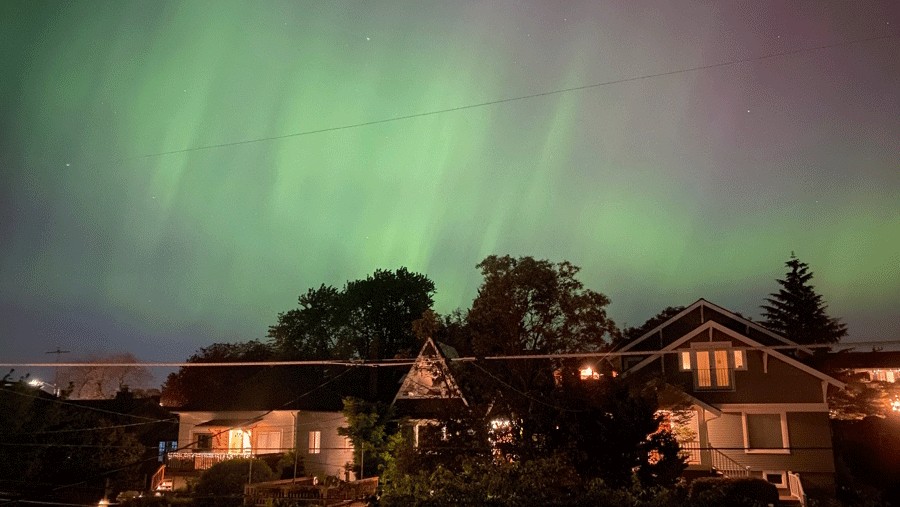
So … yes, you can see the Northern Lights from Washington, but it won’t happen all the time. And, yes, clouds and fog will probably try to ruin your plans more than once. But if you’re willing to check forecasts, drive beyond city lights and embrace a little unpredictability, you just might look up one night and see soft green curtains shifting above the northern horizon. And even if you don’t, you’ll at least have shared a quiet sky with your kids, and, perhaps, even spark a lifelong interest in space.
That alone is worth staying up past bedtime.
Aurora vocabulary for curious kids:
In order to make this experience even more educational for your family, I gathered these terms and simple definitions using online research, the U.S. National Oceanic and Atmospheric Administration and Merriam-Webster. Review them with your kids before you go out or once you’re in the field and you’ll soon be experts!
Aurora: Glowing light caused by energy from the sun interacting with Earth’s atmosphere.
Aurora borealis: The official name for the Northern Lights. “Borealis” means “northern.”
Aurora australis: The Southern Lights, seen near Antarctica. “Australis” means “southern.”
Solar wind: A stream of tiny charged particles that constantly flows from the sun out into space.
Magnetosphere: Earth’s invisible magnetic field that acts as a protective shield, deflecting from most of the sun’s charged particles.
Geomagnetic storm: Disturbances in Earth’s magnetic field from strong bursts of solar wind. Big storms mean more energy that can make auroras brighter and visible farther south.
Kp-index: A scale of 1 to 9 that scientists use to measure how strong a geomagnetic storm is. Higher numbers mean better chances of seeing the aurora.
Coronal mass ejection (CME): A massive explosion of magnetic energy and plasma from the sun. When one hits Earth, it can spark a strong aurora.
Coronal hole: An area on the sun where fast solar wind escapes into space.
Atmosphere: The layer of gases surrounding Earth. Auroras happen high up in the atmosphere.
Charged particles: Tiny bits of matter that carry electrical energy. The sun sends these toward Earth with solar wind. They cause gases to glow when they hit the Earth’s atmosphere.
Magnetic poles: Points near the top and bottom of Earth where the magnetic field is strongest. Auroras usually happen near these regions when the charged particles are pulled toward the poles.
Solar cycle: An approximately 11-year pattern of rising and falling solar activity. Auroras are more common during solar maximum.
Solar maximum: The peak of the solar cycle when the sun is most active.
Long exposure: A camera setting that collects light for several seconds, making faint auroras look brighter in photos.
Rods and cones: Special cells in your eyes. Rods help you see in the dark. Cones help you see color.