 Seattle Family Calendar
 Subscribe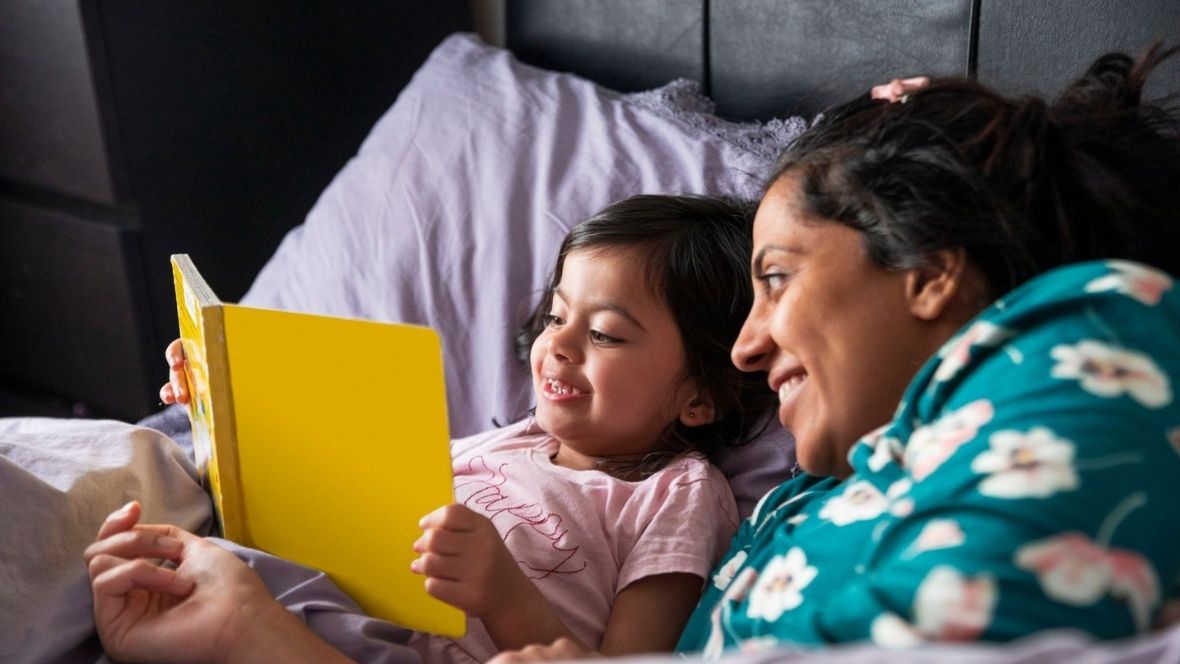

One of my favorite parts of being a parent is reading bedtime stories to my kids. Even though I’ve been doing it for about 18 years, I still relish snuggling with my youngest (she’s 7) to read each night.
Like many families, we’ve got our cherished favorites — books we can recite from memory. And while I love reading those over and over (and over) again, it’s always nice to add something different to our repertoire. So, if your nighttime reading routine needs an infusion of new books like mine does, choose a few from my list of favorites below.
I’ve organized this list by type (picture vs. chapter) and included suggested age ranges so parents can quickly find books that match their child’s reading level. I’ve also included a few read-aloud tips if you need them.
Why reading aloud to kids matters
As parents, we know that reading to our kids is important. Yet, recent research has shown a steady decline in the time kids spend reading over the past decade, with a myriad of contributing factors. Increases in screen time, busy family schedules and viewing reading as “more a subject to learn than a fun thing to do” are all part of the equation.
Despite this decline, carving out time to read for pleasure is important for kids’ development. Reading can improve academic performance, vocabulary and problem-solving skills. It can help kids develop empathy and keep them curious about the world around them. It’s also a boon to creativity. Plus, reading as a family provides a natural alternative to screen time and is an opportunity to bond with your kids.
So without further ado, here are some of my favorite read-alouds for kids of all ages.
Best picture books
“The Book That Almost Rhymed” by Omar Abed, illustrated by Hatem Aly
Ages: 3–6
Older siblings will feel seen in this book that chronicles the tale of an older brother who has written a magnificent story only to have it interrupted by his younger sister at every turn. Her zeal for “improving” his work and his tolerance for it are all too relatable to siblings at any age.
Why read it aloud? The humor of the interruptions really shines through with the help of a parent’s verbal comedic timing.
“We Are in a Book!” An Elephant and Piggie book by Mo Willems
Ages: 3–6
While I could easily include many Elephant and Piggie books on this list, this one is especially ripe for a read aloud. Elephant and Piggie break the fourth wall and encourage kids to come back for more in this one. It’s bananas (wink)!
Why read it aloud? There’s nothing funnier than a parent being told what to do by a character in a book, at least according to your kids — and Elephant and Piggie.
“A Place for Us” by James Ransome
Ages: 3–7
It may seem counterintuitive to include a wordless book on this list, but this recent release by Children’s Literature Legacy Award-winner James Ransome is too beautiful to miss. The story chronicles a day in the life of an unhoused mother and son with heart and honesty.
Why read it aloud? It’s an opportunity to discuss a difficult topic with kids, leaving room for questions, empathy and family values.
“The True Story of the Three Little Pigs” by Jon Scieszka, illustrated by Lane Smith
Ages: 3–7
They say every story has two sides. Jon Scieszka tackles alternative truth by retelling the classic children’s tale, The Three Little Pigs, from the Big Bad Wolf’s perspective. It’s a study in satire that will leave your kids wondering who’s being honest about the situation — the pigs, or the Wolf who was simply nursing a cold?
Why read it aloud? Satire is tough for kids to decipher. Reading this one to them helps kids understand the irony, humor and “truth” of the story.
“Double Trouble in Walla Walla” by Andrew Clements, illustrated by Salvatore Murdocca
Ages: 5–9
My 7-year-old can’t get enough of this super-duper silly story set in eastern Washington. Lulu’s accidentally opened up a double-trouble word warp and it’s contagious. Will she be able to contain it lickety-split, before it’s tick-tock, don’t-stop? If your kids get a kick out of this one, “Fox in Socks” has a similar twisty-truvey vibe.
Why read it aloud? Your kids will howl at this verbal romp that should only ever be read out loud.
Best chapter books
The Princess in Black series by Shannon and Dean Hale, illustrated by LeUyen Pham
Ages: 4–8
This series needs no introduction. It’s been a favorite for families since it debuted in 2015. Each book marries stories kids love with enough edge to appeal to parents too. There are currently 11 books in the series — and you can’t go wrong with any of them.
Why read them aloud? Much like ’60s “Batman” TV series, the princess’s killer moves are best read aloud for full effect.
The Goosebumps series by R.L. Stein
Ages: 8 and older
When I was a tween, Christopher Pike books were all the rage. Now, kids flock to the Goosebumps books like they do questionable TikTok trends. While we’re not always sure they should be reading them, they’re sometimes hard to avoid. So maybe we should just lean in and give them some guidance when they hit this stage.
Why read it aloud? These books live up to their name; reading them out loud may help kids have fewer nightmares.
“Firefly Hollow” by Alison McGhee, illustrated by Christopher Denise
Ages: 9–12
My family happened upon this book by chance, and I’m so glad we did. It’s the beautifully told tale of Firefly, Cricket, Vole and the Miniature Giant, Peter, who seem to find one another at just the right time. Friendship and loss is at the heart of their journey together. If your family hasn’t read “The Wild Robot” together yet, it’s another one that falls into the “beautifully told tale” category.
Why read it aloud? It’s an engaging story that will hold kids’ attention, and allow for discussions about issues kids may be facing.
“The Crossover” by Kwame Alexander
Ages: 9–12
Brothers Josh and Jordan Bell are at the center of this award-winning sports story told in verse. It’s surprisingly accessible, despite how it appears on the page. Follow it up with “Booked” (just in time for the World Cup to come to Seattle) and “Rebound,” and maybe plan to watch the TV series based on the book too.
Why read it aloud? Poetry should always be read out loud.
“A Long Walk to Water” by Linda Sue Park
Ages: 10 and older
Based on the true story of Salva Dut, one of the “lost boys” of Sudan, older kids will be fascinated by this story that weaves together two walks to water: The first for 11-year-old Salva and the second for Nya, also 11. Although the two are divided by time, their stories eventually intersect in a surprising way.
Why read it aloud? Another book with challenging topics and complex histories that will bring up lots of questions, it’s an opportunity for everyone in the family to share and learn together.
Tips for parents
- Set the stage. If you’re reading before bedtime, turn on a reading light and start to wind things down.
- Slow your reading pace. Reading with kids isn’t a race to the next chapter. Channel your inner Mr. Rogers and read at a pace kids can keep up with. This gives them space to process, make connections and think about what they’re reading.
- Be animated. Ever listen to a good audiobook? Bring that kind of energy to reading with your kids. Not too big, but definitely more than a quick read. Lean in on character voices and conveying tone to keep your kids engaged.
- Ask kids questions. Check-in to make sure they’re following the story (especially younger readers). Asking questions that relate to your family or child’s experiences supports comprehension and helps kids build their worldview.
- Run your finger under words. If you’ve got an emerging reader in the house, run your finger under the words as you read. It’ll help them follow along and enhance their reading skills too!
- Pause for pictures. Even in chapter books, let kids examine the pictures. Pictures help them visualize what they’re reading.
More great kids’ books to add to your list:
Editor’s note: This article contains affiliate links. If you purchase products through links on our site, ParentMap may earn an affiliate commission.