
 Seattle Family Calendar
 Subscribe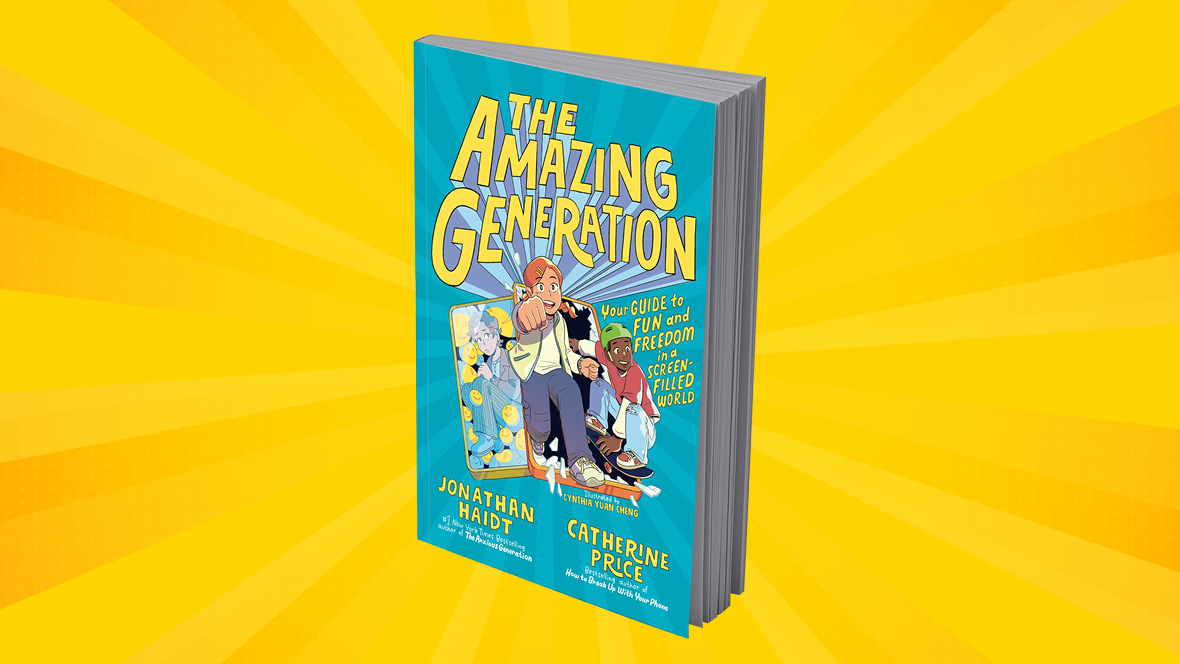

A parent recently told me that while standing at a crosswalk waiting for the light to change, his 4-year-old son pretended to pull out a smartphone and start scrolling. The dad was shocked; he and his wife were incredibly conscientious about their own technology use around their son, who has virtually no screen use at home. Yet this young boy was aware enough of the habits of those around him to know that “waiting at a red light” means “pull out your phone and scroll.”
It’s no surprise that people of all ages — adults, teens and children — are spending increasingly more time glued to devices, scrolling, scanning and swiping as the real world continues around us. The use of our phones to pass time, fill moments of boredom and distract or entertain us has become normalized, so much so that a cultural shift is both necessary and currently underway.
A kids guide inspired by ‘The Anxious Generation’
Enter Jonathan Haidt and Catherine Price’s new book for the middle-grade set, “The Amazing Generation: Your Guide to Fun and Freedom in a Screen-Filled World.” This new paperback (out Dec. 30) blends graphic novel storytelling with interactive challenges and clear explanations, offering a child-friendly approach to the serious issues covered in Haidt’s bestselling book for adults, “The Anxious Generation.”
In the new book, Haidt and Price seek to empower Generation Alpha (children born between 2013 and 2025) to become “rebels” who battle “greedy tech wizards.” These rebels live by these principles:
- Use technology as a tool; don’t let technology use you
- Fill your life with real friendship, freedom and fun
Not a kid problem
There is a lot of advice available for kids about how to better manage their screen use. As a former teacher, current parent of teens, author of my own book about parenting in the digital age and a frequent speaker on screens and social media, I object to the notion that if we simply teach children the “correct” way to handle screentime, we can limit or even eliminate addictive or problematic use. This misconception is why I find it helpful to replace the words “smartphone” or “social media” with “vape” or “cigarette”: “If we just teach children how to vape correctly, they will be fine.” Doesn’t work, does it?
This is why I was very happy to see that Haidt and Price do not hold back on pinning the problems of today’s technology on the tech companies and the “greedy wizards” that run them, blaming them for intentionally making their products addictive. The authors are absolutely correct here, and it is refreshing that these leaders in the fight to protect childhood lean so hard into this fact. This is indeed not a kid problem. It is an adult problem that is impacting children.
What this book does well
In fact, “The Amazing Generation” does a lot of things really well. It clearly names the harms of Big Tech, and it normalizes the fact that many children, even in middle school, do not have personal devices, a refreshing counter to the assumption that “all kids have these things now.” The graphic novel storyline, which runs alongside the written text, illustrates common social situations that arise when children have phones, including the anxiety caused by being recorded or posted without consent. It’s a useful counterpoint to the claim that kids without phones are the ones missing out.
Haidt and Price expertly explain the ways in which smartphones, social media and gaming apps are designed to be manipulative. They define terms like “algorithm” and explain in kid-friendly terms how these intentional design features prey on vulnerable brains by “brain hacking” dopamine feedback loops. One of my favorite moments in the book helps young readers see how the language we use around attention signals value: We “pay” attention. We “spend” time.
What teens actually took away from the book
Because this book was written for tweens and teens, I asked my 14-year-old daughter and her friend to read the book, too. Importantly, the friend said the book made her feel more empowered to be off her phone. (My 14-year-old is still without a smartphone; she’s the rare flip-phone teen who is handling things just fine!). Both girls also admitted that even though they don’t like it when adults set limits on screens (or don’t give them smartphones; sorry, daughter!), the book helped them see that for the most part, parents who set limits, say no or delay access are doing it for their longer-term health and well-being.

Both girls also really liked the quotes included throughout the book from slightly older teens and young adults reflecting back on their own experiences with the effects of tech on their lives. For example, one young person wrote that after not having her phone for a time at sleepaway camp, she felt much more rested and less anxious. These firsthand accounts provided powerful illustrations.
What this book is, and what it is not
Having spent years working at the intersection of children and technology, I approached this book with a critical eye. Within its intended scope, Haidt and Price do an excellent job addressing the realities Gen Alpha faces, and, as illustrated by my mini focus group, they have succeeded in creating a guide that feels empowering, hopeful and age-appropriate for young readers.
It’s also important to be clear about what this book is not. “The Amazing Generation” is written for tweens and teens, not for parents, educators or policymakers. Many of the broader structural critiques of Big Tech — including the role of adults in delaying access, regulating technology and challenging the spread of technology in schools — are thoroughly and forcefully addressed in Haidt’s earlier work, “The Anxious Generation,” which is squarely aimed at adults. Those discussions are largely outside the scope of this new book.
That said, parents and educators using “The Amazing Generation” should be careful not to treat it as a standalone solution. While Haidt and Price are clear about the manipulative goals of “greedy tech wizards,” some young readers may still come away feeling that the responsibility for resisting these forces rests primarily on themselves. Children can and should feel empowered, but we should be very clear that adults carry the bulk of the responsibility to change the conditions in which children are growing up, by delaying access to smartphones and social media, advocating for phone-free schools and meaningfully regulating Big Tech.
A shared rebellion
There is already a growing adult-led rebellion against the presence of school-issued technology in the daily lives of children. Also referred to as EdTech, this tech spans everything from 1:1 devices for children as young as 5 years old to the thousands of app-based learning platforms and digital curricula used by schools around the world. Haidt and Price reference the importance of not becoming distracted by screens when doing homework on a computer, but this presumes that children are benefiting from having computers for school in the first place. (For a complete analysis of why computers aren’t beneficial for learning, I highly recommend Jared Cooney Horvath’s new book, “The Digital Delusion: How Classroom Technology Harms Our Kids’ Learning – And How To Help Them Thrive Again.”)
“The Amazing Generation” also misses an opportunity to connect the argument that smartphones, social media and gaming apps are bad for young people with the fact that the very same companies that make them also make the very same products for schools, but brand them as “educational.” (To see one illustration of this, read about a lawsuit against Google, Google Classroom and YouTube, which is owned by Google.) Haidt and Price also acknowledge that YouTube is technically a social media platform; I wish they had gone a step further to assert that it also has no place being accessible to children on school-issued devices.
As bans on phones in schools sweep the nation, adults must recognize how confusing it is to say to children, “Do not bring your personal smartphone to school,” but then hand them an internet-connected device in the name of “learning” and tell them to “use it responsibly.” EdTech is Big Tech and resisting the onslaught of it and the emerging slew of GenAI products in schools is the next battle facing those who would protect the minds, health and privacy of Gen Alpha.
“The Amazing Generation” works best when it is paired with “The Anxious Generation” and adult action: delaying access to smartphones and social media, advocating for phone-free schools and questioning the unchecked expansion of EdTech. This book can spark awareness, confidence and even change in young people. But young people cannot, and should not, carry the full weight of the rebellion on their own.