 Seattle Family Calendar
 Subscribe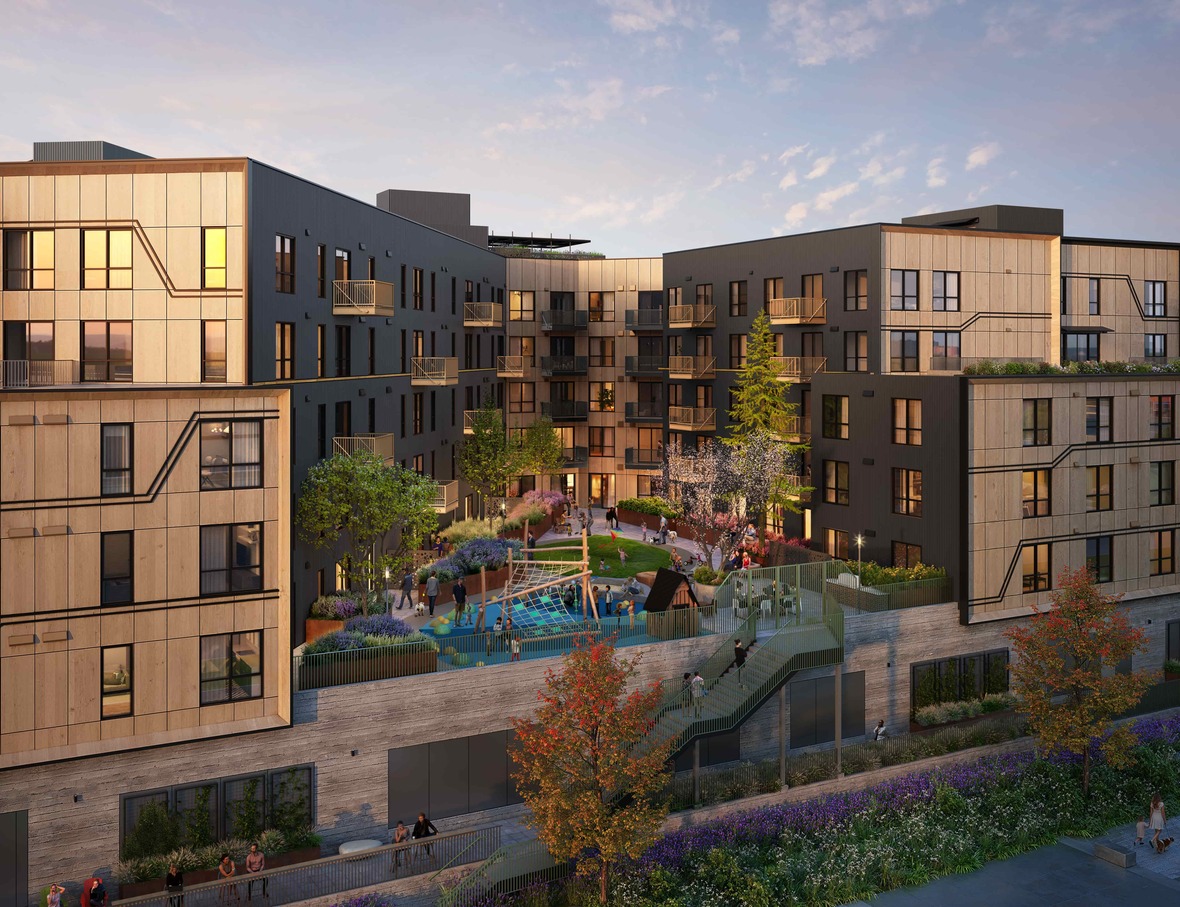

Editor’s note: This article was sponsored by AMLI Redmond Way.
Finding a home in the Puget Sound region can be a frustrating exercise, especially for families with young children. Many renters can’t afford to buy a house or are not ready to commit to a mortgage. The right neighborhood is too expensive, the affordable one is too far from work, and anything with enough bedrooms simply doesn’t exist. It feels like you have to choose between living in the city and having a family.
But signs of hope are emerging. In recent years, a handful of larger, three-bedroom apartments have been appearing in new apartment buildings. A new development with 375 apartments is putting families at the center of its plans. AMLI Redmond Way opens in January and consists of two buildings located just steps from the Downtown Redmond light rail station. The project’s East Building contains dozens of apartments with multiple bedrooms and amenities designed around the needs of families with young children — right down to toilets with built-in training seats.
In Seattle, zoning policies privileged single-family neighborhoods until very recently. A regional population boom in the 2010s (on a scale not seen since the Gold Rush) led to an explosion in new multifamily construction. In keeping with the demographics of the new residents — unmarried millennials with college degrees and tech jobs — those new buildings prioritized smaller apartments and studios. They were more likely to provide a hot tub than a playground.
When those single professionals got married and wanted to start a family, they found their options limited in both design and price — especially if they didn’t crave trading their urban lifestyle for the distant suburbs. Aside from a handful of three-story walk-up apartments built in the 1980s and ‘90s, there simply wasn’t any urban multifamily housing for actual families.
Studies have started to document the shortage of housing for families with young children.
“I’ve lived it,” says Matt Elley, senior vice president of development at AMLI Development. Elley is the father of two boys, ages 8 and 11. He spent years crammed into one of those old fourplexes before buying a single-family home. Even after he and his family moved out of the rental market, he knew that the need for family-friendly rental housing would only grow as the thousands of millennials who had moved to Seattle in the 2010s started their families.
“We’re going to have to revert to more dense living. There’s just a certain number of people that want the vibrancy of the city,” says Elley. “People are used to living in urban environments when they were younger and single, and they like the walkable neighborhoods, the convenient access to cultural and dining options.” The desire for a family doesn’t necessarily equate to a desire to spend your free time commuting long distances to a job, mowing a lawn, cleaning gutters and clearing leaves from the driveway.
AMLI Redmond Way is becoming the test case for a new brand of urban family housing. The Redmond Central Connector Eastrail trail, Redmond Town Center and Redmond Elementary School are all within a short walk of its two buildings. While the West Building follows the script for new luxury apartments, the East Building is more family-focused, and Elley drew on his own experience living with small children in an apartment to ensure the floor plans and amenities make life easier for parents.
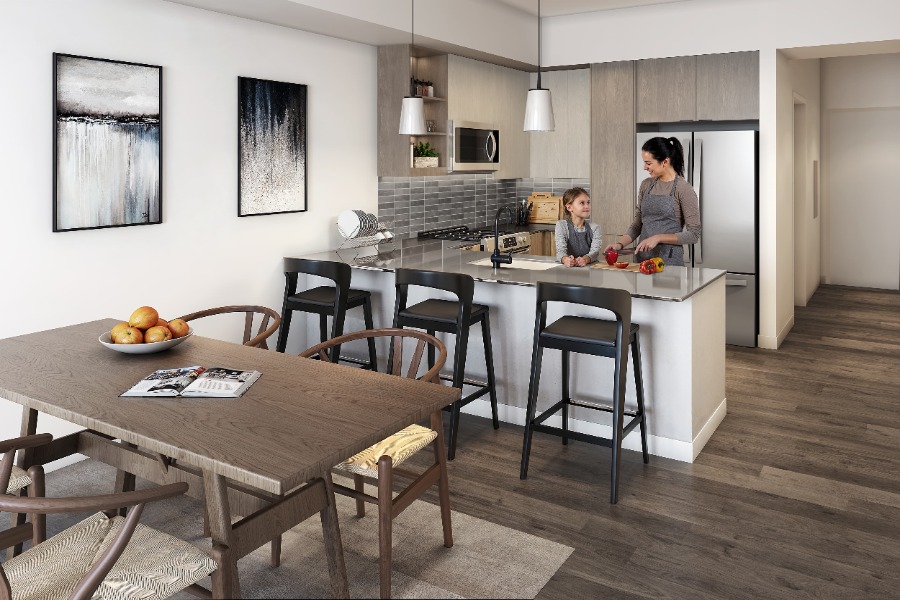
Featuring larger primary bedrooms and smaller kids’ bedrooms, there are a variety of floorplans for families of different sizes, ranging from one bedroom with a den (some windowless that are compatible with infant sleep) up to three-bedroom, two-bathroom units of 1,600 square feet (comparable to many of the post-war cottages on Seattle’s rental market). Every unit has a bathtub, large closets, and most have a mudroom-style entryway or laundry room for shedding coats and storing strollers. A few choice units have patios that directly access a courtyard with an outdoor play structure.
“I think of two different types of amenities, one being social amenities and one meeting daily living needs, the functional amenities,” says Elley. The outdoor playground is one of those social amenities. In consideration of the Northwest’s climate, it is accessed through a large indoor playroom with a castle, tricycles, blocks and a slide. The playroom is attached to a reservable event space that’s perfect for birthday parties, as well as a couple of workstations and a secondary fitness studio (there’s a larger one in the other building) where parents can work or exercise while keeping an eye on their children.
On the rooftop, there’s another community space with synthetic grass, a playhouse, tetherball, barbecues and fire pits by a lounge area. Raised beds can be reserved for P-Patch-style gardening. Older kids and adults will both enjoy the karaoke room with gaming tables and a soundproof jam space where bands can rehearse, or kids can practice their instrument during a sibling’s naptime.
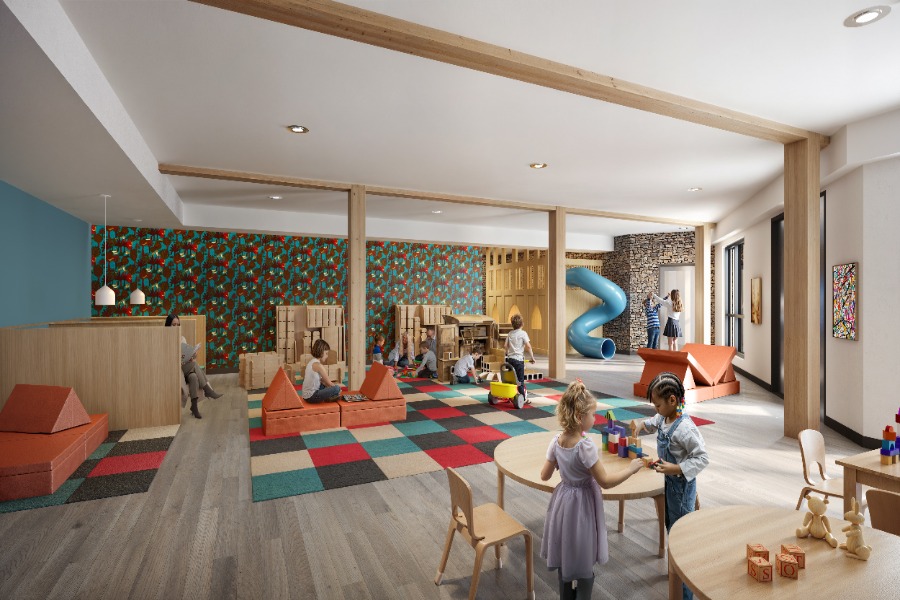
“The playroom and those areas that bring kids together, I think those social amenities will actually get more use by families than some amenities in our typical apartment buildings that don’t get as much use,” says Elley.
Many people can’t imagine having a family without a family dog — which can be a major obstacle when you’re renting.
“We’re pet-friendly,” assures Elley. “I think that makes a big difference for a lot of people.”
There’s a small dog run connected to the building for late-night potty breaks and there are facilities for dog washing and grooming, so you don’t clog your bathtub with pet hair.
The development is still under construction, so pricing is not finalized yet. But with the average home price in Redmond falling between $1.3 and $1.4 million, these apartments will be less than half the cost of buying a home nearby. Apartment living also offers cost savings in the form of reduced utility bills, negligible repair and maintenance costs, and keeping only one car instead of two, or even going car-free.
“We found in general, people living in transit-oriented apartments like having a car for errands and weekend trips. But if they can let it sit while they commute to work, they will. We’re 400 feet from the light rail stop and in 10 minutes you can be at the Microsoft campus and 20 minutes into Bellevue. So, if one parent is commuting via light rail and then the car’s available for dealing with the kid. There’s just a lot of efficiencies,” says Elley.
Our region is always growing and changing, and local priorities might be changing, too. It’s only one building, but it might be the start of a shift towards a more livable, family-friendly Puget Sound community.
Sponsored by: