 Seattle Family Calendar
 Subscribe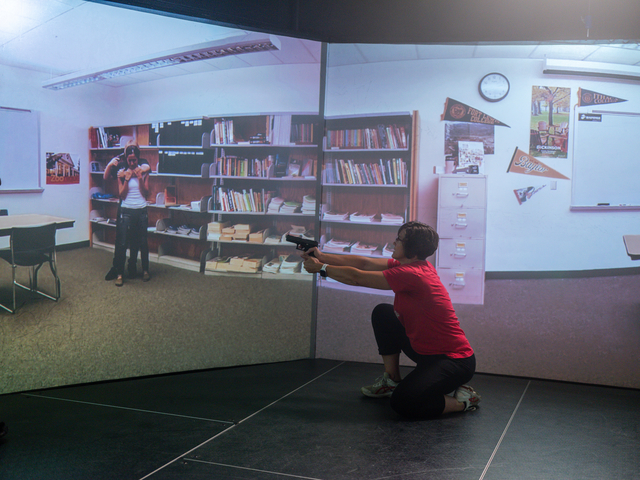

Do you ever read about a movie tackling an important issue — like racism, climate change, ultra-processed foods — and think “I should watch this,” only to guiltily move on? Instead, you watch a rom-com, because you don’t have the emotional bandwidth to take in one more scary story about powerful forces threatening your kids’ future.
You may feel that way about “Thoughts and Prayers,” the recently released HBO documentary that puts the school-shooter industry under the microscope. Whether you decide to watch it or simply read on, it is important to know that billions of taxpayer dollars are now being spent to prepare for the next school shooting. But learning about how that money is being used is not for the faint-hearted.
The documentary opens not with policy debates or expert commentary, but with demonstrations of disquieting products designed for a single purpose: preparing children and teachers for an active shooter. A small quadrupedal robot meant to distract an attacker resembles the All-Terrain Armored Transporters (ATATs to fans) from “Star Wars” (yes, I looked it up). Bullet-proof classroom tables that flip and roll into duck-and-cover mode. Metal wall art that can be ripped down and used as shields. Bullet-resistant skateboards are marketed as defensive gear because, though narrow, they protect vital organs. New-fangled, bullet-proof backpacks are advertised, but students speaking to camera explain that if necessary, metal water bottles can always be hurled as weapons.
The filmmakers never overtly editorialize, yet the point lands. Why are we investing so heavily in preparation for mass-casualty events instead of addressing the root causes of gun violence? (My answer — it’s easier and lobbyists and marketers profit from fear). As surviving students have said repeatedly after school shootings, they want more than “thoughts and prayers.”
Why are we investing so heavily in preparation for mass-casualty events instead of addressing the root causes of gun violence?
These products are aimed squarely at frightened parents and communities, and many have been rolled out with virtually no research demonstrating their effectiveness. Meanwhile, a $3 billion school-based “active-shooter preparedness” industry had emerged to meet and stoke these fears.
Today, roughly 95 percent of American schools conduct lockdown drills, many of which teach children how to hide, barricade, distract, or defend themselves. At one point, a vendor whose company profits from these trainings states flatly, “Every tragedy benefits my family.” The remark is shocking not because it is rare, but because it so clearly reveals the economic incentives behind the enterprise.
Today, roughly 95 percent of American schools conduct lockdown drills, many of which teach children how to hide, barricade, distract or defend themselves.
The film follows large-scale simulations in which adhesive, blood-soaked prosthetics — mass-produced and packaged as “wounds in a box” — are affixed to volunteers’ bodies. Teachers, students and community members participate in sprawling drills run largely by former special-operations or military personnel. They are instructed to wail, cry out and scream as part of the training.
Language is drawn directly from combat culture: “You don’t want to be a baby bird; you need to become a hawk.” In one scene, students cheer as a classmate beats a rubberized manikin with a bat until it collapses.
As a child psychologist, this is where alarm bells ring. I found myself wondering about the psychological impact of these trainings on children. A preschool teacher explains that she avoids the word “shooter,” instead telling children they must run from a “dinosaur.” To adults, this may sound gentle and protective. From a developmental perspective, however, the line between fantasy and reality is already blurry for toddlers, and such substitutions are likely to increase confusion and insecurity rather than safety. One trainer even claims children “enjoy” the drills because they are “adrenalizing.”
Adrenaline is not resilience. Brief excitement for teens participating in a school program tells us nothing about what it costs for those who internalize the idea that mass violence is inevitable — or whether these drills make them safer at all.
The worldview driving these trainings becomes explicit when a former special operations instructor asserts that the “average base-level human is violent, superstitious and savage.” This is not merely emergency preparedness; it is a grim theory of human nature being conveyed.
Participating in a school program tells us nothing about what it costs for those who internalize the idea that mass violence is inevitable — or whether these drills make them safer at all.
Notably, “Thoughts and Prayers” includes no expert commentary on why the United States experiences so many school shootings. There is no discussion of prevention, mental-health infrastructure or gun policy. This omission appears to be a deliberate choice by the filmmakers. Depending on one’s perspective, that focus may feel like either a strength or a limitation. What the film makes unmistakably clear, however, is that enormous energy and money are being devoted to managing the symptoms of violence while its causes remain largely unexamined.
The United States has experienced roughly 57 times as many school shootings as all other major industrialized nations combined. This disparity is often attributed to systemic factors, including high civilian gun ownership rates and prolonged political impasse that has slowed the adoption of evidence-based reforms implemented in other countries. Rather than grappling with these realities, “Thoughts and Prayers” documents how far we are willing to go to normalize catastrophe.
If this trajectory feels familiar, it should.
American schools have repeatedly adopted programs intended to “protect kids” that sounded intuitively right but later proved ineffective, or even harmful. The Just Say No drug campaign of the 1980s promised that refusal alone could prevent substance use. The D.A.R.E. program put police officers in classrooms to teach children to resist drugs. Early good touch/bad touch curricula to prevent child sexual abuse were rolled out rapidly in the wake of public panic about day care safety.
Each relied heavily on what researchers call face validity — the reassuring idea that a program works because it sounds like it should. Only later did evaluation research show that D.A.R.E. produced little lasting reduction in substance use, that simplistic refusal-based messaging could shame or backfire for vulnerable youth and that some child-safety curricula were developmentally confusing or shifted responsibility onto children rather than adults and systems.
The logic behind all of these reactions is always the same: This is an emergency. We don’t have time for research. We have to protect our children now. That emotionally powerful reasoning has repeatedly allowed industries to take hold before evidence catches up. We saw it with smartphones and social media before their links to anxiety, sleep disruption and attention problems were widely understood. We are now seeing it again with AI companions marketed to children and teens. “Thoughts and Prayers” suggests we may be repeating this pattern once more, this time in the name of school safety.
The film’s most poignant moment for me comes when a pair of middle-school siblings speak quietly to the camera. The sister explains that she worries constantly, that she feels she has to “think like an adult” about school shootings, comparing them to hurricanes and tornadoes. These, of course, are not natural disasters, yet children are increasingly encouraged to treat them as such. She describes carrying a pound of items in her backpack every day to help herself or others if a school shooting happens. Her brother begins to cry; he didn’t realize how frightened she was.
She says people care more about their right to own guns than about kids. “People don’t listen to kids,” she tells us.
Maybe it is time we do.