
 Seattle Family Calendar
 Subscribe

Ask any working parent and they will tell you that child care is expensive, especially in large cities like Seattle. Depending on the type of care families choose, whether it’s center-based child care, a cooperative program or a nanny, costs can vary significantly. Understanding those costs and what they mean for families can be confusing.
Crunch Care, a national child-care staffing and placement company, released its “The State of the Domestic Hiring” report last week. The report analyzes factors affecting nanny wages in high-demand markets like Seattle.
According to the report, costs for a nanny in Greater Seattle fell on the higher end of the spectrum: between $32–$45 per hour, and is comparable to other coastal cities like New York City and San Francisco, which average $30–$50. Portland, Oregon fell just below Seattle’s average at $28–$38 per hour.
Diana Clemons, a Seattle parent and founder of Shortlist, a child-care finding tool, made it her mission to uncover neighborhood-level data for more than 100 daycare providers across Greater Seattle. Shortlist also provides similar data on providers in Chicago, Denver, Kansas City, Charlotte and Austin.
“I realized there was no one place that pulled it all together,” Clemons says about creating Shortlist after her move to Seattle. “The cost data specifically came from a frustration with how child care is priced. Every provider publishes a monthly tuition number, but that number is meaningless for comparison.”
Seattle child care cost by neighborhood
Clemons analyzed 105 child care providers across 33 neighborhoods in the Seattle area and published her findings. The data collected comes from provider websites, state licensing records and direct provider outreach — everything is publicly available.
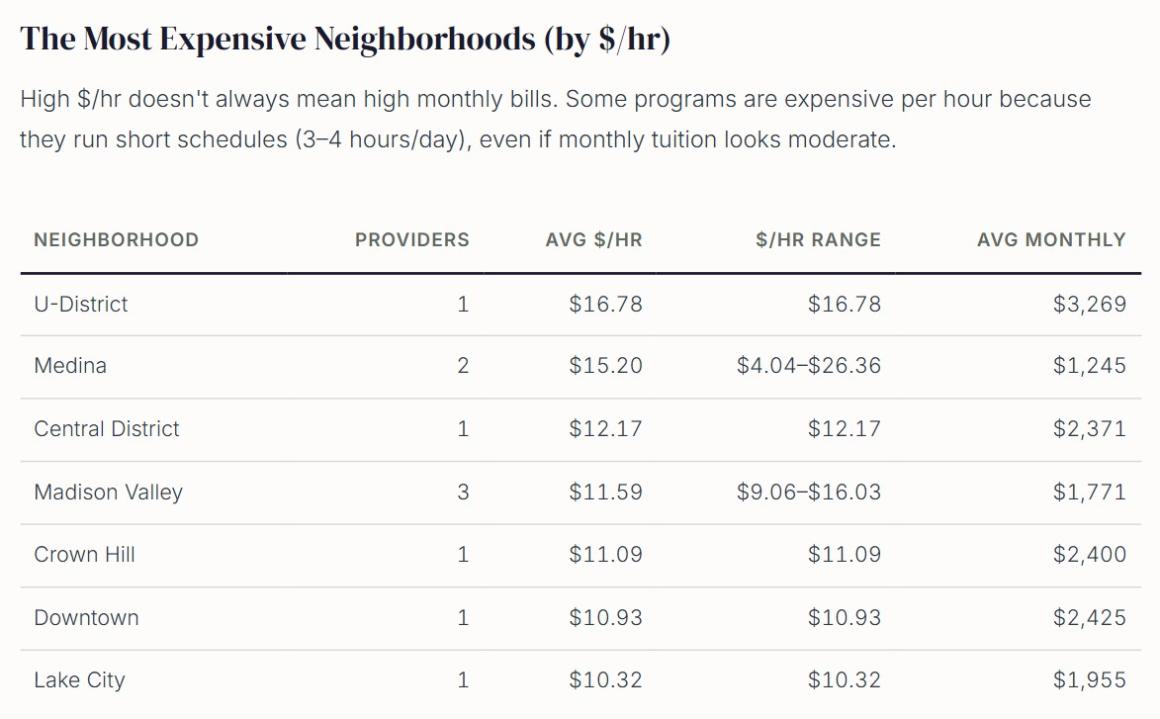
Findings from Clemons’ report, “What Childcare Costs Per Hour in Seattle”
Her research indicates that child care costs ranged from as low as $1.88 per hour, at the White Center Co-Op, to as high as $26.36 per hour at the St. Thomas School, a private school in Medina.
Care providers on the Eastside are broken out in the report as well. “The Eastside suburbs — Bellevue, Kirkland, Redmond — are 15 to 20 percent cheaper than Seattle-proper’s most expensive neighborhoods, which surprises most families moving east,” says Clemons.
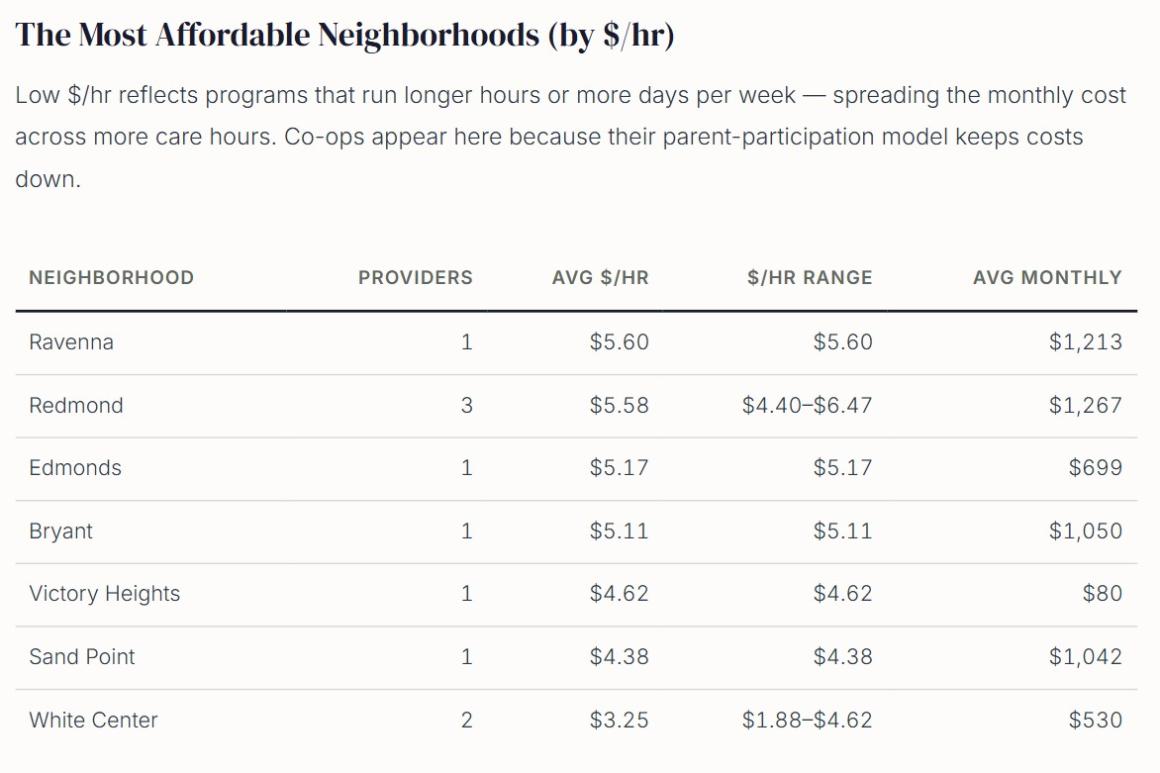
Findings from Clemons’ report, “What Childcare Costs Per Hour in Seattle”
“About 80 percent of providers fall between $4 and $12 per hour,” Clemons explains. “The outliers on the high end are part-time programs where short schedules push up the hourly cost, even when monthly tuition looks moderate.”
What’s driving rates?
When it comes to analyzing child care costs, there are external factors to consider. According to the Crunch Care report, the hourly rates for nannies reflect more than the standard of child care. They often include additional work many families rely on nannies to take on, such as completing household tasks like meal preparation, cleaning and family logistics. Additionally, with the rise of everyday emergencies, many individuals seek out caretakers on short notice, and rates for this service typically start around $45 per hour.
Factors such as parent participation, curriculum, operational costs and location can also affect child care pricing.
At the end of the day, Clemons wants parents to understand that monthly tuition can be deeply misleading in many cases and it’s important to look at the numbers. “The range we found in Seattle is under $2 to over $26 per hour — and that’s not counting the co-ops where parents contribute labor in lieu of tuition,” she says.
Why it matters to parents
The cost of child care has continued to increase nationally and in Puget Sound, according to a recent report by Child Care Aware of America, a nonprofit that’s mission is to ensure every family in the U.S. has access to a high-quality, affordable child care system.
The report found that “the average annual price of child care for two children in a center exceeded annual mortgage payments” in 45 states and it “exceeded the median annual rent payments by 19 percent to over 100 percent” in 49 states.
In Washington state, 2026 child care cost projections predict the average annual cost of center-based child care will be 18 percent of a single parent’s median income ($86,588) or 11 percent of a family’s median income ($139,828), according to a recent report.
Resources to help pay for child care
- Washington State Department of Child, Youth and Families: Families may qualify for free or reduced cost child care through the Working Connections Child Care subsidy program
- Early Childhood Education and Assistance Program (ECAP): State-funded early childhood education program for children 3 and older, for qualifying families
- Seattle Child Care Assistance Program: Provides child care assistance for children living in Seattle, from ages 1 month to 13 years
- BrightSpark: Assistance finding affordable child care options in Greater Seattle