
 Seattle Family Calendar
 Subscribe

Divorce is hard, as anyone who’s gone through one can tell you. What’s less expected is the litany of paperwork — from drafting parenting plans to changing last names. (Which is like Whac-a-Mole; just when you think you’ve caught every bank card and email address — wham! There’s your old surname again.) Some days it can feel like drowning in logistics as much as an emotional rollercoaster.
So, emergency planning might not be top of mind for divorcing parents — but doing so early can help smooth out future bad days.
What does disaster prep look like if parents live apart? Not so different from families under one roof, said Karen Bonnell, a divorce and co-parent coach and the author of “The Co-Parents’ Handbook” and “The Stepfamily Handbook.”
“In many ways, one-home families, where parents work away from home, face the exact same challenges,” she says. “If one parent is in downtown Seattle and the other is working in a school on the Eastside, they could be separated for days!”
Another parallel? “Emergencies will bring parents together faster than anything else.”
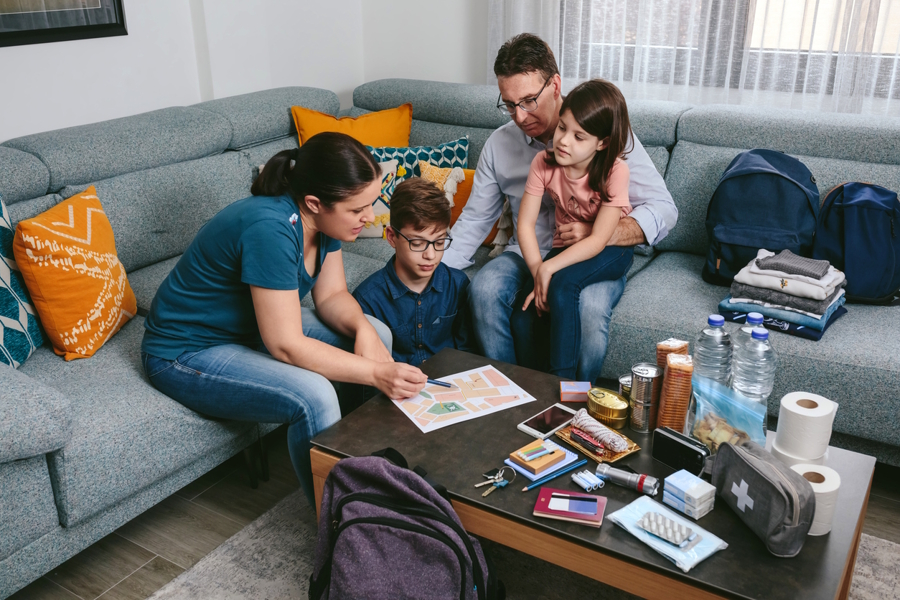
Preparing for emergencies across two households
Here are some best practices that Bonnell suggests for co-parents.
- Identify mutual out-of-state contacts. Depending on how messy your divorce was, this might be easier said than done — but think of it as a lifeline if local cell service is spotty. “Whatever the situation is, the parents can hopefully identify two people outside the area that they will contact in the case of a natural disaster — both designated people understand that their job is to serve as a conduit to both parents and information sharing. Keep it simple — because Wi-Fi and cell service may be difficult.”
- Have emergency backpacks ready. “I rarely have healthy parents who aren’t actually willing to make sure there’s adequate access to water and medications readied as needed. This includes emergency blankets, and so forth, when traveling over Snoqualmie Pass.” The Red Cross identifies this list of 10 essentials for car travel. “Sometimes a parent simply needs to have support to know what’s needed and why,” according to Bonnell.
- Point to authorities — and step back. While guidance may be necessary, nobody likes a know-it-all. “That information is rarely welcomed from a co-parent. So, when possible, the pediatrician, a co-parenting coach, even a website, is more likely a better source of ‘what to do’ than a co-parent if the receiving parent experiences them as controlling, insulting or overstepping boundaries.”

- Be generous. “This is a time for trusting in the best of your co-parent,” writes Bonnell. “There may be a period of time when contacting the children may not be possible by the off-duty parent. Stress and emergency management are key.”
- Stick to the schedule. It’s natural to want to hug your kiddos after an emergency or natural disaster. But if showing up unannounced at your ex’s front doorstep could incite a fight, rethink it. “If a visit from a non-residential parent only serves to dysregulate children, increase tension, cause acting out on the part of parents — don’t do it,” she advises. “Wait until a return to the regular daily schedule is possible.”
- Ask stepparents to step aside, for now. “In the case of a true emergency, parents must realize that their child(ren) is the focus. Period. If a child is in the emergency room or admitted to a hospital, please ask stepparents to wait outside unless agreed upon by both parents. … Prayers and care can be heard and felt from home or the waiting room. Once the emergency is over, then planned-for visits by others should be allowed.”
- Get a professional involved, if needed. “Many parents find the ‘safety standards’ in two-home family life are much lower than they would like,” says Bonnell — well beyond the scope of emergency planning. “Locking up narcotics, guns, cannabis gummies, pornography is ideally dealt with in the parenting plan — if those are issues that need to be addressed. … You can’t legislate ‘healthy parenting’ or ‘good judgment.’ A co-parenting coach or parenting coordinator can sometimes be a useful or necessary intervention to make changes that are true safety issues.”
- Leverage your parenting plan. For couples in the midst of splitting up, plan ahead. You can use your divorce as a forcing function to hash out the logistics for your emergency plan in advance.

What does the law require?
As for what is legally required, Washington state law already has built-in provisions for co-parents handling emergencies, so it’s not necessary to write these contingencies yourself. According to the Revised Code of Washington (RCW) 26.09.184: “Regardless of the allocation of decision-making in the parenting plan, either parent may make emergency decisions affecting the health or safety of the child.”
The Elise Buie Family Law Group explains it this way: “The law already grants each parent the right to make day-to-day decisions when the child is in their care. This includes emergency situations, unless the parenting plan states otherwise.”
That said, an extra dose of clarity never hurt anyone. It’s better to pin down the details when your tempers are calm and your thinking is clear. “Spelling out what should happen in an emergency can avoid confusion or conflict during a time when every minute counts,” writes the law group.
The language in a parenting plan can be simple, “even a few sentences on what to do in the event of an unexpected situation can help keep a child safe.” This is especially important if a family member has health issues, parents live far away from each other or their communication is limited or contentious.
“So no, it’s not legally necessary, but, given a family’s dynamics, it might still be worth including for peace of mind and smoother co-parenting during and after an emergency.”
At the end of the day, emergencies are stressful enough without added confusion. Taking a little time now to plan, communicate and cover the basics can make a huge difference for you, your co-parent and your kids. And once you’ve got a plan in place, you can breathe easier knowing you’re all ready for whatever life throws your way.
Emergency planning steps and resources to explore today:
- Download an earthquake early warning app. Try MyShake, an app built by University of California Berkeley seismologists and engineers, and expanded to include Washington state in 2022.
- Safety-proof where you sleep. Do you have heavy objects or artwork above your bed? Find another place to display them.
- Print out a checklist. Try one from FEMA, the Red Cross or Ready.gov.
- Explore a resource about general emergency prep:
- MakeItThrough.org
- Ready.gov/plan
- King County’s Office of Emergency Management webinars
- NPR’s Life Kit
- Learn how to prepare for two likely Pacific Northwest emergencies: an earthquake or a tsunami:
- “Get Ready! How to Prepare for and Stay Safe After a Pacific Northwest Earthquake” by Deb Moller.
- U.S. Tsunami warning system
- Tsunami information page from Emergency Management Division
Editor’s note: This article contains affiliate links. If you purchase products through links on our site, ParentMap may earn an affiliate commission.