 Seattle Family Calendar
 Subscribe

When it comes to medical care, children aren’t little adults.
“Kids are different and hospitals should be, too,” says Kendal Kemery, a spokesperson for Mary Bridge Children’s Hospital in Tacoma. “That’s why it’s so important to have a hospital set up to take care of kids.”
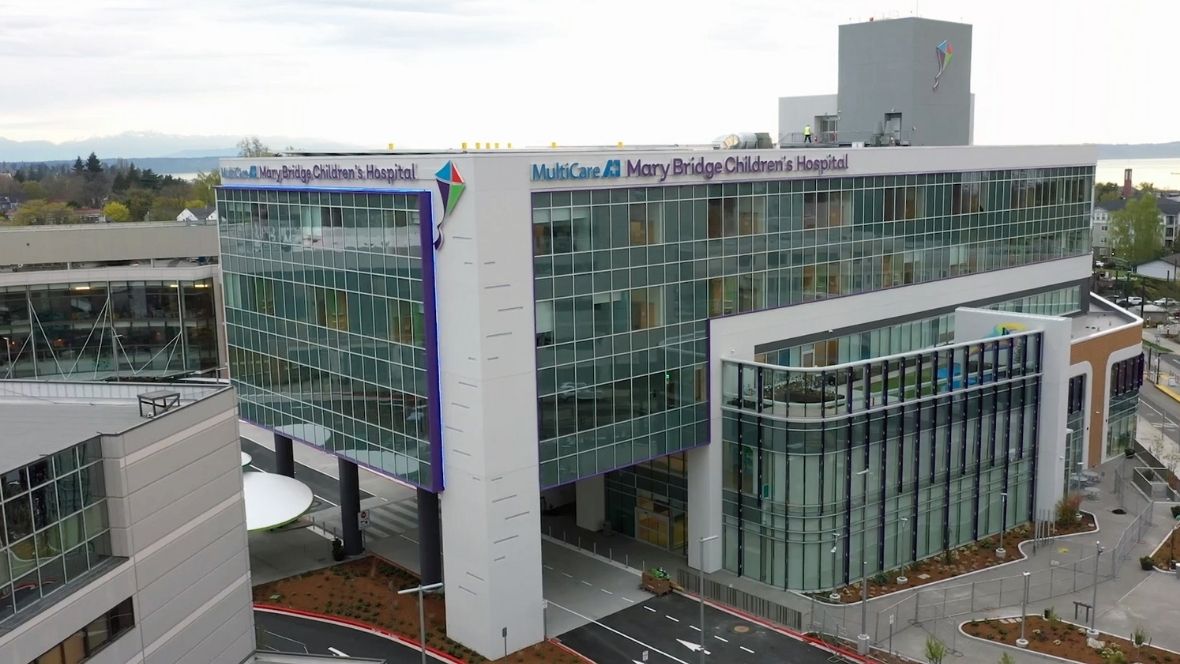
Mary Bridge opened its 82-bed children’s hospital, the centerpiece of a $500 million investment that expands pediatric capacity in the Tacoma area and beyond, on May 16. The new facility offers additional resources in areas like pediatric surgery, behavioral health and neonatal care. With 250 new jobs, the effort also boosts the area’s supply of medical specialists geared toward the region’s youngest patients.
The just-opened modern complex houses eight operating rooms, a pediatric intensive care unit, an infusion center, and an interventional cardiology and radiology suite. The pediatric Emergency Department contains 38 treatment rooms as well as a mental health crisis stabilization unit.
“We will care for the smallest baby that’s born premature to the adolescent with specialized equipment, training and talent we can centralize in one awesome facility,” says Jeff Poltawsky, the President and Market Leader of Mary Bridge Children’s Hospital & Health Network.
Culmination of a long journey
While the six-story tower and expanded outpatient center are new, Mary Bridge Children’s Hospital has supported Tacoma for 70 years. The original 1955 facility existed as a standalone building. As it grew, the children’s hospital integrated with Tacoma General Hospital in the 1980s.
Over the years, sharing equipment and waiting rooms between children and adult patients posed logistical challenges.
“You’re mixing the populations and trying to serve both the best you can,” Poltawsky explains.
The idea of returning to the stand-alone roots made sense, especially in a region with growing medical demand. The timing, though, proved to be tricky. The health system embarked on the design process just before the COVID-19 pandemic. Supply chain shortages drove up construction prices, and the initial bid came in well over budget. The team regrouped and went back to the drawing board.
“It added a year, but we weathered the COVID storm and got a beautiful space where every square foot is dedicated to infants, children, and adolescents,” Poltawsky says.
The evolution from shared spaces to a specialized environment is well worth the effort. The child focus dramatically transforms a patients’ experiences, he said, pointing to the example of imaging. In the current space, children share equipment and waiting rooms with adults. Helping a child or infant through adult-oriented medical equipment like an MRI can prove time-consuming and require sedation.
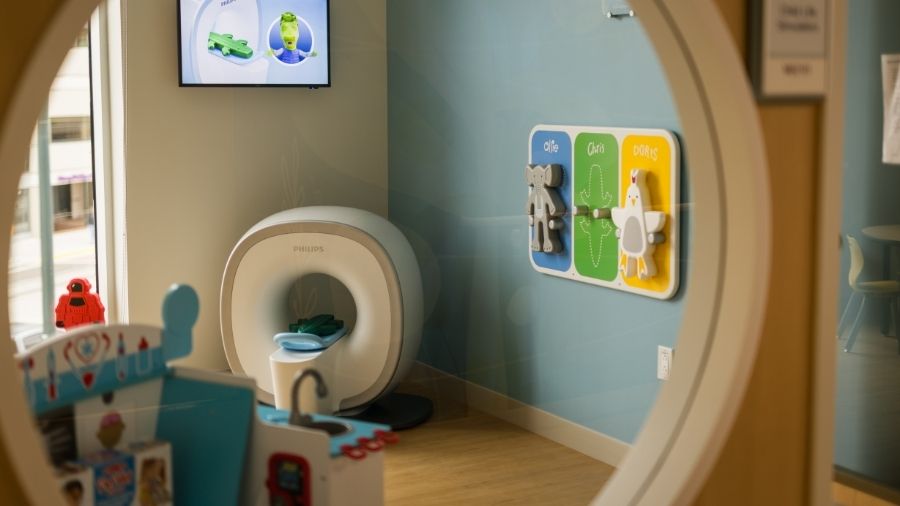
Now, the new space offers child-friendly projection goggles to distract from being in a tube, as well as warm blankets and the option to bring a stuffy along for the scan. Those details may improve a young child’s experience to the point where they might not need sedation, he added.
Intentional design improves experiences
Other measures throughout the facility are similarly aimed at easing hospital anxieties. The hospital has just one easy-to-find entrance, which also simplifies security. Everyone who enters will be screened and given a name badge.
“Parents can’t be with their children 24 hours a day,” he says. “This will give parents the security to know their child is safe.”
Inside, a 10-person team is devoted to the patient experience, helping children feel knowledgeable and comfortable about their treatment and procedures.
There are playrooms on each floor, a teen space and a special room that includes child-size imaging machines for stuffed animals. Practicing and understanding a procedure can go a long way in easing anxieties, Poltawsky noted.
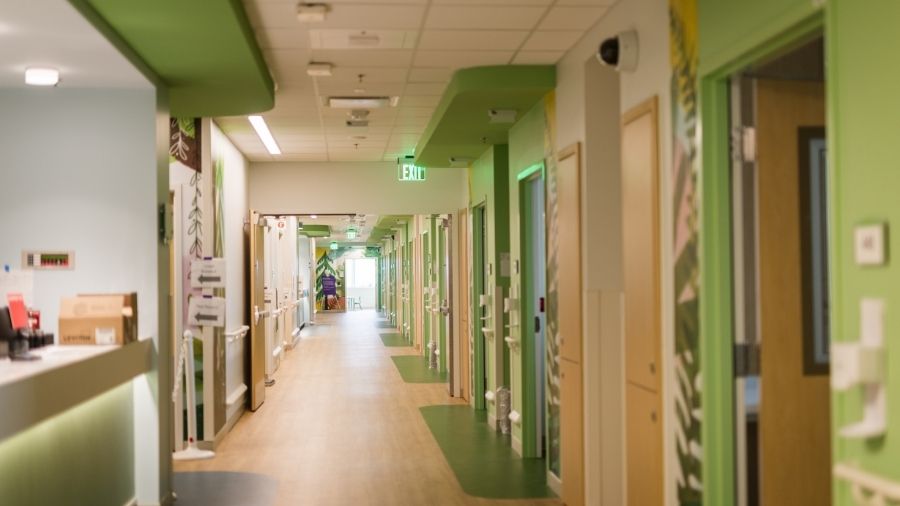
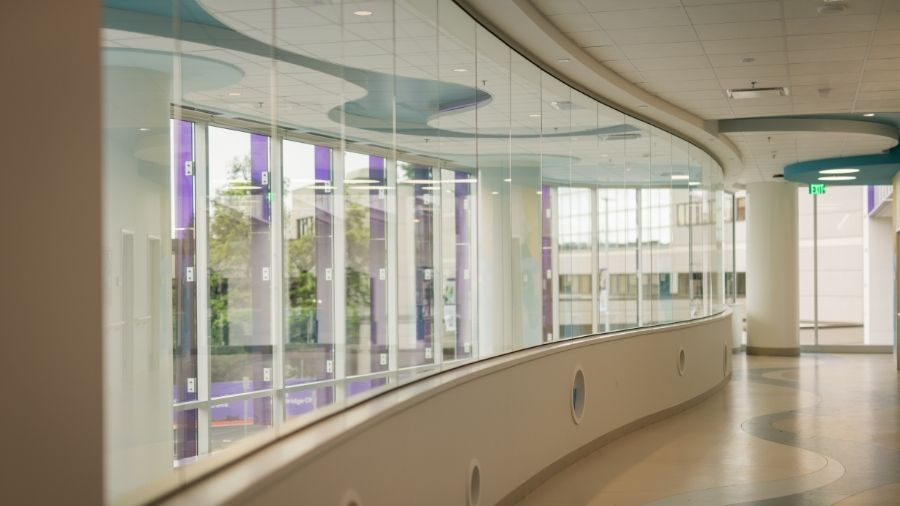
Throughout the building, small design details cultivate a child-friendly environment. Take the intentional curves — instead of sharp edges — on desks that protect toddlers. The spacious rooms themselves keep families’ comfort at the forefront, with a pull-out double bed and a private bathroom with a walk-in shower.
Young patients can order fresh food right from their rooms using the television controller. Meals are prepared on site, and designed to appeal to children as well as families, visitors and staff. The hospital’s caffeinated offerings reflect the region’s coffee culture with locally-roasted beans and coffee poured from a purple espresso machine.
“These little touches make it special,” he says. “We’re celebrating our local heritage.”
Reaping the healing benefits of nature
Family gathering spaces dot the campus, including several outdoor green spaces. Each floor evokes a natural theme such as mountains, rivers, shoreline and forest. Local artists crafted works that reflect those Pacific Northwest motifs.
“We’re really celebrating the communities where we come from,” he says. “We wanted to make sure all the families and children could see themselves in the spirit of the building.”
Architects designed the building itself with the goal of maximizing the sun’s daily movements. Enormous windows embrace the light, brightening the rooms and corridors. They also showcase striking views of Mt. Rainier and the Olympic Mountains as well as the urban cityscapes just below. Lush landscaping — including a rose garden — beckons from patients’ windows.
TThe distinct wall art is captivating and interactive. Astute young observers may spot a hidden moose or slugs camouflaged among the pine trees of the forest floor.
“Looking at the graphics will really spark a child’s imagination,” he says. “It’s a peaceful environment with pops of color.”
An outdoor playground within the facility allows patients to enjoy fresh air and the Pacific Northwest’s occasional sunshine. That way, children can reap the physical and mental health benefits of being outside.
“You’re not confined to an enclosed space,” he says. “Both our indoor and outdoor spaces will promote healing. We want to lift spirits and calm anxiety.”
Mary Bridge Children’s Hospital by the numbers
- 262,000 square feet: Combined size of the new hospital tower and expanded medical center
- 256: New jobs created, with more projected
- $100 million: Portion of the nearly $500 million total project funded through donations
- 800: Parking spots housed in two distinct structures, one for patients and visitors, and another for staff and providers
Editor’s note: This article was originally published on March 23, 2026 and was updated on June 2, 2026, by ParentMap’s managing editor, Allison Sutcliffe, to reflect the hospital’s recent opening. This article was sponsored by Mary Bridge Children’s.