 Seattle Family Calendar
 Subscribe

Few things are as evocative of childhood delight as splashing in cold water on a hot day. Activities like playing Marco Polo in the pool or racing to a buoy in the lake are so joyful that it’s easy to forget how dangerous water can be. In Washington state, an estimated average of 17 children and teens drown every year. That isn’t a huge number, but Chezik Tsunoda wants people to know that those deaths are preventable. She founded the nonprofit No More Under to help families swim safely for a lifetime.
The collection of statistics about drowning is not standardized across communities, so it can be hard to get a very clear picture of the risk. In King County, there were 30 preventable drowning deaths in 2023; three of those drowned were younger than 18. Nationwide, drowning is the second-leading cause of injury-related death for children ages 1 to 14 years old, and among children ages 1 to 4 years old, most drownings occur in residential swimming pools. In most cases, the children were last seen indoors, were out of sight for less than five minutes, and were in the care of at least one parent at the time.
For every child who dies from drowning, seven children require emergency care for nonfatal submersion. Nonfatal drownings can cause brain damage with long-term disabilities that could include memory problems, learning disabilities or permanent loss of basic functioning.
Tsunoda didn’t know those terrifying statistics when her own family suffered an unthinkable tragedy. Her son Yori was only 3 years old when he slipped beneath the water in a friend’s home swimming pool. First responders were able to revive his heart, but he never regained consciousness and died in the hospital two weeks later.
No More Under
“I started researching, why did this happen? Why did this happen to our family? I had my kids in swim lessons. I thought I was doing all the right things,” says Tsunoda. “But you know, drowning is not like what it looks like in movies. There’s not screaming, there’s not a bunch of splashing. It’s quiet, and people don’t know that. People don’t know how quickly it happens. Literally, in the amount of time it takes to read and answer a text message, someone can drown. It felt really important for me to share that information with other parents who, I know, think that they’re doing the right thing.”
Another thing Tsunoda learned from research is that people of color are at higher risk of drowning.
“I didn’t realize some of the racial implications,” she says. From 2018 to 2022, the national rate of preventable drowning deaths was twice as high for African Americans as for whites. Native Americans have even higher rates.
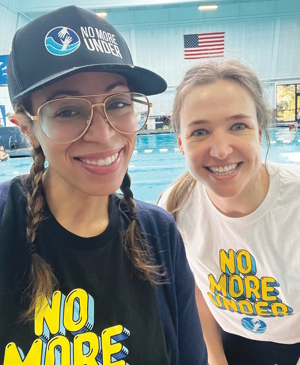
“When my grandparents were growing up, Jim Crow laws basically cut people of color from pool spaces,” explains Tsunoda. Even after public pools were desegregated, pools remained primarily white spaces that did not feel particularly welcoming to families of color. Noting that only 13 percent of children whose parents do not know how to swim will learn how to swim themselves, Tsunoda says, “There’s a fear around water. There are cultural barriers, informational barriers, and also socioeconomic barriers.” Nearly 80 percent of children in families with income of less than $50,000 do not know how to swim.
Motivated to save lives and eliminate the generational barriers that make swimming more dangerous for some children than others, Tsunoda founded the nonprofit No More Under.
Working with the City of Seattle, the organization helped develop the water safety and equity program Swim Seattle in 2023. Swim Seattle provides early registration for free swimming lessons to scholarship-eligible kids, hosts free weekly teen swims at select pools, participates in state Water Safety Days, and holds giveaways of life jackets and swim gear.
Now, No More Under is focused on its “Swim Safely” series, which offers weeklong swimming workshops to communities at higher risk.
“We train collegiate swimmers, athletes that are incredibly passionate about swimming, to work with children in their community,” says Tsunoda. Acting as a bridge, No More Under reserves swimming pools during school breaks and enlists instructors to teach students recruited through community organizations that support children, such as churches, the nonprofit Treehouse and low-income housing facilities. No More Under provides transportation assistance and ensures that kids have a swim cap, goggles and a swim bag to keep their things in. Finally, it helps create pathways for students who complete the five-day series to either participate in Swim Seattle or access discounts for swimming in their local pool.
“I don’t just want to say, ‘Oh, we got a kid in a pool.’ It’s like, ‘How do we make this child be a lifelong, water-safe child and potentially have a love for aquatics?’” says Tsunoda.
Swim safely
Learning to swim is the single most effective way for kids to stay safe near the water. Swimming lessons can reduce the risk of drowning by up to 88 percent, but water safety has many layers, and No More Under is dedicated to informing parents of all the right things to do to keep their kids safe.
- No one should ever swim alone.
- Children should always inform an adult before going in the water.
- Adults should never take their eyes off children in the water. The typical lifeguard-to-swimmer ratio at public swimming areas may be as high as 25 swimmers per lifeguard. When swimming without a professional lifeguard, there should always be at least one designated “water watcher” — a responsible adult who agrees to watch the children in the water without being distracted, socializing or using their phone.
- If you own a pool, learn and follow all state and local regulations for pool and spa safety.
- Wear life jackets at all times while on boats. “We need to be modeling for our kids that we should be wearing life jackets. We all put our helmets on when we jump on a bike, we all put our seat belts on getting into a car. We don’t have that same diligence with life jackets when we’re on boats,” say Tsunoda.
Know that swimming pools and open water present very different swimming conditions. Natural bodies of water present safety challenges that include shock-inducing temperatures (even on extremely hot days), unpredictable currents, and hidden hazards from slippery rocks and debris below the surface.
“Having the conversation as early as you can and incorporating safety into your family’s way of being around the water can really make a difference for lifelong safety.”
Safety conversations
Parents are often tempted to avoid talking to kids about topics that scare them, and yet, when we try to teach our kids about safety, it’s all too easy to use scare tactics. But Tsunoda says we need not frighten our children to teach them a healthy respect for water.
For those who aren’t sure how to talk to their kids about water safety, No More Under partnered with YouTube channel HiHo Kids to create the video “Kids Meet a Lifeguard.” The nonprofit also advocated for the passage of Yori’s Law by the Washington State Legislature, which designates an annual Water Safety Day. This year, Water Safety Day will be marked with an event at the Kent YMCA on May 17, with activities, information booths, an open swim and possibly CPR training.
“Having the conversation as early as you can and incorporating safety into your family’s way of being around the water can really make a difference for lifelong safety,” says Tsunoda. Even though it comes with risks, swimming is a fun and healthy activity that Tsunoda wants every child to be able to enjoy for a lifetime.