
 Seattle Family Calendar
 Subscribe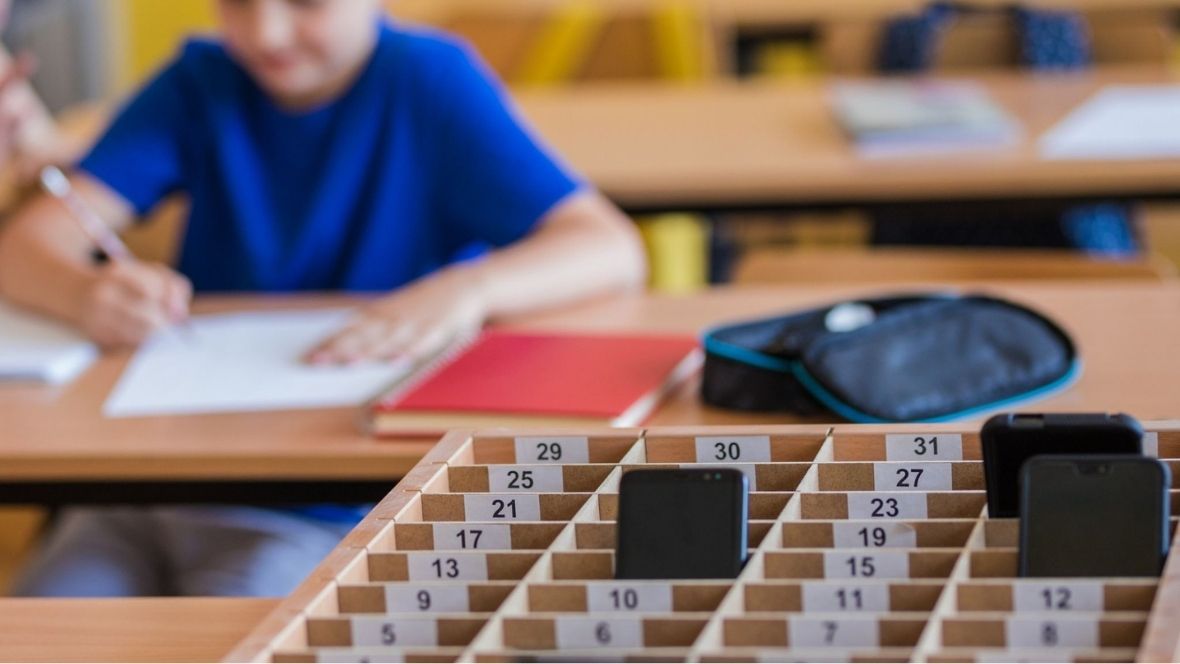

Key takeaways:
- Seattle Public Schools’ new cell phone policy takes effect May 4, 2026. K–8 students must keep phones off and stored all day. Students in grades 9–12 must keep them away during class but can use them at lunch and between periods.
- Washington has no statewide cell phone ban. A coalition including Jonathan Haidt’s Anxious Generation Movement gave the state an F grade.
- SPS is late to act. According to OSPI, about 75 percent of Washington districts already had cell phone policies before this school year and roughly one-third went further than SPS’s new rules.
A new cell phone policy took effect May 4, 2026 across Seattle Public Schools, bringing the state’s largest district in line with hundreds of other districts in Washington, which have moved on cell phones while the state itself has yet to act.
Under the new rules, students in grades K–8 must keep phones off and stored for the entire school day, with no access during instruction, passing periods or lunch. High schoolers are allowed limited use during lunch and between periods. Exceptions remain for medical needs and documented IEP or 504 accommodations.
School leaders will have flexibility when it comes to phone management and storage, and schools will set clear expectations for parents and students regarding the new policy, according to a press release.
The policy lands as Washington’s legislature continues to sit out the issue. The state has no uniform, bell-to-bell cell phone ban, and a recent national report card issued by a coalition of advocacy groups including The Anxious Generation, the movement founded by social psychologist Jonathan Haidt, gave Washington a failing grade for its inaction. Lawmakers passed legislation earlier this year directing the state superintendent’s office to study best practices and report back by December 2027, but this approach has frustrated parents and educators who would prefer the state simply act.
Seattle behind the curve
Districts haven’t waited. According to a survey by the state’s Office of Superintendent of Public Instruction from last August, roughly 75 percent of Washington school districts already had cell phone policies in place heading into the 2025–26 school year, and about one-third of those went further than Seattle’s new rules, requiring devices to be stowed for the entire school day across all grades, including high school.
Cell phone research shows mixed results
The phone-free schools movement, championed most prominently by Haidt, has built national momentum, but the research on whether bans actually deliver the promised benefits shows mixed results. A new study released yesterday by the National Bureau of Economic Research, the largest of its kind, covering more than 40,000 schools, found that strict bans do meaningfully reduce in-school phone use, but have produced “close to zero” effect on test scores so far. But students do report a stronger sense of personal well-being over time, and teachers are broadly enthusiastic about the change.
The study’s authors offered one possible explanation: Once phones are locked away, students may simply shift their distraction to the laptops that are now ubiquitous in classrooms. In other words: Getting phones out of pockets may be the easy part. Getting kids’ attention back is harder.