
 Seattle Family Calendar
 Subscribe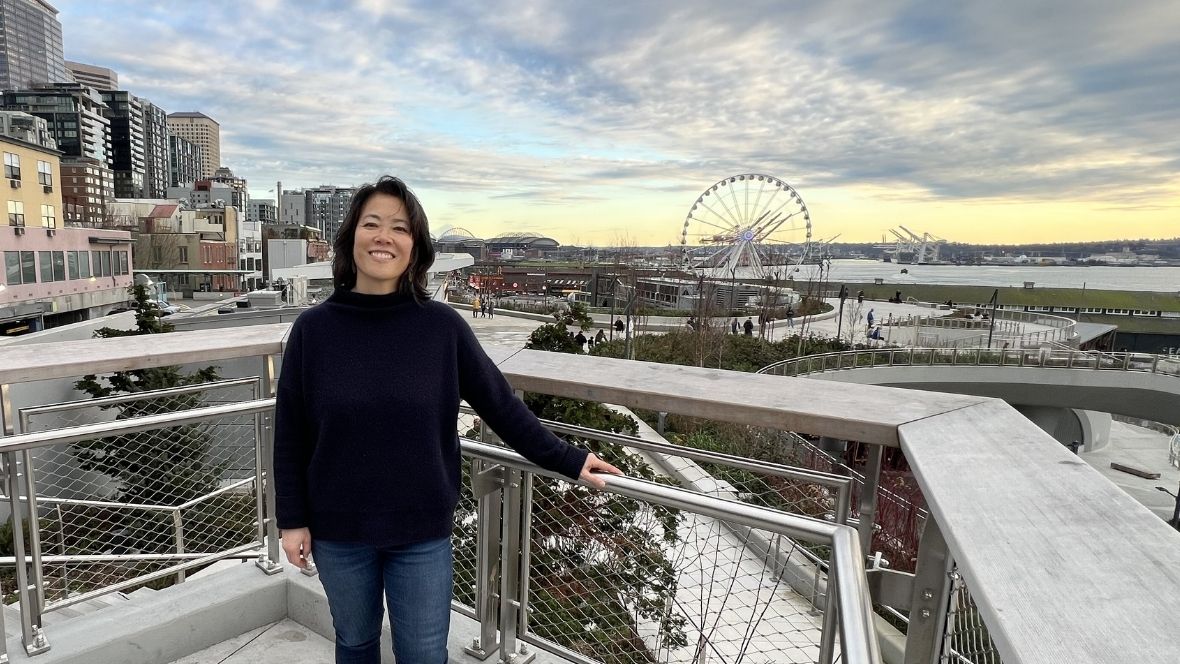

For decades, Seattle’s waterfront was dominated by elevated highway infrastructure and vehicle traffic. Today, it has been reimagined as a public park that reconnects the city to the shoreline and the Salish Sea, the interconnected body of coastal waterways in the Pacific Northwest that includes Puget Sound, The Strait of Juan de Fuca and The Strait of Georgia.
At the center of that transformation is Joy Shigaki, President and CEO of Friends of Waterfront Seattle. Her leadership has helped turn a once divisive infrastructure project into a vibrant, 20-acre civic gathering place. Waterfront Park is more than a destination, it is Seattle’s shared open space where families rediscover their city and one another.
I was lucky enough to get the chance to talk with Shigaki about the long process of making Waterfront Park a reality and what families can enjoy in this new inviting space.
Q: You led the transformation of Seattle’s viaduct into a 20-acre waterfront park. How do you see this space strengthening family life and community connection? A:
We created an extraordinary public space to replace 1950s infrastructure many of us had simply grown accustomed to. The city had an audacious vision to build something beautiful and welcoming for everyone.
Waterfront Park invites families and neighbors from across the region to rediscover wonder in downtown Seattle. It’s a place to gather for free programming, to connect with the natural beauty of this place and to continually rediscover our city.
Tens of thousands of people followed this project for more than 20 years. The fact that it’s now realized is a testament to our city’s perseverance and shared vision and to the power of public spaces to bring people together.
Q: When you think about families, parents, children and multi-generational groups, what aspects of the park’s design and programming do you hope resonate most deeply? A:
Much of our programming, especially in the summer and increasingly in the colder months, is designed to delight people in the community. It’s about being surprised, encountering culture and experiencing the richness of this region.
Everything we do is family-friendly. In winter, families can gather around fire pits or visit the sauna at Pier 62. In warmer months, they can enjoy recreation classes, arts and music programming or simply take in a sunset at the end of the day.
Public spaces allow you to center yourself and find respite, but they also create shared experiences. You see your community in one place and you recognize that you belong.
Q: Your work is grounded in equity and partnership. How have voices from diverse families and neighborhoods shaped Waterfront Park’s programming and stewardship? A:
Much of our work is rooted in co-curation. It’s easy to design programming independently and decide what’s best. But if you truly want inclusion, if you want people to see themselves reflected, then you have to listen.
From recreation to arts and markets, we partner with communities across the region. When visitors see artists, performers and small businesses that reflect their identities and cultures, it signals that this is a place for them. It builds pride and sparks connection.
We move at the speed of trust. That trust is how authentic public spaces are created.
Q: For families who may not have felt downtown was for them in the past, how are you intentionally changing that experience? A:
Design signals matter. If you want families to come, you have to visibly welcome them.
There are slides on the Overlook Walk connecting Pike Place Market to the waterfront. Pier 58 features the Jellyfish Playground. Swings along the promenade invite both children and adults who are young at heart. Abundant seating signals that people are meant to stay.
There’s also the beach near Molly Moon’s, where families can watch the tide roll in before sharing an ice cream. The new Seattle Aquarium Ocean Pavilion gives families another reason to make a full day of exploring downtown. This space is actually about forming memories together.
Q: Besides Waterfront Park, what are some of your favorite outdoor spaces for families? A:
I grew up in Seattle’s parks and still treasure places like Discovery Park, Lincoln Park and Seward Park. They offer quiet beauty and space to gather.
I’m also an avid hiker. One of the gifts of living here is that within 20 minutes on I-90, you can find yourself immersed in extraordinary natural beauty. That accessibility is part of what makes this region so special.