 Seattle Family Calendar
 Subscribe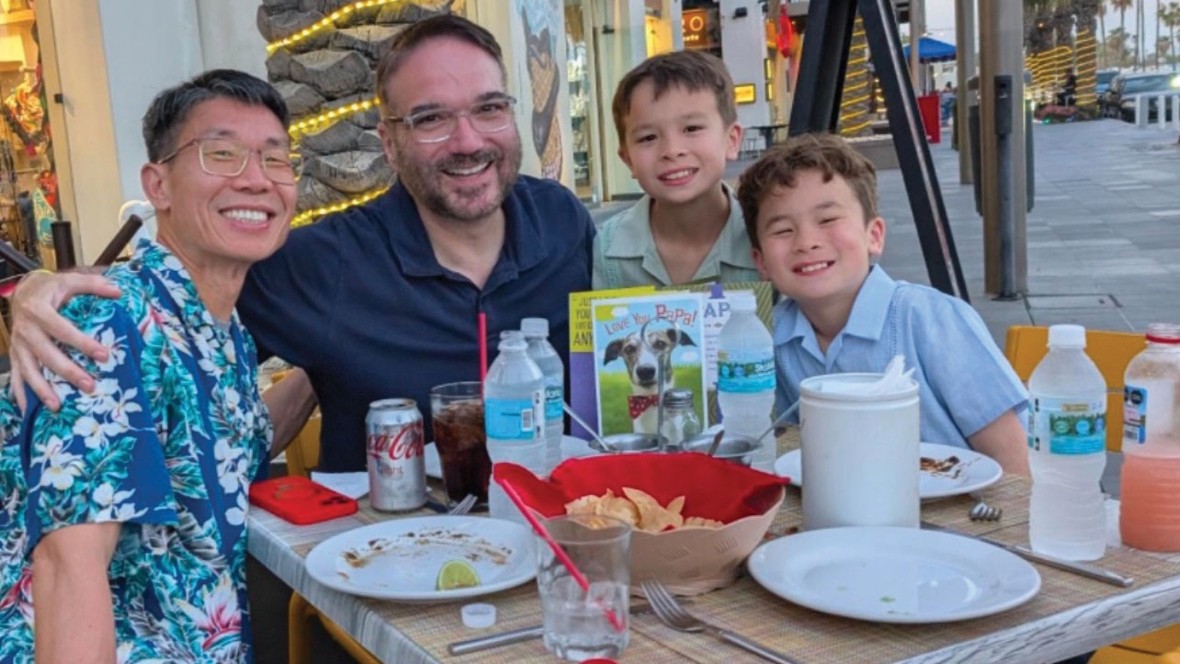

Portland-based surgeon Manny Moy has gotten used to being called a “tiger dad” in reference to the intensive parenting style made infamous in Amy Chua’s 2011 memoir, “Battle Hymn of the Tiger Mother.” Chua described tiger parents as first or second-generation Americans who highly value education and are driven to ensure their children’s success. The tiger parent is known for accepting nothing less than perfection in their child’s academic career, and driving their kids hard to achieve it.
In some ways, the label fits Moy’s learning-focused parenting. But there are critical differences.
“The tiger mom image has a lot of yelling. We don’t yell. We just do good stuff,” says Moy, called “Baba,” the Chinese word for daddy, by his twin sons, Benjamin and Robert.
Learning adventures
Moy’s soon-to-be husband Tony Varona (“Papi” to the boys) explains, “What Manny has done is structured their lives so that they are very richly filled with adventures into knowledge so that they want to learn. There’s lots of play, lots of outdoor activity, and we should be clear that the academic work they do outside of school is in short bursts. They aren’t drilled for hours and hours.”
Like the tiger mom, Moy is actively engaged in his kids’ learning. There’s no sending kids to their rooms to finish homework alone. And when learning is treated like a treat instead of punishment, Moy finds that “They love the fact that they are being engaged and that the world is being explained to them.”
Before the twins tested into Portland Public Schools’ gifted program, they attended a Mandarin immersion school. Now, on Saturdays and during the summer, their former teacher gives Mandarin and math lessons to up to 10 neighborhood children in Moy’s living room, which has been converted into a classroom. Outside, there are tennis and basketball courts and a pool.
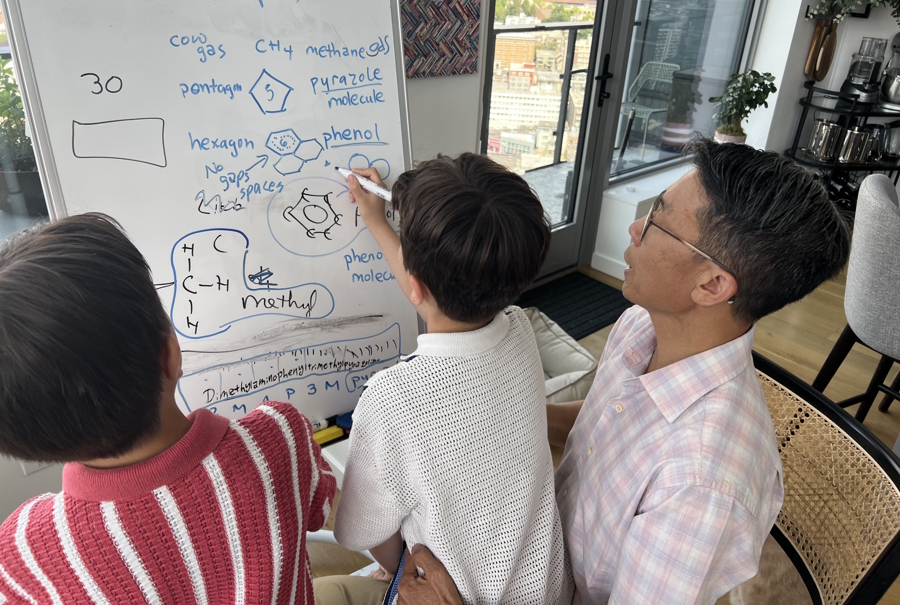
“In the book ‘The Anxious Generation,’ [author Jonathan Haidt’s] solution is to turn the neighborhood into a playborhood. In this sense, our house has become a community center,” says Moy. “I believe in public school, but I also recognize that there are a lot of flaws and holes, so I like to add to it,” says Moy. “I tell them there is no such thing as smart, there is just practiced and not practiced. It’s okay to forget, it’s okay to make mistakes. We keep on practicing.”
“Manny has been very effective at teaching them using spaced repetition and other very effective pedagogical techniques, concepts that are near and dear to my heart,” says Seattle-based Varona, who is the law school dean at Seattle University. Moy’s favorite academic tool is Anki, a digital flashcard system that allows you to add your own content. Moy, whose first language is Cantonese, uses Anki to learn Mandarin alongside the boys.
Something else he’s still practicing? “To be honest, we get a D- in managing screen time,” says Moy. He is also still figuring out how to talk about cyberbullying and other social media risks before letting the boys have their own accounts, but he has started to teach the fourth graders to think critically about technology.
“Alexa is often erroneous, ChatGPT makes up stuff, and Instagram is also fake in the sense that people only show a small part of what actually happens,” Moy says.
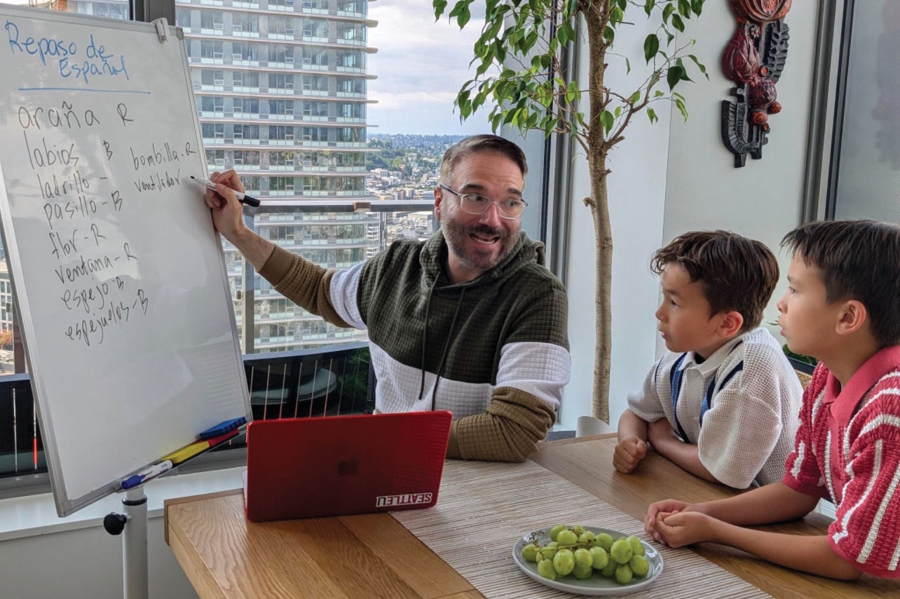
Aside from Anki, he tries to keep learning grounded in the real world. On a recent family vacation to Mexico, Varona, who immigrated to the United States from Cuba as a child, began teaching the boys Spanish. By the end of the week, the boys were ordering drinks “sin” alcohol in Spanish by themselves.
“That sense of confidence is our prize. To know that they feel confident enough and supported enough to open their mouth and speak Spanish,” says Moy.
Now Varona records new vocabulary on Anki, and holds nightly phone conversations with the boys in Spanish from his home in Seattle.
A modern family village
It takes a village to teach a child. “I’m the helper parent; I follow the learning agenda set by Manny,” says Varona. Moy’s former partner, Daddy Rob, from whom he separated when the twins were 3, is an active parent, too. And of course, the boys are learning from their teacher at school and their Chinese teacher. Moy’s team approach to education is another major break from tiger parenting, in which the parent seeks to control every detail of a child’s education.
“They have an enormous amount of trust and respect and affection for their Baba so that they are eager to learn from him and anyone that he puts in front of them as a teacher,” says Varona, who reviews the boys’ extracurricular essays. “A lot of the love of learning has to do with how Manny has shown them that it’s an adventure, and can be great fun. That concept of learning as fun and adventure is Manny’s secret sauce to teaching as a parent. I am in awe of what he accomplishes with them as a result of that approach.” A recent assignment was the differences between cats and dogs based on their experience with their own pets.
“I believe essay writing is the ultimate assessment of someone’s skill,” says Moy. When the family is at Varona’s house in Seattle, the twins practice spelling on a whiteboard in the kitchen while he cooks breakfast before their regular field trip to the public library.
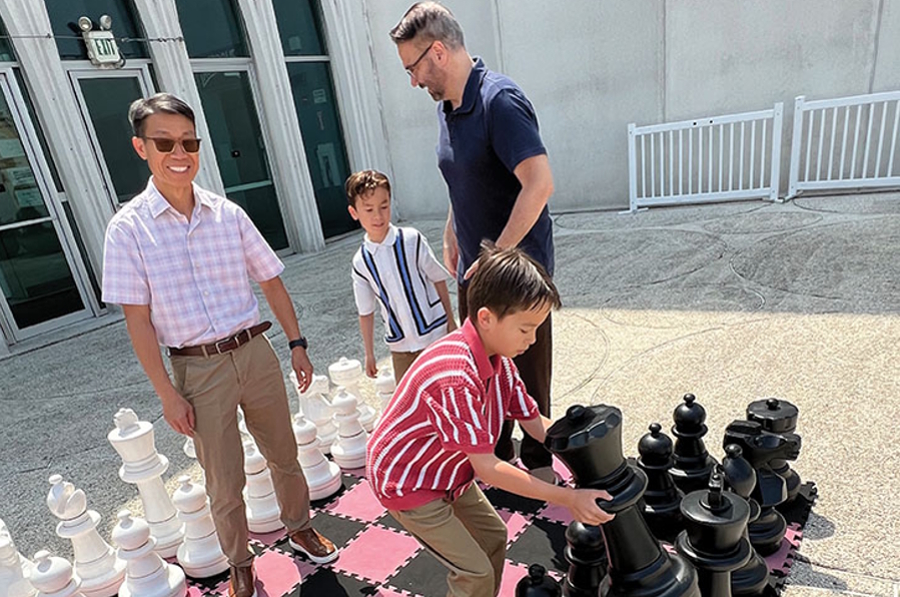
“Manny and I are complementary in that he is the mathematical science mind and I’m the language guy,” says Varona. “And then Daddy Rob, his contribution is to expose them to the world and make them wonderful travelers.”
When they stay with Daddy Rob, he follows Moy and Varona’s rule that the boys must finish 15 minutes of Anki every day before they can play videogames. However, he is more focused on experiential learning. He takes the boys to the park and the beach, and on bigger adventures to international destinations, a perk of his job with Delta Airlines.
Moy adds, “I told the boys; Daddy loves you the way he loves you, I love you the way I love you, and Papi the way he loves you. There’s no conflict. Just like I let Ben be different from Robert, I’m not going to say we have to parent the same. I allow for differences,” says Moy.
A different definition of success
“All of this learning happens within the immersion of love and affection. I think that makes a very big difference,” says Varona. Moy’s emphasis on expressing love and having fun learning highlights the biggest departure from tiger parenting.
“This is definitely a cultural thing. The Chinese do not say ‘I love you.’ Even though they will sacrifice their life for you, they won’t say it,” explains Moy. Although he admits at first it was “amazingly difficult” for him to overcome this cultural silence, he saw how much the boys thrived on the open affection in Daddy Rob’s family, so he made the effort.
In her book, Chua theorizes that tiger parenting is largely rooted in immigrant parents’ fear that their children will suffer unless they achieve the external markers of success. In contrast, Varona says Manny’s definition of success is more unconventional.
“Manny has told the boys that if they decide not to go to college, he’s okay with that. He has told them that what is important to him is not just external achievement, but becoming good people, becoming good world citizens, and well-rounded, intelligent adults. That has left them with a really interesting perspective that the value of knowledge is not tied solely to the pursuit of professional success.”
That’s why Moy pays as much attention to social emotional learning as academics (he recommends the book “Zones of Regulation” by Leah Kuypers). Varona says when he met them, “I was absolutely struck by how wonderfully thoughtful these two boys were.” As evidence, he shares a story reminiscent of a famous rom-com set in Seattle.
Three years ago, when Daddy Rob entered a new relationship, one of the boys began to worry that Baba was lonely. So he helped Moy set up an online dating profile.
“For a week, I kept getting these messages from Dr. Manny Moy. ‘You have a dog. She’s very cute,’ these very charming, child-like messages and I was thinking, ‘This guy does surgery?’ Finally, Manny comes on and says, ‘I’m so sorry, you’ve been texting with one of my eight-year-old twins!’ His little Cyrano de Bergerac had been screening his matches,” recalls Varona.
In November, the twins will be best men at their fathers’ wedding.
“We’ll keep a commuter marriage. I know, Interstate 5, people cringe, but I actually look forward to that 4-hour drive. The boys tell me all the things they would not have talked about without that mandatory downtime,” says Moy.
Varona admits, though, that shuttling among three households requires mindful attention to logistical details. By making sure the boys have what they need wherever they are, and appreciating the differences among their parenting styles, they hope the boys will feel a richness of experience rather than an absence of stability.
“I don’t care if they become a surgeon or a lawyer. If they have a good foundation, they will be a good human being no matter where they go,” says Moy. “Once I realize that, I have no stress.”