 Seattle Family Calendar
 Subscribe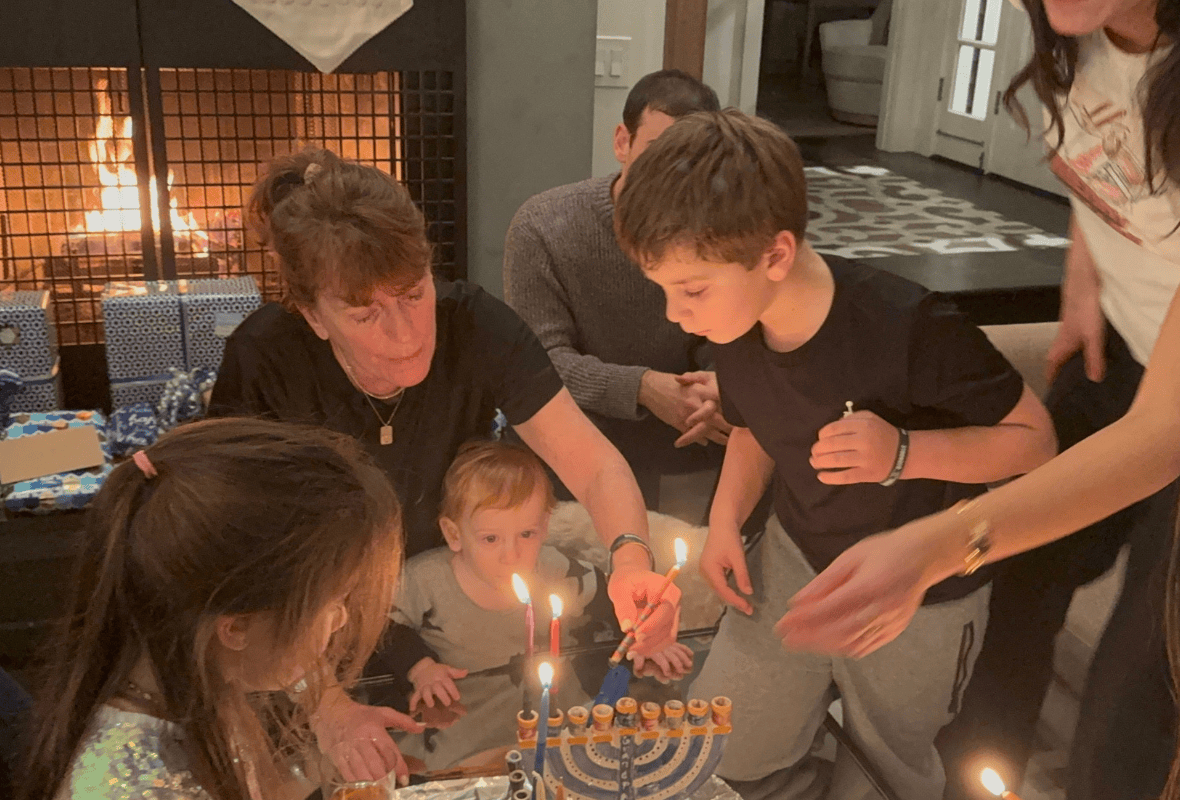

On the third night of Hanukkah, I stood in an unrelenting downpour, holding the hand of my soaked but always joyful 5-year-old granddaughter, Stella. For years, I had aspired to attend one of the local Chabad-hosted community menorah lightings, though I had never quite managed to rally Team Sulkin. This night was different. I had no choice but to join my small, devastated and brokenhearted community* after the brutal gunning down of 15 innocent Jewish people, ranging in age from 10 to 87.
They were murdered at a similarly hosted Chabad Hanukkah celebration across the world at Bondi Beach in Sydney, Australia on Dec. 14, 2025, in an attack that specifically targeted the Jewish community that had gathered for the holiday.
Nothing — not the pouring rain, nor the fear that we could be targeted — would keep me from that public menorah lighting. We had to be there. In our deep pain, standing together as a family and as a community, we also needed to stand visibly and proudly as Jews who refuse to be silenced.
What truly stunned me wasn’t the relentless rain or Stella’s cheerful willingness to endure it, but the heavy police presence: multiple officers, squad cars and security guards stationed throughout the park. They were not there for traffic or crowd control. They were there because, in 2025, a gathering of Jews to light Hanukkah candles is considered a potential target.
As a mother and grandmother, this realization landed hard. I felt fear – the fear that I might be leading my granddaughter into a risky situation. And I felt anger. It infuriates me that my grandchildren encounter police and armed security everywhere: entering preschool, walking into synagogues and attending Jewish community gatherings.
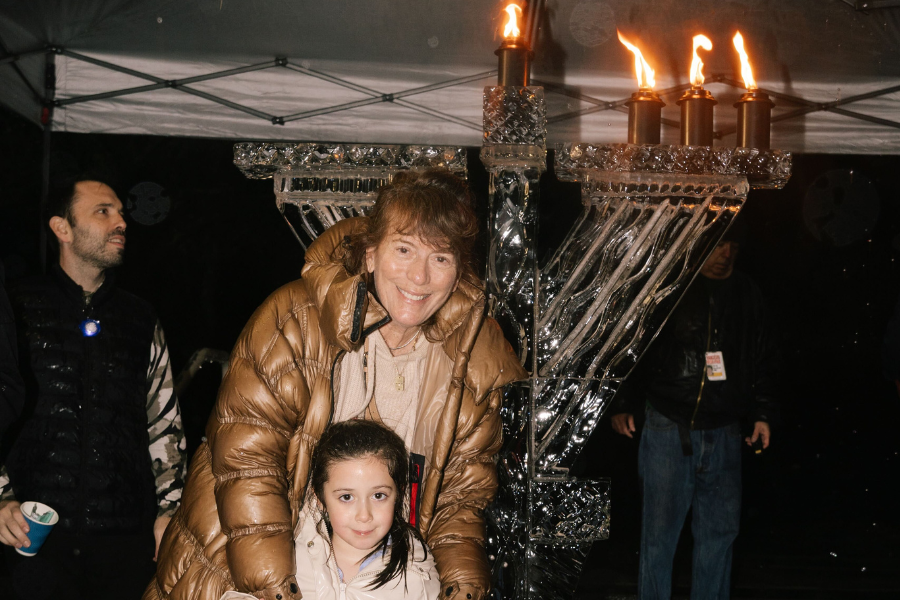
The Jewish tradition of gathering, showing unity and spreading light in moments of darkness is exactly what Hanukkah is about. The holiday commemorates the Jewish people’s fight to survive religious persecution and reclaim their identity, marked by the miracle of a small amount of oil that burned for eight days, long after it — and hope — should have run out. At its core, Hanukkah is about choosing light, faith and resilience in the face of oppression, a story Jews have been living, not just remembering, for more than 2,000 years.
This is not the world we thought we’d raise our children in
The 1990s lulled many American Jews into a false sense of security. The TV show “Seinfeld” became cultural shorthand for acceptance, with Jerry Seinfeld symbolizing how “Jewish” one could safely be in public life. That he is now harassed at appearances for being openly Jewish exposes the illusion we absorbed in that era: that antisemitism had ended, that “never again” was a promise rather than a warning.
Jews have understood for generations that hatred toward us is persistent, simply changing its guise over time. Despite this history, many of us held onto the hope that this time would be an exception, that education, democratic values and the vow of “never again” would spare our children and grandchildren from inheriting the same anxieties.
We were wrong.
Since Oct. 7, I have stood nearly every Sunday with my children and grandchildren at Bring Them Home Now/Run For Their Lives hostage rallies, demanding the return of innocent civilians who were ripped from their homes. We protested peacefully. We held signs bearing the faces of the young and the elderly. We showed up even after the firebombing at a Boulder, Colorado hostage rally that killed a Holocaust survivor. Fear could easily have sent us back inside.
We did not stop. Because Jews do not disappear when threatened. We gather.
When fear enters the smallest decisions
The day after the Bondi Beach massacre, a close friend of mine came to our local Jewish Community Center to listen to my daughter Maya, a journalist for The Free Press, conduct an interview of hostage Noa Argamani. As she was getting dressed, she changed her shoes. Not for comfort or fashion, but because she looked at a more elegant pair of boots and thought, “What if I need to run quickly like the kids at the Nova music festival on October 7, or the families lighting Hanukkah candles at Bondi Beach?”
That is the calculation Jews are now making before attending a conversation with a hostage survivor. Before lighting candles in public. Before walking into synagogues or preschools. Before wearing a Star of David.
Not metaphorically afraid.
Physically afraid.
But I need to be honest: I am not only afraid and sad. I am angry.
Angry that Jews must calculate escape routes to attend community events. Angry that the silence from institutions, corporations and leaders who once spoke loudly against hate has become deafening. Angry that our fear is treated as inconvenient or “complicated.”
There are only 15 million Jews in the world.
When Jews are gunned down at a Hanukkah celebration anywhere, it is not distant. It is personal. It is global. It is all of us. And yet, when this violence targets Jews, whether in Australia or by Hamas terrorists in Israel, the response from public figures too often blurs that reality instead of naming it.
Oprah Winfrey’s carefully worded response to the Bondi Beach massacre expressing sorrow without naming Jews, Hanukkah or antisemitism felt like a familiar performative reflex: empathy without specificity, grief without moral clarity. For many Jews, it underscored how quickly our pain is universalized and stripped of its truth, reinforcing the same illusion the 1990s taught us that acceptance lasts only as long as Jewish particularity remains unspoken.
Had this been a massacre of another minority at a public celebration of their identity, I believe the response would have looked different. Celebrities would have been more explicit, more specific, more willing to name the hate itself. The careful avoidance of Jewish identity and antisemitism felt emblematic of a broader instinct to universalize Jewish suffering in ways that would be unthinkable for any other minority.
A question we are finally asking
An Instagram post by Northwestern University professor Suzanne Muchin helped shift my own thinking and the exhausting defensive posture many Jews have learned to adopt. Instead of pleading, once again, to be understood, many of us are asking something else now, genuinely and directly:
Please, help us understand you.
Why won’t you speak up?
Why does your moral clarity stop here?
Why, when Jews are being hunted and murdered for being Jews, is your response silence?
If you speak about justice, equity and human dignity, we are owed an answer.
What we teach the next generation
As parents and grandparents, our children are watching what we do next. They are also watching and listening to what you do next. Did you make a statement on behalf of your Jewish neighbors or colleagues, as you did after the murder of George Floyd?
It was long overdue, but, as my mother habitually reminded me, “better late than never.” In 2020, we rallied worldwide with public condemnations, corporate statements and demands for reform. Did your business issue a statement of empathy and support to combat racism? Please, do the same now to fight Jew hatred.
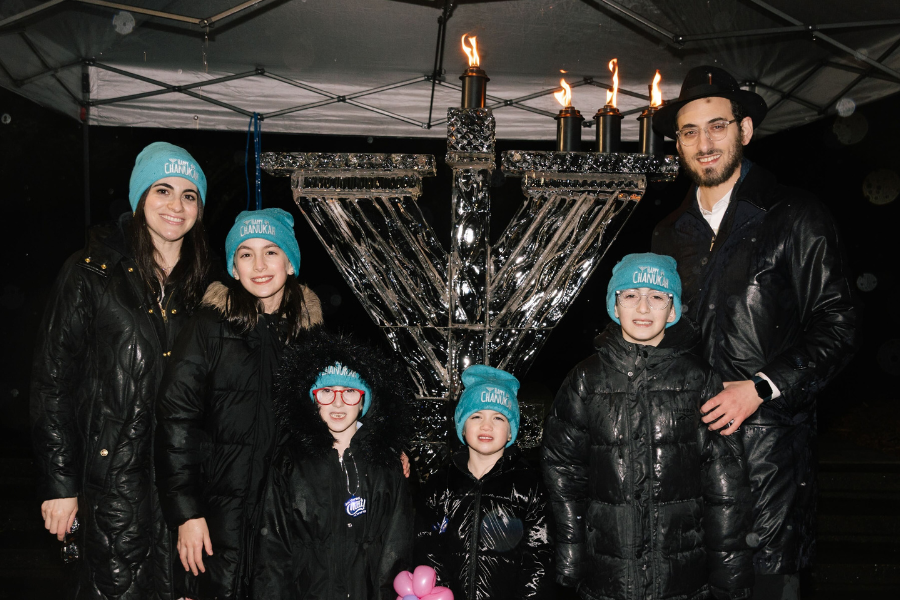
Tonight at the public lighting, Chabad Mercer Island Rabbi Nissim Kornfeld ended with a charge: “Go home, gather your family, and light your own menorah. Fill Mercer Island with light, block by block, window by window.”
So that’s what we did.
Even afraid.
Even angry.
Even soaked to the bone.
This public lighting of Hanukkah candles is not just tradition. It is resistance. It is good parenting. And it is an essential teaching moment.
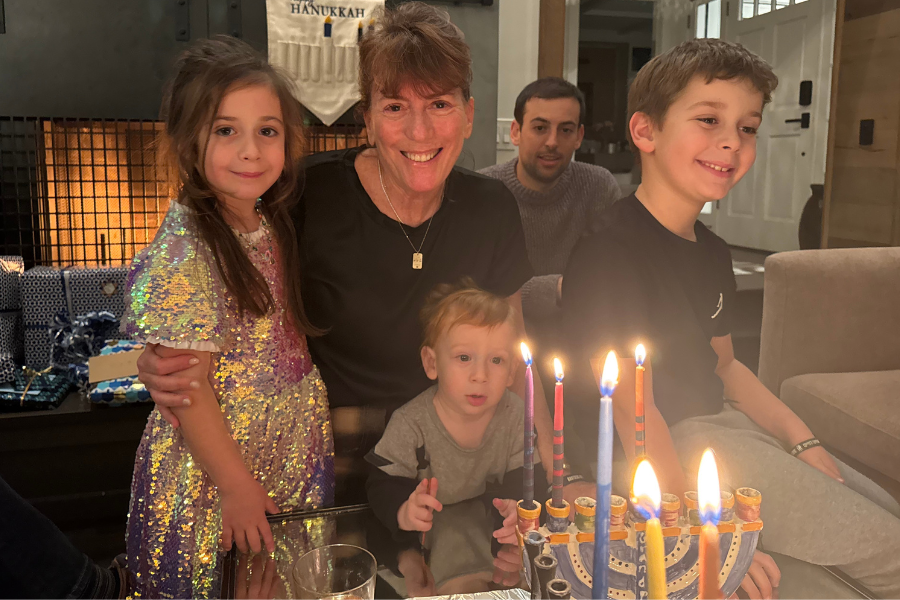
It is Jewish survival.
And it is how we teach our children and our grandchildren that light still wins.
*In a world of 1.3 billion Chinese, 1.4 billion Indians, 1.4 billion Africans, 1.3 billion Catholics, and nearly 2 billion Muslims, there are only about 15 million Jews left worldwide. And we are being hunted. Roughly half of the world’s Jews live in Israel, and about half of the global Jewish population are Jews of color, with roots in the Middle East, Africa and beyond. Israel itself is a diverse society, home as well to a 20 percent Arab population. Our numbers would be vastly different had the Holocaust not wiped out 6 million Jews. Jews were expelled from Yemen, Ethiopia and countless other countries — chased from land after land for centuries. Israel is a tiny country, roughly the size of New Jersey. When Jews are under attack, humanity has a responsibility to defend the people who remain. You may agree or disagree with the policies of the Israeli government, just as people debate the policies of our own, but that is not the point. The West cannot abandon the Jewish people. History has already shown us the cost of a world in which Jews had no homeland.